

Outside bets roulette generally fit players who want steadier swings and longer sessions, while inside bets roulette suit players who accept sharper variance in exchange for high payout multipliers. On a single-zero wheel, every bet shares the same long-run house edge; the real choice is volatility, hit frequency, and how each bet size fits your bankroll and session plan.
Core Contrasts: Odds, Payouts, and Bankroll Impact
- Same house edge, different ride: inside and outside bets have the same expected loss rate on the same wheel; volatility is what changes.
- Inside = higher payouts, lower hit rate: bigger multipliers but longer losing streaks are normal.
- Outside = lower payouts, higher hit rate: more frequent small wins can stabilize session swings.
- Bankroll fit is usually the deciding factor: inside bets often require smaller unit sizing to avoid busting early.
- "Best" depends on your goal: time-on-table, shot-taking, or a balanced roulette betting strategy across both.
Statistical Foundations: Probabilities, Variance, and House Edge
- Wheel type (single-zero assumed): this page assumes European roulette (0-36). If you're on double-zero, probabilities change and the house edge is worse.
- Hit frequency: how often a bet wins (e.g., even-money hits close to half the spins; straight-up hits rarely).
- Payout multiplier: inside bets pay more (e.g., 35:1 on a straight-up) but don't change long-run edge.
- Variance (session swing size): fewer hits with bigger payouts increases volatility and bankroll stress.
- Loss-streak tolerance: can you keep staking through 10-30 misses without tilting or doubling?
- Unit sizing discipline: the most practical edge is avoiding overbetting relative to bankroll.
- Session objective: entertainment time, controlled grind, or "shot-taking" for a big hit.
- Coverage preference: spreading chips across multiple inside numbers vs focusing on outside lines.
Inside Bets Explained: Payout Multipliers, Hit Frequency, and Risk Profile
Inside bets roulette are placed on specific numbers or small groups of numbers on the layout. They produce the most dramatic session curves: long miss streaks punctuated by large wins. Use them when your bankroll plan explicitly allows high variance and you accept that frequent losing runs are normal.
| Variant | Who it suits | Pros | Cons | When to choose |
|---|---|---|---|---|
| Straight-up (1 number) | High-variance "shot takers" | Largest payout multiplier (35:1) | Very low hit frequency; long droughts | When you want a clear, small-stake lottery-style attempt |
| Split (2 numbers) | Aggressive, but wants slightly more coverage | High payout (17:1); simple targeting | Still swingy; misses cluster easily | When you're narrowing to a "two-number story" (e.g., neighbors) |
| Street (3 numbers) | Intermediate players balancing payout and coverage | Good payout (11:1); manageable coverage | Streaks still common | When you want inside exposure without extreme droughts |
| Corner / Square (4 numbers) | Balanced players who still want inside action | Decent hit rate for an inside bet; payout (8:1) | Can feel "small" when you finally hit after a run | When you prefer fewer dead spins than streets/splits |
| Six line / Double street (6 numbers) | Coverage-first inside players | Higher hit frequency; payout (5:1) | Lower multiplier; easier to overbet because it "hits often" | When you want inside structure that behaves closer to outside volatility |
Outside Bets Explained: Lower Volatility, Return Patterns, and Strategic Roles
Outside bets roulette are placed on broader groups (red/black, odd/even, dozens, columns). They tend to extend session length by reducing swing size per unit. They don't improve expected value, but they can improve your ability to follow a plan without overreacting.
- If you're building a time-on-table plan, then prioritize even-money bets (Red/Black, Odd/Even, High/Low) with small, fixed units.
- If you want moderate payouts without extreme droughts, then use dozens or columns as your "core" and treat inside bets as optional add-ons.
- If your bankroll is tight for the session, then avoid stacking many simultaneous inside bets; use one outside bet per spin to control total exposure.
- If tilt is your main leak, then avoid progressions and keep outside bets flat; the goal is fewer decision points, not "chasing back" losses.
- If you're mixing bets as a roulette betting strategy, then use outside bets for stability and reserve a small, capped portion for inside shots.
Side-by-Side Comparison Table: Payouts, Probabilities, EV, and Typical Risk
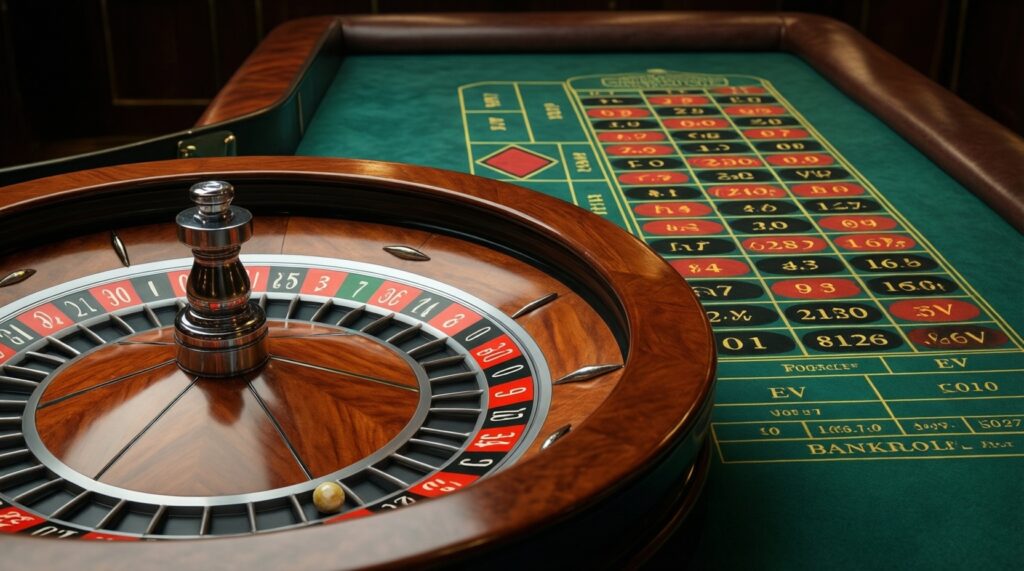
The table below uses a single-zero wheel (37 pockets). "EV" is shown conceptually: all bets have the same long-run house edge on the same wheel; the practical difference is volatility and how much bankroll you risk per spin.
| Bet type | Probability (single-zero) | Payout | EV (same wheel) | Suggested bankroll % per spin (guideline) |
|---|---|---|---|---|
| Straight-up | 1/37 | 35:1 | Same house edge as other bets | 0.25%-0.75% |
| Split | 2/37 | 17:1 | Same house edge as other bets | 0.25%-1% |
| Street | 3/37 | 11:1 | Same house edge as other bets | 0.5%-1.25% |
| Corner | 4/37 | 8:1 | Same house edge as other bets | 0.75%-1.5% |
| Six line | 6/37 | 5:1 | Same house edge as other bets | 1%-2% |
| Dozen / Column | 12/37 | 2:1 | Same house edge as other bets | 1%-3% |
| Even-money (Red/Black, Odd/Even, High/Low) | 18/37 | 1:1 | Same house edge as other bets | 1%-4% |
- Pick your session goal: longer play (outside focus) or high-upside hits (inside focus).
- Set a hard per-spin exposure cap: decide the maximum total units you can lose on one spin.
- Choose a volatility tier: even-money → dozens/columns → six line/corner → street/split/straight-up.
- Match bet size to tier: the higher the payout, the smaller the unit as a percent of bankroll.
- Decide whether you're mixing: one "base" outside bet plus one small inside shot is easier to control than many scattered chips.
- Validate against your stop rules: can your plan survive normal losing streaks without changing stakes mid-session?
Bankroll Fit: Sizing Bets and Session Planning by Tolerance
- Overbetting inside wagers: staking straight-ups like they're even-money bets is the fastest way to bust.
- Confusing payout with profitability: "roulette payouts inside vs outside bets" differ, but expected loss rate on the same wheel does not.
- Stacking too many bets per spin: ten "small" inside chips can exceed your intended risk cap.
- Progressions without limits: raising stakes after losses can outgrow your bankroll before variance turns.
- No stop-win / stop-loss: without endpoints, players drift into higher risk when tired or tilted.
- Ignoring table limits: limits can prevent recovery plans and can also force you to bet too large relative to bankroll.
- Chasing "due" outcomes: roulette spins are independent; adjust only based on bankroll rules, not perceived patterns.
- Switching bet types mid-tilt: jumping from outside to inside after losses usually increases volatility at the worst time.
Persona-Based Playbooks: Conservative, Balanced, and High-Variance Approaches
For a conservative player seeking the best roulette bets for bankroll management, outside bets are usually the cleanest fit because they simplify sizing and reduce swings. For a balanced player, a small inside "shot" layered onto a single outside base bet can keep variance controllable. For a high-variance player, inside bets can be the main focus, but only with strict micro-sizing and a pre-set loss cap.
Conservative (low volatility, longer sessions)
- Bankroll model: 100 units total.
- Per-spin exposure cap: 2 units (2%).
- Example staking: 2 units on Red (even-money) each spin.
- Rule: do not add inside bets until you're up; keep it flat-stake.
Balanced (controlled mix of outside + inside)
- Bankroll model: 100 units total.
- Per-spin exposure cap: 2 units (2%).
- Example staking: 1.5 units on a Dozen + 0.5 units on a Corner.
- Rule: if you lose 3 spins in a row, drop the inside portion to 0 for the next 5 spins.
Aggressive (inside-led, strict micro-sizing)
- Bankroll model: 100 units total.
- Per-spin exposure cap: 1 unit (1%).
- Example staking: 0.25 units each on 4 straight-up numbers (total 1 unit).
- Rule: stop the session at -20 units or +15 units; no progressions.
Concise Answers to Practical Betting Questions
Do outside bets roulette increase my chance of profit?

No. They usually increase hit frequency and reduce volatility, but they don't change the underlying house edge on the same wheel.
Are inside bets roulette ever "better" than outside bets?
They can be better for a goal like "high payout shots" or excitement per spin. They are not better for expected value; they are simply higher variance.
What is the simplest roulette betting strategy for an intermediate player?
Use one flat outside bet with a fixed unit size and clear stop rules. Add a small, capped inside bet only if it fits your per-spin exposure limit.
How should I interpret roulette payouts inside vs outside bets?

Payouts reflect how many numbers you cover: fewer numbers pay more. Higher payout does not mean higher long-run profitability; it usually means larger swings.
Which bets are the best roulette bets for bankroll management?
Even-money and dozens/columns are typically easiest to size and control. The "best" choice is the one that keeps your per-spin loss within a rule you will actually follow.
Should I switch from outside to inside after a losing streak?
Usually no. That change increases volatility when your bankroll is already pressured and often leads to larger-than-planned stakes.