

European roulette is usually the better default because the wheel has one zero (0) instead of two (0 and 00), which lowers the house edge and improves long-run value on the same payouts. Choose American roulette mainly for specific table features, promos, or limited availability-then manage variance and set stricter stop rules.
How a Single Zero Reshapes Odds and Strategy
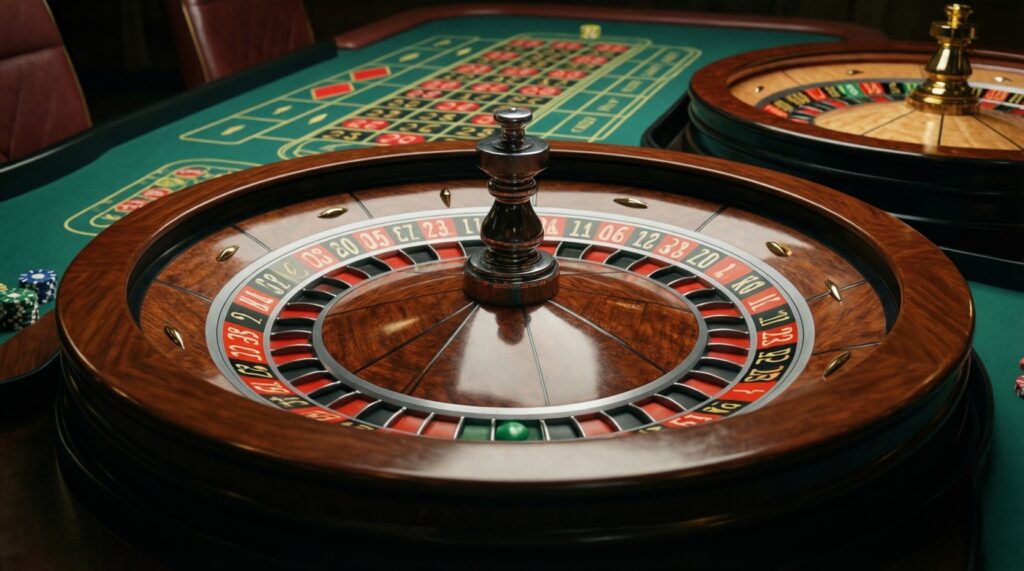
- A single extra pocket (00) changes every bet's long-run expected value while payouts stay the same.
- European roulette odds are mechanically better across standard bets because fewer numbers dilute hit probability.
- American roulette odds are worse by design; you must compensate with tighter session controls and table selection.
- Rule add-ons (La Partage / En Prison) can materially improve even-money outcomes when available.
- For online play from Thailand, the "best" choice often depends on wheel rules, limits, and how fast you're betting, not just the label.
Probability mechanics: European single-zero vs American double-zero
- Wheel layout: European has 37 pockets (0-36); American has 38 (0-36 plus 00). Fewer pockets means higher hit probability for every standard bet.
- Payout schedule: Standard payouts (e.g., straight-up 35:1, even-money 1:1) are the same on both wheels, so the extra pocket directly worsens expected value on American.
- Even-money bets: Red/Black, Odd/Even, High/Low lose more often on American because the extra 00 increases non-winning outcomes.
- Single-number coverage: A straight-up bet covers 1 number; its probability is 1/37 vs 1/38, which looks small per spin but accumulates over volume.
- Street/corner/line bets: Multi-number bets also suffer proportionally on American: the covered set stays the same size, the sample space grows.
- Special rules: French-style rules (La Partage, En Prison) apply mainly to even-money bets and can reduce losses when 0 hits (rarely available on American wheels).
- Speed and decision fatigue: Faster online/live tables increase total spins per session, amplifying the impact of the house edge difference and increasing tilt risk.
House edge and expected value: numeric breakdown with examples
Key numbers you can use at the table: On standard rules, European (single-zero) roulette has a house edge of about 2.70%; American (double-zero) is about 5.26%. Example: a 1-unit bet on Red has expected loss of ~0.027 units per spin on European vs ~0.053 units per spin on American, because the payout stays 1:1 while the "green" outcomes expand.
| Variant | Who it suits | Pros | Cons | When to choose |
|---|---|---|---|---|
| European single-zero (0) roulette | Most intermediate players prioritizing value | Lower house edge (~2.70%); better hit rates than American for the same payouts (e.g., straight-up still pays 35:1) | Still negative EV; variance remains high on inside bets | Default pick for European roulette vs American roulette comparisons and general bankroll efficiency |
| American double-zero (0, 00) roulette | Players with limited game availability or specific promos | Widely available in some lobbies; familiar layout; standard payouts unchanged | Higher house edge (~5.26%); American roulette odds are worse on every standard bet because of the extra 00 | Only when you have a concrete advantage elsewhere (bonuses you can clear safely, softer limits for your plan, or no European tables) |
| French roulette with La Partage (even-money) | Even-money focused players (Red/Black, Odd/Even, High/Low) | On a 0 result, you typically get half your even-money stake back, improving long-run value on those bets compared with plain European | Does not improve inside bets (straight-up, splits, etc.); not always offered in Thai-facing menus | When your plan is primarily even-money grinding with strict stop-loss/stop-win rules |
| French roulette with En Prison (even-money) | Players comfortable with "stake locked" mechanics | When 0 hits on an even-money bet, the stake is typically held for the next spin, which can soften losses versus plain European | Ties up bankroll for at least one spin; execution varies by operator and UI clarity | When you can tolerate temporary bankroll lock and will not chase during locked bets |
| Live dealer European roulette | Players who value transparency and pacing | Single-zero wheel with real dealing; slower pace can reduce impulsive over-betting; often clearer rule display | Higher minimums on some tables; time-zone/stream stability considerations in Thailand | When you want to play European roulette online with better discipline and you prefer a controlled cadence |
| RNG (digital) European roulette | Players optimizing for low limits and fast sessions | Single-zero rules with low minimums; fast bet placement; easy to multi-table (not recommended for most) | High speed magnifies errors and tilt; easier to drift into "just one more spin" behavior | When you can commit to a pre-set spin cap and strict break schedule |
Betting strategy adaptations for intermediate players
- If you must play American roulette, then shift more of your action to even-money bets and reduce inside-bet frequency; the higher edge punishes high-variance chasing faster.
- If you're choosing between two European tables, then prefer the one with La Partage/En Prison for an even-money plan; keep inside bets as "small spice," not the core.
- If your style is inside-bet hunting (straight-ups/splits), then play single-zero only and cap losses per sequence; accept that short-run wins don't change negative EV.
- If you notice pace-driven mistakes (late bets, misclicks, doubling on impulse), then move from RNG to live dealer European or pick a slower table and pre-select chip sizes.
- If you're clearing a bonus at a best online roulette casino, then calculate wagering comfort first and avoid raising bet size to "finish faster"; choose the lowest-edge eligible game (usually European single-zero, sometimes French rules).
Three practical play-patterns (pick one, don't mix mid-session)
- Even-money disciplined cycle: Flat bet (or very small step-ups), stop-loss fixed, stop-win fixed; best on European/French tables.
- Inside-bet micro-allocation: Majority on even-money/2:1 bets, small fixed fraction on 1-2 straight-ups you can justify (not more); best on European only.
- Short-session "quality over quantity": Pre-set spin cap and breaks; best for fast RNG players to control overexposure.
Table selection, wheel rules and casino-level factors
- Confirm wheel type: 0 only (European) vs 0 and 00 (American). Don't rely on thumbnails.
- Open the rules panel and verify: La Partage / En Prison availability and exactly which bets they apply to.
- Check table limits vs your bankroll plan (minimum bet, maximum bet, and maximum payout caps).
- Verify bet settlement behavior on 0 (especially for French rules) and whether "call bets" or special bets exist.
- Assess pace: RNG speed / live betting window length; choose the slowest pace you can tolerate without boredom betting.
- Review session friction: stream stability in Thailand, currency handling, and whether the UI prevents misclicks (clear confirmation before spin close).
- Only after the above, compare promotions/loyalty points-never use promos to justify a worse wheel by default.
Risk models, bankroll sizing and session planning
- Assuming "double-zero doesn't matter much" because the difference per spin looks small; it compounds with volume.
- Using progression systems to "force" a win; progressions change variance and failure modes, not the underlying edge.
- Chasing losses after a run of greens; green frequency is built into the wheel, not a signal.
- Mixing strategies mid-session (flat betting, then martingale, then inside bets) and losing track of exposure.
- Ignoring table max limits; progressions often collide with caps exactly when you're most pressured.
- Over-multi-tabling RNG because it feels controlled; it accelerates decisions and amplifies tilt.
- Setting stop-win but no stop-loss (or vice versa); you need both to avoid marathon sessions.
- Letting "almost hit" outcomes (neighbors, near-misses) trigger bet expansion; roulette outcomes are independent.
Decision tree: which wheel to play and when to walk away
- Step 1: Is a single-zero (European) wheel available?
- Yes: Go to Step 2.
- No: Only play American if you can accept higher expected cost; otherwise, do not start the session.
- Step 2: Is La Partage or En Prison offered (and you plan mostly even-money)?
- Yes: Prefer that table; lock a flat-bet plan.
- No: Standard European is still the baseline choice.
- Step 3: Are limits and UI pace compatible with your discipline?
- Yes: Play your pre-chosen pattern with a fixed stop-loss and stop-win.
- No: Switch table type (live vs RNG) or walk away.
- Step 4: During play, did you break rules (chasing, doubling impulsively, extending session)?
- Yes: End session immediately; do not "repair" the session with bigger bets.
- No: Continue until a stop is hit, then stop.
Best fit for most players seeking value is European single-zero (and French-rule tables when your plan is even-money heavy). Best fit for players who prioritize availability or a specific promotion is American double-zero, but only with stricter limits, fewer inside bets, and a short, pre-committed session plan-otherwise the higher edge is doing most of the decision-making for you.
Common decision points and clarifications
Is European roulette always better than American?
For standard rules and identical payouts, European is usually better because the single zero lowers the house edge. "Better" still means negative EV, so bankroll control remains the main skill.
What are the European roulette odds for a straight-up number?
A straight-up covers 1 number out of 37, so the hit probability is 1/37. The standard payout is 35:1, which is why the edge exists despite big wins.
What are the American roulette odds for even-money bets?
Even-money bets win on 18 numbers, lose on 18, and lose on both 0 and 00, so they lose on 20 outcomes total. The payout stays 1:1, so the extra 00 worsens expected value.
Should I change strategy when I switch wheels?
Yes: on American, reduce aggressive inside betting and keep sessions shorter. On European/French rules, even-money-focused plans generally bleed slower.
Is it smart to play European roulette online or only in live casinos?
Both can be fine; the key is confirming single-zero rules and choosing a pace you can control. Live dealer can help discipline; RNG can help with low limits but increases speed risk.
How do I pick the best online roulette casino for Thailand?
Prioritize clear wheel labeling, published rules (including La Partage/En Prison), sensible limits, stable streaming for live tables, and transparent bonus terms. Avoid choosing solely on promotions if the game selection pushes you to double-zero.