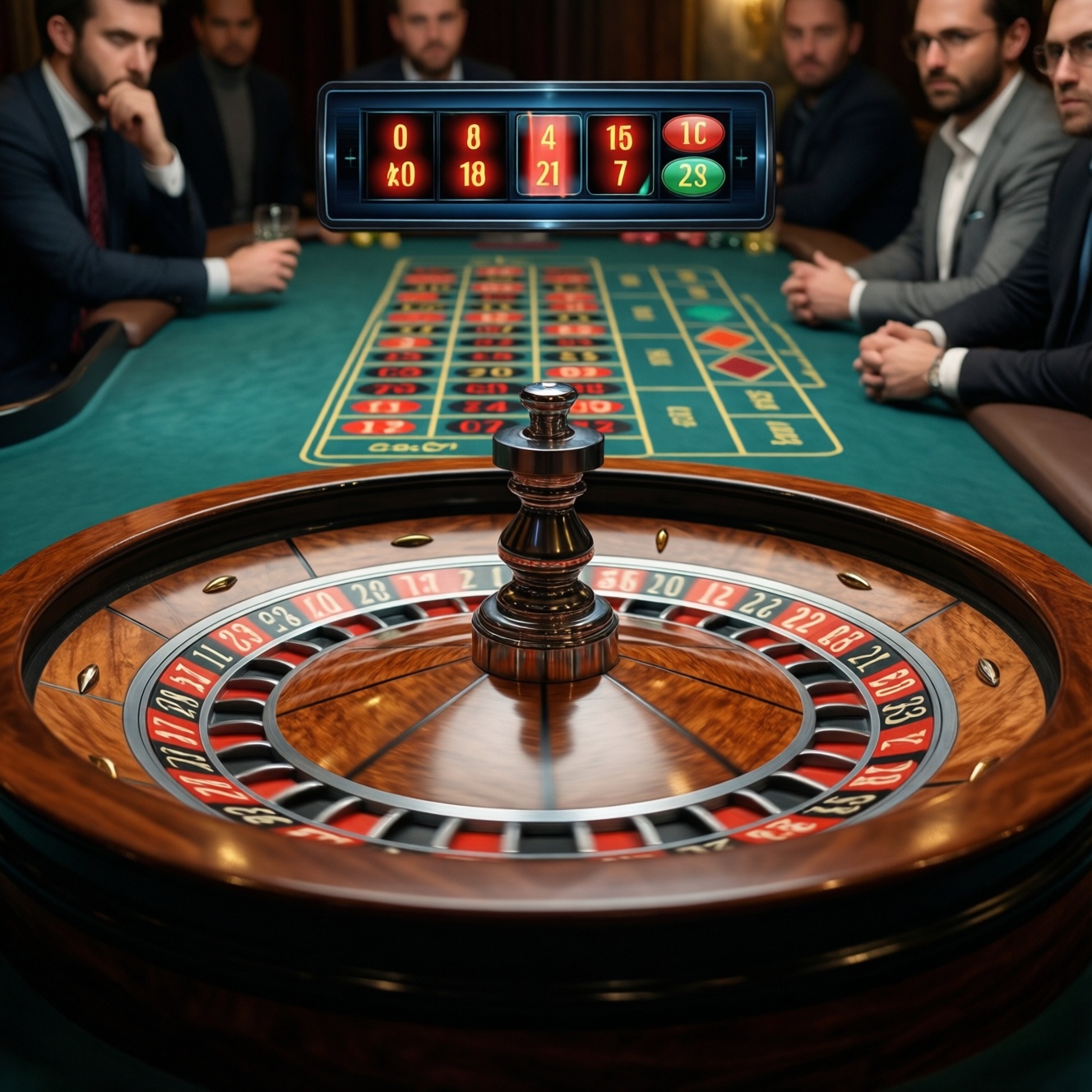
Roulette "hot/cold numbers" and most roulette betting patterns do not change the math of the next spin: each outcome is (under a fair wheel) memoryless, so past results don't raise the true probability of a number repeating. What patterns can do is change your risk (volatility) and bankroll path-not your long-run expected value.
Concise Mathematical Conclusions
- For a wheel with N pockets, the probability of any single number on the next spin is 1/N, regardless of recent history.
- "Hot" and "cold" labels are descriptions of the past sample, not proof of a changed process.
- Most pattern-based staking changes variance (how wild the swings are), not expectation (the average outcome).
- To claim a real edge, you must show a repeatable bias that survives proper testing and fresh data.
- The practical goal is controllable decisions: limits, bet sizing, and game selection-not chasing streaks.
Myths First: Claims About Hot and Cold Numbers
Myth: roulette hot and cold numbers "must" revert soon, so betting the cold ones is smarter. Math reality: unless the wheel is biased, there is no force that makes a specific number "due"; the next-spin probability stays the same.
Myth: roulette strategy hot numbers works because "hot means it's trending." Math reality: a streak can happen in random sequences; "trend" is not evidence by itself. You need a mechanism (physical bias, RNG defect, or rule exploitation), not a story.
Myth: you can spot profitable roulette betting patterns by eye. Math reality: the human brain over-detects structure in noise; you must quantify whether the observed deviation is bigger than what randomness regularly produces.
Boundary: "Hot/cold" is a descriptive dashboard feature. It becomes meaningful only if you independently verify a stable, repeatable bias and you can act on it within table limits and game rules.
Roulette Mechanics and the Foundation of Randomness
Myth: the wheel "remembers." Math reality: standard roulette is modeled as independent trials: each spin is a new trial with fixed probabilities (again, assuming a fair game).
- Outcomes are discrete: each spin lands in one of N pockets; for a fair wheel, each has probability 1/N.
- Independence (ideal model): the distribution for spin t+1 does not depend on spins 1..t.
- "Random" still clumps: runs and clusters occur naturally; they are expected features of randomness, not contradictions.
- Online roulette strategy: RNG-based games aim to simulate the same independent-trial model; if you suspect otherwise, you need evidence, not streak screenshots.
- What can break the model: mechanical bias, flawed dealing/spin procedure, biased RNG, or rule differences that change payouts (not probabilities).
Single numeric example (illustrative): if a wheel has N = 37 pockets, then for a fair wheel the chance of a specific number next spin is 1/37, whether it hit twice in a row or not at all for an hour.
How to Test for Genuine Patterns: Statistical Tools
Myth: "I saw it happen, so it's real." Math reality: patterns must be tested against what randomness already produces, and they must persist out-of-sample.
- Frequency (goodness-of-fit) check: compare observed counts per number (or per group: red/black, dozens) versus expected counts. If the deviation is within normal random fluctuation for your sample size, it's not actionable.
- Runs test: evaluates whether streakiness (e.g., long red/black runs) is unusual compared with independence.
- Independence check on transitions: test whether "after red, black is more likely" is supported, rather than assumed.
- Pre-registration mindset: define your rule before you look (e.g., "bet number 17 after it hits twice in 10 spins"), otherwise you're optimizing to noise.
- Out-of-sample validation: split data: develop a hypothesis on one set, test on a fresh set. If it vanishes, it was likely overfitting.
Single numeric example (illustrative): if you watch 200 spins and a number appears 10 times, the key question is not "10 feels hot," but "is 10 meaningfully above the expected 200×(1/N) once we account for randomness and multiple comparisons across many numbers?"
| Observed "pattern" | Common interpretation | Math-based interpretation | Actionable only if... |
|---|---|---|---|
| One number repeats several times | "Hot number; keep betting it" | Run/clustering can occur by chance | Repeatable bias is verified and stable |
| Long absence of a number | "Cold; it's due" | Absences happen naturally in independent trials | There is evidence the probability changed (rare) |
| Red/black streaks | "Trend" or "reversal signal" | Runs are expected; direction is not predictive | Transition probabilities differ consistently from chance |
| Martingale-like escalation | "Guaranteed recovery" | Higher variance; risk of ruin under limits | Never, as a long-run edge; only as risk preference |
Expected Value, Variance and the Unavoidable House Edge
Myth: the best roulette strategy is the one that "wins often." Math reality: frequent small wins can hide rare large losses; what matters is expected value and risk.
- Expected value (EV): for a bet with outcomes x and probabilities p, EV = Σ p·x. A casino edge means the EV is negative for the player over the long run.
- Variance: measures swinginess; many "systems" mainly increase variance, creating dramatic upswings that feel like skill.
- What pattern betting can change: session profile (how often you win, average win size, drawdowns).
- What it cannot change without a real bias: the underlying EV of standard payouts versus true probabilities.
- Why escalation fails in practice: table limits and finite bankroll force you to stop exactly when the rare losing streak arrives.
Single numeric example (illustrative): if a strategy wins 9 times +1 unit and loses once −12 units, it "wins often" (90% hit rate) but still averages −3 units per 10 trials; the win rate alone is not the edge.
Interpreting Streaks: When Runs Are Just Noise
Myth: unusual-looking sequences are proof the wheel is "in a mode." Math reality: in long enough play, rare-looking sequences are expected to appear.
- Gambler's fallacy: believing a cold number is "due" simply because it hasn't appeared recently.
- Hot-hand fallacy: believing a hot number is more likely because it just appeared several times.
- Selection bias: remembering exciting streaks and forgetting boring stretches that contradict the story.
- Multiple comparisons: if you scan many numbers and many pattern rules, something will look "significant" by chance.
- Data window shopping: changing the lookback window until you see confirmation (e.g., 20 spins, then 30, then 12).
Single numeric example (illustrative): if you track 37 numbers, you are effectively running 37 "tests" at once; even if each number is fair, the maximum "hotness" across all numbers can look impressive purely by chance.
Translation to Practice: What Bettors Should Actually Do
Myth: you need a clever pattern to be "smart" at roulette. Math reality: the only reliably controllable levers are game choice, limits, and bet sizing. Use hot/cold displays as entertainment unless you can verify bias with discipline.
A simple decision workflow (actionable, not magical)
- Choose your game rules first: pick the roulette variant and rules you understand; don't rely on "best roulette strategy" claims that ignore rules and limits.
- Define your session constraints: bankroll for the session, a stop-loss, and a stop-win (both optional, but define them before play).
- Pick a flat stake: one unit per bet is the baseline. Avoid progression systems unless you explicitly accept higher risk of ruin.
- If you insist on using roulette hot and cold numbers: treat it as a pre-registered experiment, not intuition.
- Review with a log: record bets, outcomes, and rationale; if it's not measurable, it's not testable.
Mini-case (with pseudocode): testing a "hot number" rule without fooling yourself
Rule idea: "Bet a number for the next 10 spins if it appeared at least 3 times in the last 50 spins." This is a typical roulette strategy hot numbers approach; the point is to test it cleanly, not to assume it works.
Set N = number of pockets on the wheel
Set lookback = 50
Set trigger_hits = 3
Set bet_horizon = 10
FlatStake = 1 unit

For each spin t after you have lookback spins logged:
  Count hits for each number in spins (t-lookback ... t-1)
  If any number i has hits >= trigger_hits:
    For next bet_horizon spins:
      Bet FlatStake on i
    Continue logging results
Evaluate:
  Net profit/loss, drawdown, and performance on a fresh dataset
  Compare against flat random-number betting baseline
What to conclude: if the rule only looks good on the same data you used to discover it, it's likely overfitting. That's the most common failure mode behind "pattern" screenshots for online roulette strategy.
Brief Answers to Practical Doubts
Are roulette hot and cold numbers ever real?
They can reflect a real bias only if the underlying process is biased and the bias is stable. Without independent evidence, they are just a summary of recent outcomes.
Do roulette betting patterns help me win more often?
They can change how wins and losses are distributed (variance), so you might see more frequent small wins. That does not imply a better long-run expected value.
Is betting "due" numbers smarter than betting hot ones?
No. "Due" is the gambler's fallacy under an independence model; the next-spin probability does not increase because of absence.
What is the best roulette strategy for most players?
The best roulette strategy in practice is risk control: choose clear rules, use flat or conservative sizing, and set session limits. Treat any claim of a guaranteed edge as unproven until tested out-of-sample.
Does online roulette strategy differ from live roulette strategy?
The math model is similar (independent trials), but the failure modes differ: mechanical bias is a live concern, while RNG integrity and game configuration are online concerns. In both cases, you need data and a test plan.
Can I "prove" a hot-number edge with my own history?
You can test it, but you must avoid cherry-picking rules after seeing results and you must validate on fresh spins. Otherwise you're measuring noise.