To track poker results like a pro, log every session with consistent fields, separate luck from decision quality using an EV workflow, and tag destructive habits the moment they appear. Use a simple spreadsheet or a poker session tracking app, review weekly, and convert patterns into one small process change per week.
Core principles for pro-level tracking
- Standardize fields so you can compare sessions across formats, stakes, and locations.
- Track both outcome (profit/loss) and process (A-game execution, tilt triggers, table quality).
- Use EV thinking to judge decisions, not short-term variance.
- Write notes immediately; memory-based notes are biased within hours.
- Keep the system lightweight: fewer fields completed 100% beats many fields completed 30%.
- Review on a fixed cadence (weekly/monthly) and change only one lever at a time.
Designing a session log that scales with your goals
Who this fits: intermediate players who play enough volume to see patterns, want to stabilize a poker bankroll tracker routine, and are ready to connect mindset + table selection + technical leaks into one log.
When not to do this (yet): if you can't consistently record start/end time and buy-ins, or you change formats every day without enough volume in any one game. In that case, reduce to a "minimal log" (time, game, stakes, in/out, one note) for two weeks first.
What to record / When / Why
- What: game type, stakes, location/site, duration, in/out, table count (online), and 2-5 notes.
- When: in real time for key events; within 10 minutes after the session for totals and reflection.
- Why: you need clean inputs to separate skill signals from noise and to make weekly reviews actionable.
How to calculate and apply expected value to each session
What you'll need (requirements)
- A capture method: notes + timestamps, or a poker hand history tracker (online) that exports hands.
- An evaluation workflow: a short review queue of hands plus a poker EV calculator (or solver/trainer you already use) for critical spots.
- A storage layer: spreadsheet, Notion, or a dedicated poker bankroll tracker / tracking tool.
- Access: hand histories (online) or marked hands/photos (live). For live, you must record details immediately (positions, stacks, action, board runout).
How to apply EV without overcomplicating
- Use EV at the decision level: judge a session by whether you repeatedly chose +EV lines in your biggest spots.
- Maintain a "Top 5 EV spots" list per session: select the 3-5 hands with the largest pots or highest uncertainty; run them through your EV workflow.
- Tag each reviewed hand: "+EV confirmed", "-EV confirmed", or "unclear-needs study". You don't need perfect precision; you need consistent labeling.
Which metrics and KPIs to record every time
Prep mini-checklist (before you start the steps)
- Choose one primary format to track (e.g., cash NLHE, MTTs) for at least 2-4 weeks.
- Decide your "minimum viable log": fields you will complete every session, no exceptions.
- Create quick-entry shortcuts (phone note template, spreadsheet dropdowns, or your poker session tracking app).
- Pick 3 habit tags you'll use consistently (e.g., "chase", "auto-pilot", "avoid tough tables").
- Set a weekly review slot in your calendar (same day/time each week).
-
Record session identifiers first (so data stays comparable)
Log date, location/site, game type, stakes, and table count (online). This allows filtering later when you evaluate whether changes are real or just format differences.
- Example fields: Format, Stakes, Live/Online, Room/Site, Table count
-
Capture bankroll inputs cleanly (no guessing)
Write down total buy-in (or sum of rebuys), cash-out, and fees/rake if you track them. This is the core of any poker bankroll tracker workflow.
- Live: record each buy-in amount as it happens to avoid end-of-session reconstruction.
- Online: export from cashier if possible; otherwise log by session summary.
-
Measure time and volume (so results normalize)
Log start time, end time, and hands played (online) or an estimate method (live: hours only). Without this, you can't compare two "winning" sessions that had very different volume.
- Online: hands/hour and tables help explain fatigue and autopilot.
-
Grade decision quality separately from outcome
Add a quick A/B/C performance rating and one sentence why (e.g., "C: chased losses after cooler"). This prevents "I won so I played well" bias.
- Optional: confidence score (low/medium/high) to guide what to review.
-
Mark EV-critical hands for review
Tag 3-5 hands that were largest pots or most confusing. If you use a poker hand history tracker, mark hands in-client; if live, write a timestamp + short action line.
- Goal: build a small queue that you will actually review, not a mountain of hands.
-
Tag habits and triggers in plain language
Use consistent labels for tilt, fear, boredom, entitlement, or "playing not to lose". Add the trigger ("lost flip", "tough reg sat down") so you can design countermeasures.
-
Close the loop with one next action
End every session with one actionable next step: a study topic, a table-selection rule, or a stop-loss/stop-win behavior change. This converts logging into improvement.
Methods to detect, measure, and label destructive habits
Result check: habit-spotting checklist
- I played longer than planned after a loss (time creep).
- I changed stakes or game selection to "win it back".
- I ignored table quality because I didn't want to move/wait.
- I noticed autopilot (no plan on turns/rivers, clicking fast online).
- I avoided marginal-but-profitable spots due to fear of variance.
- I over-bluffed or over-called because I felt "owed" a win.
- I stopped taking notes/marking hands once emotions rose.
- I broke a pre-committed rule (stop-loss, quit time, warm-up).
- I chased action when tired, hungry, or distracted.
Labeling method (keep it consistent)
- Habit tag: short noun/verb (e.g., "chase", "autopilot", "avoidance").
- Trigger: what started it (e.g., "cooler", "trash talk", "tough table").
- Cost signal: what changed (stakes jumped, table selection worsened, pace sped up).
- Countermeasure: one small rule (stand up for 3 minutes; reduce tables; quit after X).
Turning raw logs into a rapid feedback loop
Common mistakes that block improvement
- Only tracking profit/loss: you can't fix leaks you don't name; add process metrics and habit tags.
- Changing fields weekly: constant schema changes destroy comparability; lock your "minimum viable log" for a month.
- Reviewing everything: you burn out; review only the biggest/uncertain hands and the most repeated habit tags.
- Confusing EV review with perfection: label hands and move on; "unclear" is a valid category.
- No weekly synthesis: daily notes without a weekly decision become journaling, not training.
- Not separating formats: mixing MTTs and cash (or different stakes) hides patterns; filter before conclusions.
- Ignoring context: fatigue, alcohol, heat, and distraction often explain "mystery downswings".
- Tool-hopping: switching between the best poker tracking software options every week stops momentum; pick one and commit.
Troubleshooting mini-checklist (when your log feels useless)
- Are you missing start/end time or in/out totals for any session? Fix completion first.
- Do your habit tags change names each time? Reduce to 3-5 fixed tags.
- Are your notes outcome-focused ("won big") instead of decision-focused? Add "why" and "trigger".
- Do you review at random times? Set one recurring weekly slot.
- Are you trying to measure too much? Cut fields until you're consistent.
Practical tools, templates and a sample tracking table
Tooling options (choose based on friction)
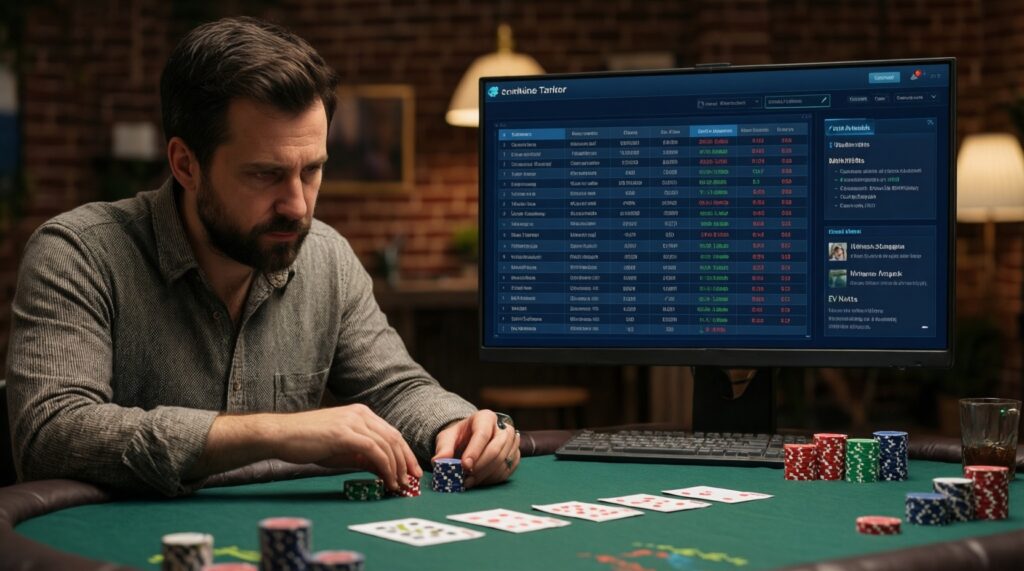
- Spreadsheet (Google Sheets/Excel): best for full control and custom fields; ideal if you want one place for bankroll + habits + EV notes.
- Dedicated tracker (online): useful if you rely on automated imports and a poker hand history tracker workflow; best when you play high online volume.
- Notes-first (phone/Notion) + weekly spreadsheet update: best for live players; fast capture during play, structured data later.
- All-in-one apps: a poker session tracking app can be easiest for consistency; choose it if manual spreadsheets make you skip logging.
Short template you can copy (one session)
- Identifiers: Date; Format; Stakes; Location/Site; Tables
- Volume: Start; End; Hours; Hands (if available)
- Money: Buy-ins; Cash-out; Net
- Process: A/B/C; Top 3 hands to review; Habit tags + triggers
- Next action: one rule or one study topic
Sample tracking table (fields × example row)
| Field | Example entry (one session) |
|---|---|
| Date | 2026-08-13 |
| Format | Cash NLHE |
| Stakes | 1/2 (THB) |
| Location/Site | Bangkok (live room) |
| Start-End | 19:10-23:20 |
| Hours | 4:10 |
| Total buy-ins | 2 × 4,000 THB |
| Cash-out | 9,100 THB |
| Net result | +1,100 THB |
| Table quality note | Good: 2 loose callers on my right |
| Performance grade | B (good discipline; one rushed river call) |
| Hands to review | 3 biggest pots; one river decision unclear |
| Habit tags + triggers | autopilot (late), avoidance (vs strong reg) |
| Next action | Quit rule: stop after 4h unless A-grade; review river bluff-catch ranges |
Choosing the "best poker tracking software" for your workflow
- If you mainly play online and want automation, prioritize imports, marking hands fast, and reliable exports.
- If you play live, prioritize speed of entry, offline access, and consistent bankroll/session summaries.
- If you want EV improvement, prioritize linking hands-to-review with notes and a clear queue, not fancy graphs.
Common practical clarifications and edge cases
Should I log every single session, even short ones?
Yes. Short sessions often contain the most tilt-driven decisions, and missing them biases your dataset toward "clean" days.
How do I handle tournaments when results are lumpy?
Track by tournament and also by session block (e.g., an evening). Keep process metrics (decision quality, fatigue, late-reg choices) so you can improve even when cashes are rare.
What if I don't have hand histories (live poker)?
Write a minimal hand record immediately: positions, stacks, preflop action, key turn/river decision, and your reasoning. Even partial notes can be reviewed later for line selection.
Is EV tracking the same as a profit projection?
No. EV tracking is decision evaluation, not a guarantee of results. Use it to label whether your biggest choices were likely +EV, not to predict next week's winnings.
How many hands should I review per session?
Usually 3-5 marked hands is enough. If you review more, quality drops and you stop doing it consistently.
What's the simplest way to start if I'm inconsistent?
Use a poker session tracking app or a one-note template: time, in/out, one habit tag, one hand to review. Build consistency first, then add fields.
How do I prevent "tool hopping" when looking for the best poker tracking software?
Define your non-negotiables (imports vs live entry, bankroll totals, hand review queue) and commit for 30 days. Switch only if a requirement is truly unmet.