
Effective slot session management means pre-setting a fixed bankroll and time window, using conservative bet sizing that fits the game's volatility, and treating bonus features as optional-not targets you must chase. You protect your bankroll by defining stop-loss and stop-win points in advance and by using objective rules for when to stop playing slots, even when you feel close to a feature.
Essential session rules
- Decide your session bankroll before you open the game, and keep it separate from other funds.
- Set a hard time cap and a hard loss cap; stop when either one is hit.
- Use stable bet sizing; avoid escalating bets to "recover" losses.
- Only pursue a bonus/feature when the math and your limits still fit; otherwise skip.
- Pause after big wins or big losses; reassess instead of instantly re-spinning.
- Track outcomes briefly after the session to improve decisions, not to justify chasing.
Structuring your session bankroll and time targets
Who this fits: intermediate players who want consistent, repeatable decisions and fewer emotionally-driven spikes in stakes. It's especially useful if you switch between providers, game styles, or mobile/land-based play and need a single control system.
When not to do this (or to simplify it): if you're tired, tilted, drinking, playing on credit/borrowed funds, or you can't commit to stopping at a preset limit. In those cases, the safest move is not to start; the next safest is a very short, low-stake session with a strict cap and no feature chasing.
- Bankroll rule: choose a session bankroll you can lose without affecting bills or obligations.
- Time rule: set a fixed duration (for example, 20-45 minutes) and stop at the end regardless of results.
- Two-trigger stop: end the session when you hit either the time cap or the loss cap-whichever comes first.
Bet-sizing frameworks for volatility, RTP and bankroll health
What you'll need:
- Access to the slot's info panel/paytable: volatility label (if shown), paylines/ways, bonus rules, max bet, and any "buy feature" cost (if available).
- Your session bankroll amount and your planned session length.
- A simple note app or paper to record: starting bankroll, base bet, and your stop-loss/stop-win.
- One chosen bet-sizing rule (below) that you will not change mid-session.
Framework A: Flat base bet (risk-minimizing default). Pick a base bet that lets you survive variance without forcing you into increases. Example: with a 1,000 THB session bankroll, you might choose 5-10 THB/spin to keep swings manageable; commit to staying flat unless your pre-written plan says otherwise.
Framework B: Two-tier bet (only if you can stay disciplined).
- Base bet: your normal spin size for most of the session.
- Optional "review" bet: a slightly higher level used only after a scheduled review point (for example, after a timed break), and only if you are above a pre-set bankroll threshold.
Framework C: Volatility-adjusted cap. If the game is high volatility (or frequently produces long dead streaks), lower your base bet. If it's medium/low volatility, you can usually hold a slightly higher base bet-but still keep it stable. This is the practical core of finding the best bet sizing for slots: your bet should be small enough that variance cannot force you into chasing behavior.
Bankroll health check (fast): if a normal downswing would make you feel pressure to raise stakes, your bet is too high for your bankroll and session goals.
Feature chasing: when to pursue bonuses and when to ignore them
Risks and limitations (read before you chase):
- Near-misses and "almost triggered" bonuses do not increase your odds on the next spin in a meaningful, reliable way.
- Chasing features often turns a controlled plan into an uncontrolled session, especially after losses.
- Raising stakes late in a session concentrates risk when you have the least bankroll buffer.
- Some mechanics (progress meters, hold-and-spin qualifiers, multi-stage bonuses) can increase engagement without improving your expected value.
-
Define the feature you mean and its cost to you.
Write down what you're chasing (free spins, respins, hold-and-win, bonus wheel) and what it costs: time, bankroll, and emotional control. If you cannot describe the trigger condition clearly, you're not in a position to chase it.
-
Set a "feature budget" inside the session bankroll.
Allocate a small portion of your session bankroll as the maximum you're willing to spend attempting to trigger a bonus (for example, 10-20%). When that budget is spent, you stop the chase-even if the feature feels close.
- If you're already down near your stop-loss, the feature budget is automatically zero.
-
Use a fixed attempt window, not an emotional one.
Decide a bounded number of spins or a short time window to try (for example, "I'll try for 50 spins at base bet"). This prevents open-ended chasing driven by sunk-cost pressure.
-
Chase only at base bet unless your plan explicitly allows otherwise.
Most "slot feature chasing strategy" failures come from increasing bet size after losses. If you want a higher stake, it must be scheduled in advance and must fit your bankroll health check-not triggered by frustration.
-
Stop the chase when a clear trigger is hit.
End your attempt immediately if any of these occur: you hit the feature budget cap, you hit the session stop-loss, you reach the time cap, or you notice tilt signals (speeding up spins, muttering "one more"). That is the operational answer to when to stop playing slots.
-
Handle "progress" mechanics with a hard cutoff.
If the slot shows a meter that carries within the session, decide your cutoff before you start (for example, "I will not continue after my feature budget is spent, even if the meter is high"). Never convert "progress" into permission to violate limits.
Maximizing returns during bonus rounds and free spins
- Confirm the bet level locked into the bonus (some bonuses lock the triggering bet); avoid changing stakes mid-bonus unless the rules allow and your plan permits it.
- Read the bonus-specific rules once: retriggers, multipliers, expanding symbols, collect mechanics, and any "gamble" option.
- Keep decision points slow: if you can choose volatility paths or pick items, pause and choose based on your risk tolerance, not on recent outcomes.
- Do not increase stake immediately after a strong bonus; take a short break and re-check your stop-win and time cap.
- If there is a risky double-or-nothing option, decide your policy before the session (always skip, or only under strict conditions) and stick to it.
- After the bonus ends, return to your base bet automatically; no "pressing" unless pre-planned.
- Record one line: "Bonus triggered? Y/N; bet; outcome vs starting bankroll." This improves how to manage bankroll when playing slots over time.
Limits, stop-loss mechanics and objective exit triggers
- Moving the stop-loss: shifting the loss limit because "the slot owes" is a loss of control, not a strategy.
- Chasing with bigger bets: increasing stakes to recover faster is the most common path from manageable variance to bankroll collapse.
- Ignoring time: treating a session as "until I win" removes the only reliable boundary you control.
- Confusing entertainment with investment: playing longer because you're "due" turns randomness into a false schedule.
- Using wins as justification to stay: a stop-win is a protection rule; breaking it gives back profit under variance.
- Feature fixation: continuing because you were one symbol away is a near-miss bias; it's not a predictive signal.
- Loss concealment: refusing to log results keeps you repeating the same pattern without noticing.
- Stacking risky choices: combining high volatility, higher stakes, and feature chasing in one session multiplies downside.
Post-session analysis: tracking outcomes and adjusting strategy
Use a lightweight review that improves future decisions without turning into obsessive tracking. Alternatives below are appropriate depending on your goals:
- Two-minute ledger (best default). Note starting bankroll, ending bankroll, base bet, whether you chased a feature, and whether you respected stop rules. Use it to spot recurring triggers (tilt, late-night play, stake creep).
- Rule compliance score (when discipline is the issue). Score yourself on 3 items: stayed within time cap, respected stop-loss, kept bet sizing stable. Adjust rules only after several sessions, not after a single swingy result.
- Game shortlist rotation (when game-hopping causes chaos). Limit yourself to a small shortlist of games that match your volatility preference; rotate only at session boundaries to reduce impulsive switching.
- "No-chase" blocks (when feature chasing is your leak). Schedule sessions where chasing is forbidden; compare your emotional control and bankroll stability to chase sessions.
Practical dilemmas and quick decisions
I'm one symbol away from the bonus-should I keep going?
No, not unless you are still inside both your feature budget and your time/loss limits. Near-misses do not justify extending the session.
What is the safest default bet size if I'm unsure?
Use a flat base bet that feels "almost boring" and does not tempt you to raise it after losses. If you feel pressure to increase, your bet is too high for your bankroll.
Should I switch slots after a long dead streak?
Switch only at a pre-set review point (time-based), not because you feel the game is cold. Random streaks are normal; impulsive switching often leads to chasing behavior.
How do I decide when to stop playing slots if I'm up?
Stop at your pre-set stop-win or at the time cap, whichever comes first. Locking profit is a rule, not a feeling.
Is buying a feature a good way to avoid chasing?
It can reduce time spent chasing, but it concentrates variance and can drain bankroll fast. Only consider it if it fits your feature budget and you accept the higher swing risk.
I keep raising my bet after losses-what single rule fixes this?
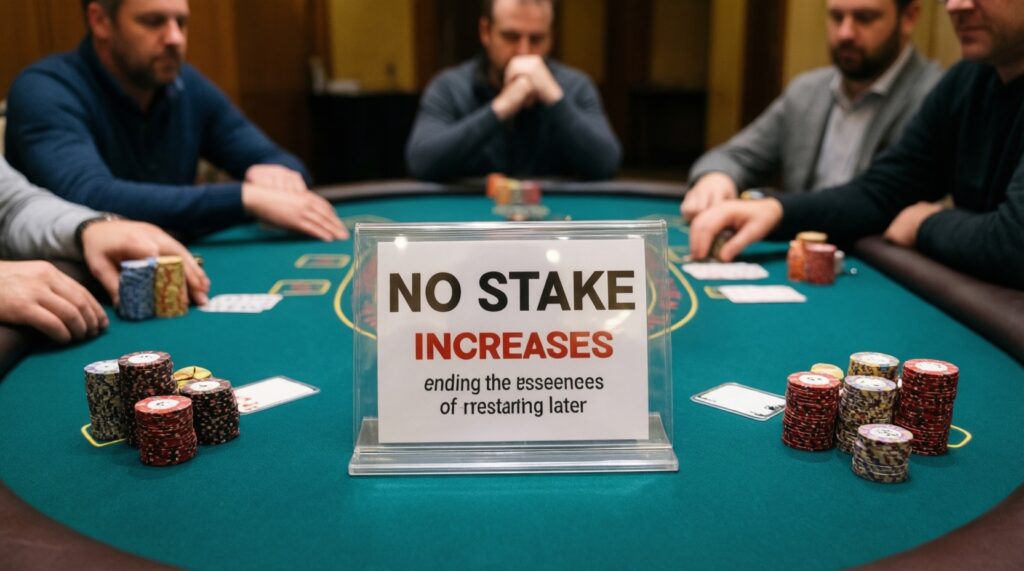
Write one rule: "No stake increases during the session." If you want a different stake, end the session and start a new one another time with a new plan.
What should I log after each session to improve decisions?
Record starting bankroll, ending bankroll, base bet, whether you chased, and whether you hit a stop trigger. That's enough to refine slot session management without overtracking.