

European roulette (single-zero) has a higher expected value for the player than American roulette (double-zero) because the extra 00 increases the house edge across virtually all bets. Strategy adjustments are therefore mainly about table selection, bet selection, and session rules: keep payouts constant, reduce volatility intentionally, and switch wheels when the rules or bankroll make the EV gap matter most.
Core EV contrasts between European and American wheels
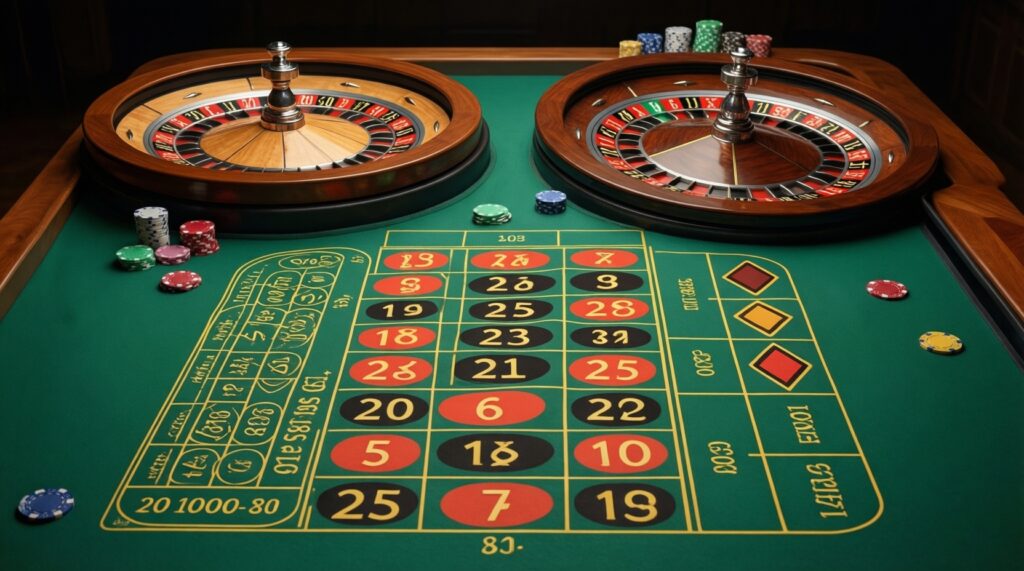
- Wheel layout: European has 37 pockets (0-36); American has 38 (0-36 plus 00).
- House edge difference: the extra 00 makes roulette house edge European vs American meaningfully worse on American for standard rules.
- Same payouts, different probabilities: casinos keep payouts identical, so the probability shift drives the EV drop.
- EV scales with stakes: higher bet sizes amplify the EV gap over time; low stakes make variance feel more important than EV.
- Bet type does not "fix" the wheel: straight-up, outside, and most common bets inherit the wheel's edge.
How wheel geometry creates different house edges
To choose the better wheel for your goal, focus on geometry-driven EV and on rule modifiers that can partially offset (or worsen) it. The phrase American roulette vs European roulette odds is mostly about one thing: 37 pockets versus 38 pockets, while payouts stay the same.
- Number of pockets: 37 (European) versus 38 (American) determines baseline house edge.
- Presence of 00: American's 00 increases the chance that all non-zero bets lose.
- Zero-handling rules: check for La Partage or En Prison on European tables; they can improve EV on even-money bets.
- Available bet limits: tight limits can force you into higher-risk bets (variance) or prevent proper bankroll scaling.
- Speed and decision frequency: faster spins mean the house edge expresses itself faster per hour.
- Bet menu and side bets: extra proposition/side bets typically worsen EV; treat them as entertainment, not optimization.
- Online RNG vs live dealer conditions: practical friction (minimums, speed, side bets) affects how closely you can follow a plan when you play European roulette online real money.
- Your bankroll and risk tolerance: EV difference is structural, but bankroll determines whether volatility or expected loss is your main constraint.
Mathematical derivation of expected value per bet type
For a standard roulette bet with stake 1 unit and payout k:1, the expected value (EV) is:
EV = P(win) × k − P(lose) × 1
On European (37 pockets): P(win)=w/37. On American (38 pockets): P(win)=w/38. For most common bets, payouts are set so that EV becomes a constant negative fraction of stake that matches the wheel's house edge.
Worked example (even-money bet, e.g., Red):
European: EV = (18/37)×1 − (19/37)×1 = −1/37.
American: EV = (18/38)×1 − (20/38)×1 = −2/38.
Worked example (straight-up number):
European: EV = (1/37)×35 − (36/37)×1 = −1/37.
American: EV = (1/38)×35 − (37/38)×1 = −2/38.
| Variant | Who it suits | Pros | Cons | When to choose |
|---|---|---|---|---|
| European single-zero (standard rules) | Players optimizing European vs American roulette expected value with simple bet menus | Better EV baseline; straightforward bankroll planning | Still negative EV; variance can dominate short sessions | Default pick when you can freely choose the wheel |
| European single-zero with La Partage | Outside-bet players who mostly bet even money | Improves EV on even-money bets when zero hits | Not always offered; applies mainly to even-money bets | If your plan is Red/Black, Odd/Even, High/Low |
| European single-zero with En Prison | Disciplined players who can follow rule-specific handling | Can reduce expected loss on even-money bets | Rule implementation varies by casino; can slow play | When clearly stated rules are available and you stick to even-money bets |
| American double-zero (standard rules) | Players prioritizing availability (especially some live rooms) over EV | Common in some venues; familiar layout to some players | Worse EV; more frequent zero outcomes against most bets | Only when European tables/rules are unavailable or minimums are better |
| American double-zero with dealer or house promos | Players who can capture specific, verifiable value offers | Promos may offset some expected loss if terms are favorable | Most promos are capped/conditional; can increase wagering and variance | When the offer is clear, achievable, and you can quantify the net effect |
Comparative table: payouts, probabilities, and EVs
The key insight behind roulette house edge European vs American is that standard payouts do not change, while win probabilities shrink on the American wheel. That makes EV more negative for the same bet.
| Bet type | Payout (net) | Win probability (European, 37) | EV per 1 unit (European) | Win probability (American, 38) | EV per 1 unit (American) |
|---|---|---|---|---|---|
| Even-money (Red/Black, Odd/Even, High/Low) | 1:1 | 18/37 | −1/37 | 18/38 | −2/38 |
| Dozen / Column | 2:1 | 12/37 | −1/37 | 12/38 | −2/38 |
| Split (2 numbers) | 17:1 | 2/37 | −1/37 | 2/38 | −2/38 |
| Straight-up (single number) | 35:1 | 1/37 | −1/37 | 1/38 | −2/38 |
- If you can choose the wheel freely, then prefer European single-zero because the EV penalty per unit staked is smaller across standard bets.
- If you mainly play even-money bets, then actively search for European tables with La Partage or En Prison and avoid American when optimizing best roulette strategy European roulette.
- If you are forced onto American double-zero, then reduce session length or decision count (slower pace, fewer side bets) to limit how quickly the worse EV compounds.
- If you want higher hit frequency, then favor outside bets on European; do not confuse higher hit rate with better EV, especially on American.
- If minimums on European are higher than your bankroll supports, then a lower-minimum table may be more practical even if EV is worse, because bankroll ruin risk can dominate.
Tactical adjustments for single-zero (European) play

Use this quick algorithm to keep decisions consistent and avoid drifting into higher-edge bets. It fits most intermediate players who want cleaner execution when they play European roulette online real money.
- Confirm the wheel is single-zero and read any La Partage or En Prison rules before placing the first bet.
- Pick a primary bet class: even-money for steadier swings, or dozens/columns for moderate volatility; avoid mixing unless planned.
- Set a unit size that allows a meaningful number of spins without needing to chase losses.
- Define stop rules (time-based or win/loss caps) to prevent volume creep; EV expresses per decision.
- If playing even-money and La Partage/En Prison is available, keep the same outside bet rather than hopping between patterns.
- Limit "fun" bets (straight-ups, neighbors, call bets) to a small, pre-budgeted slice if you want entertainment without derailing discipline.
Tactical adjustments for double-zero (American) play
- Assuming bet type changes the edge: on standard rules, most common bets inherit the American wheel disadvantage.
- Overusing 5-number and exotic proposition bets: these are typically worse than even-money/outside bets on top of the double-zero penalty.
- Chasing with progression systems: progressions change variance, not the negative expectation; they often increase table-limit risk.
- Ignoring decision volume: fast play increases the speed at which negative EV accumulates.
- Mixing goals mid-session: switching from "low swing" to "jackpot hunting" after losses usually increases risk without improving EV.
- Failing to compare minimums and rules: sometimes a slightly higher European minimum is still better than many hours at a worse EV on American.
- Misreading American layout: accidental 00 coverage gaps happen when translating European number patterns to the American felt.
- Not tracking comps/promos correctly: if you rely on offers to justify American play, you must quantify terms and realistic completion.
Decision criteria for choosing bets and switching wheels
- If you see single-zero European with clear rules, choose it and play your planned bet class (even-money or dozens/columns) with fixed units.
- If you only see American double-zero, reduce decision count (shorter sessions, fewer side bets) and avoid high-edge proposition bets.
- If European is available but minimums are too high for your bankroll, either scale down stakes by switching venue/provider or accept fewer spins rather than forcing aggressive progressions.
- If you find La Partage or En Prison on European, prefer even-money bets to maximize the rule benefit.
- If you are comparing tables, treat European vs American roulette expected value as the first filter, then confirm practical constraints (minimums, speed, rule text).
For most intermediate players choosing between wheels, European single-zero is typically best for EV-focused play and for building a repeatable plan; American double-zero is typically best only when access, minimums, or specific offers materially change your practical outcome. Use the EV gap to pick the wheel, then pick bets based on volatility you can actually bankroll.
Practical clarifications and quick rules of thumb
Is European roulette always better EV than American?
Under standard rules, yes, because the single-zero wheel has fewer losing pockets than the double-zero wheel while paying the same odds.
Do outside bets have a better expected value than straight-up bets?
On standard rules, no: the wheel determines the house edge, so common bets share the same baseline EV; outside bets mainly change volatility and hit rate.
What is the simplest way to compare American roulette vs European roulette odds at a glance?
Count the zero pockets: one zero (European) versus two zeros (American). Same payouts plus more zero pockets means worse EV on the American wheel.
What is a practical best roulette strategy European roulette players can actually follow?
Pick a single-zero table, prefer even-money or dozen/column bets, use fixed units, and set stop rules. Add La Partage/En Prison when available and clearly stated.
When I play European roulette online real money, what table details must I check first?
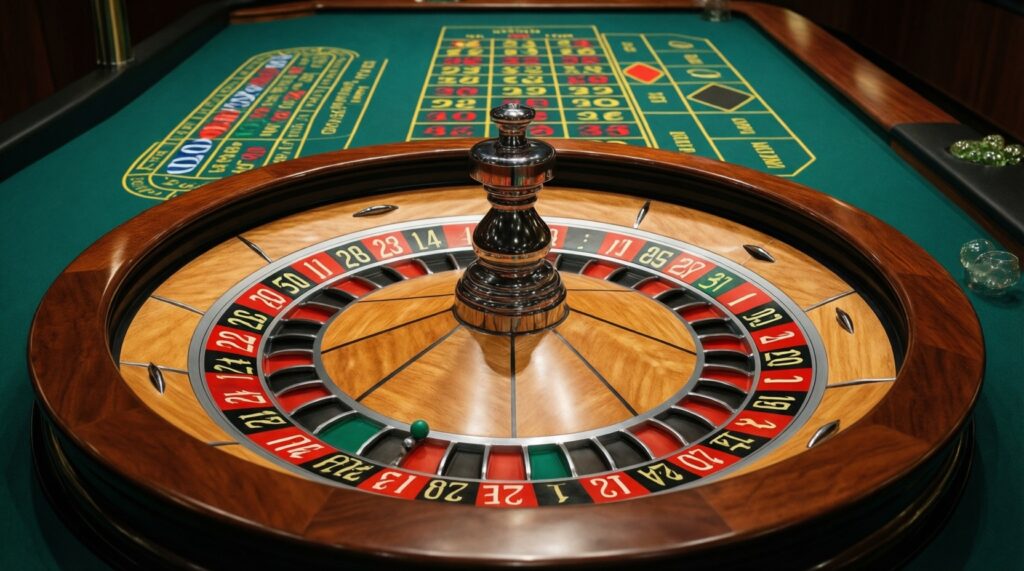
Confirm single-zero, read zero-handling rules (La Partage/En Prison), verify minimum/maximum limits, and avoid hidden side-bet menus that tempt higher-edge wagering.
Does switching wheels mid-session help?
Switching from American to European improves your EV per bet immediately. Switching the other way usually makes sense only for practical constraints like minimums or availability.
Can I overcome the roulette house edge European vs American with a betting system?
No betting system changes the underlying expected value of a fair wheel with fixed payouts; systems mostly reshuffle variance and can increase risk of hitting limits.