

Outside bets trade lower variance for frequent small wins, while inside bets trade higher variance for infrequent large payouts. On a European wheel, the house edge is the same across standard bets, so the practical choice is bankroll volatility and session goals: use outside bets to smooth swings, inside bets to pursue spikes and specific number coverage.
At-a-glance comparison
- Expected value: for standard bets on the same wheel type, EV is effectively identical; outcomes differ mainly by variance and hit frequency.
- Hit frequency: outside bets hit often (e.g., red/black) while roulette inside bets hit rarely (e.g., straight-up).
- Payout shape: outside bets are usually 1:1 or 2:1; inside bets can be 11:1, 17:1, 35:1.
- Bankroll behavior: outside bets reduce drawdowns; inside bets increase drawdowns but allow faster upside spikes.
- Best use: outside bets for time-on-table and controlled sessions; inside bets for targeted coverage and "jackpot-chase" style sessions.
- Practical mix: many players do best using an outside "base" plus a small inside "shot" sized as a fraction of the base.
Mathematical foundations: variance and expected value
- Wheel type first: European (single-zero) vs American (double-zero) changes the house edge; your roulette betting strategy starts by confirming the layout and rules.
- Expected value is not the differentiator: across standard bets on the same wheel, the house edge is structurally similar; "smart" selection is mostly about variance management.
- Hit probability drives session feel: higher hit rate (outside) reduces long losing streaks; lower hit rate (inside) increases streak risk.
- Payout multiple drives jump size: bigger payouts (inside) create larger positive jumps but require tolerating larger negative drift between hits.
- Variance per unit stake: two bets with the same house edge can have radically different variance; this is why "roulette odds and payouts" must be read together, not separately.
- Correlation of simultaneous bets: stacking multiple inside bets can unintentionally concentrate risk (many bets lose together), even if coverage looks wide.
- Table limits and minimums: outside-base systems can hit max-bet ceilings during progressions; inside-heavy play can hit practical limits via many chips placed.
- Time horizon: short sessions amplify variance differences; longer sessions make bankroll control (unit sizing, stop rules) more important than bet type.
Payout mechanics: outside bets versus inside bets
The core distinction is payout structure: roulette outside bets pay smaller multiples with higher hit frequency, while inside bets pay higher multiples with lower hit frequency. The table below compares common options as "variants" you can combine in one session plan.
| Variant | Who it fits | Pros | Cons | When to choose |
|---|---|---|---|---|
| Red/Black (even-money, outside) | Players prioritizing steadier bankroll swings | Frequent hits; simple tracking; good base bet | Small wins; susceptible to long color streaks | When your goal is capital preservation and longer table time |
| Dozen (1-12, 13-24, 25-36; outside) | Players wanting moderate swings with some selection | 2:1 payout; flexible coverage; pairs well with small inside "shots" | Lower hit rate than even-money; can feel "swingy" in short sessions | When you want a middle ground between stability and upside |
| Column (2:1, outside) | Players who like pattern tracking without single-number variance | 2:1 payout; works as a structured base | Same hit rate as dozens; outcomes can cluster against you | When you prefer consistent structure over number picking |
| Split (two numbers, inside) | Players seeking higher payouts but not straight-up volatility | Meaningful payout; can be combined into lines for coverage | Longer losing streaks than outside bets; chip placement complexity | When you want targeted coverage with controlled "shot size" |
| Straight-up (single number, inside) | Players intentionally accepting high variance for spikes | Maximum standard payout; clear target | Very low hit rate; bankroll drawdowns are common | When your session objective is a jackpot-chase style outcome |
| Street (three numbers, inside) | Players who want inside action with slightly better hit frequency | Balance between split and outside bets; easy to repeat | Still high variance vs outside bets; can "leak" chips via overbetting | When you want inside exposure without going straight-up |
Representative math snapshot (European wheel, per 1 unit stake)
These figures help compare volatility directly. "Net win" is profit excluding returned stake. Variance is for the net outcome per 1 unit bet (higher = more volatile).
| Bet type | Category | Payout (net) | Win probability | Loss probability | Variance (net outcome) |
|---|---|---|---|---|---|
| Red/Black | Outside | +1 | 18/37 | 19/37 | 1 - (1/37)2 |
| Dozen | Outside | +2 | 12/37 | 25/37 | 73/37 - (1/37)2 |
| Column | Outside | +2 | 12/37 | 25/37 | 73/37 - (1/37)2 |
| Split | Inside | +17 | 2/37 | 35/37 | 613/37 - (1/37)2 |
| Straight-up | Inside | +35 | 1/37 | 36/37 | 1261/37 - (1/37)2 |
Risk profiles and bankroll volatility

- If you tilt after losing streaks, then keep most of your stake on outside bets (even-money or dozens) and cap inside exposure to a small, fixed fraction per spin.
- If you have a short session window and need a chance at a meaningful jump, then add 1-3 inside bets (e.g., a split or street) while keeping an outside base to avoid going "all-in variance."
- If your bankroll is small relative to the table minimum, then avoid straight-ups as a main plan; choose a lower-volatility outside structure so you can survive normal negative drift.
- If you are target-chasing a specific number/sector, then accept inside-bet drawdowns intentionally: size straight-ups/splits as "shots" with pre-set stop-loss and stop-win rules.
- If you tend to increase stakes during losses, then avoid aggressive progressions on even-money bets; the volatility may look low, but bet growth can dominate risk.
Worked examples (unit sizing with simple stops)

- Stability-first session: Use 1 unit on Red/Black as the base, optional 0.25 unit on a Dozen for mild upside. Stop-loss: 10 base units; stop-win: 6-8 base units. Keep stake flat to prevent progression risk from overwhelming the "low-variance" bet.
- Spike-seeking but controlled: Use 1 unit on a Dozen plus 0.2-0.3 unit on one Split that complements your dozen coverage. Stop-loss: 12-15 total units; stop-win: 10-12 total units. If the split hits once, consider removing it and continue with the dozen base.
Strategic frameworks: selecting bets by session objective
- Confirm rules (single-zero vs double-zero, en prison/la partage if offered); base your plan on the actual wheel.
- Pick a primary objective: capital preservation, short-term swing, or jackpot chase.
- Set a unit (1 unit = a stake you can repeat many times) and define a stop-loss and stop-win before placing chips.
- Choose a base bet: even-money for smoothest swings; dozens/columns for moderate swings.
- Add inside exposure only if it serves the objective: size it as a fixed fraction of the base (not as a reaction to losses).
- Limit complexity: cap total simultaneous inside positions so you can track risk and avoid accidental overbetting.
- Review after a block of spins: keep, reduce, or remove inside "shots" based on whether you're still playing the same goal.
Tactical implementations: inside-bet lines, splits and combos
- Overpaying for coverage: placing many inside bets feels safer, but it often recreates an outside bet with worse volatility and more chips at risk.
- Double-counting numbers: overlapping splits/streets can unintentionally concentrate stake on a few numbers while you believe you are diversified.
- Chasing due numbers: inside bets placed because a number is "due" are a variance trap; treat number selection as preference, not prediction.
- Progressing inside stakes: increasing straight-up/split size after misses escalates volatility extremely fast; keep inside bets flat or pre-planned.
- Ignoring interaction with the base: if you run an outside base plus inside bets, measure total risk per spin (base + shots), not each bet in isolation.
- Misreading payout math: "roulette odds and payouts" differ by bet type; a higher payout does not imply a better expectation, only a different risk distribution.
- Using systems that rely on quick hits: inside-heavy systems often assume early wins; when they don't arrive, bankroll drawdowns can exceed your stop-loss quickly.
- Not matching bet type to objective: the best roulette bets for a long session are rarely the same as the best roulette bets for a single high-variance shot.
Decision tree: stepwise betting choices for common scenarios
Session-goal mapping (decision-tree table)
| Session goal | Recommended base | Optional inside "shot" | Default sizing rule | When to stop or simplify |
|---|---|---|---|---|
| Capital preservation / long play | Red/Black (or similar even-money) | None, or a very small Street | Inside ≤ 0.25× base | After 2-3 missed inside attempts, remove the shot |
| Short-term swing (balanced) | Dozen or Column | One Split that aligns with your base | Inside 0.2-0.4× base | If down a pre-set block (e.g., several base units), revert to base-only |
| Targeted number coverage | Dozen/Column to finance volatility | 1-2 Splits (or a Street) around the target zone | Total inside ≤ base | After one solid inside hit, reduce exposure and lock profit structure |
| Jackpot chase (high variance) | Small even-money "anchor" or no base | Straight-up (single number) or a small cluster of Splits | Shots fixed; no progression | Hard stop-loss; if missed, end session rather than escalating |
Mini decision-tree checklist (fast pick)
- If you want steadier results → start with roulette outside bets (even-money); skip inside shots.
- If you want moderate swings → choose Dozen/Column as the base; add one Split as a controlled shot.
- If you want a single big hit → use roulette inside bets (straight-up or split) with a strict stop-loss and no stake progression.
- If you feel compelled to increase stakes → simplify to one base bet only; volatility is already doing enough.
- If your plan is getting complex → reduce the number of simultaneous positions before increasing any unit size.
Best for time-on-table and smoother bankroll swings is usually an even-money or 2:1 outside base with flat sizing. Best for high-upside spikes is a small, fixed inside "shot" (split/straight-up) optionally supported by an outside anchor, so you can pursue upside without turning every spin into maximum volatility.
Practical clarifications and edge cases
Do outside bets have better odds than inside bets?
No-on the same wheel type, the house edge is broadly similar; outside bets mainly feel "better" because they hit more often.
Are inside bets ever the right default?
Yes, if your session objective is explicitly a high-variance payout spike and you can tolerate long losing sequences with fixed, pre-set risk.
Does combining many inside bets reduce variance?
Not automatically. It often increases total stake-at-risk per spin and can create correlated losses if your coverage overlaps.
What's the cleanest beginner-friendly mix for intermediate players?
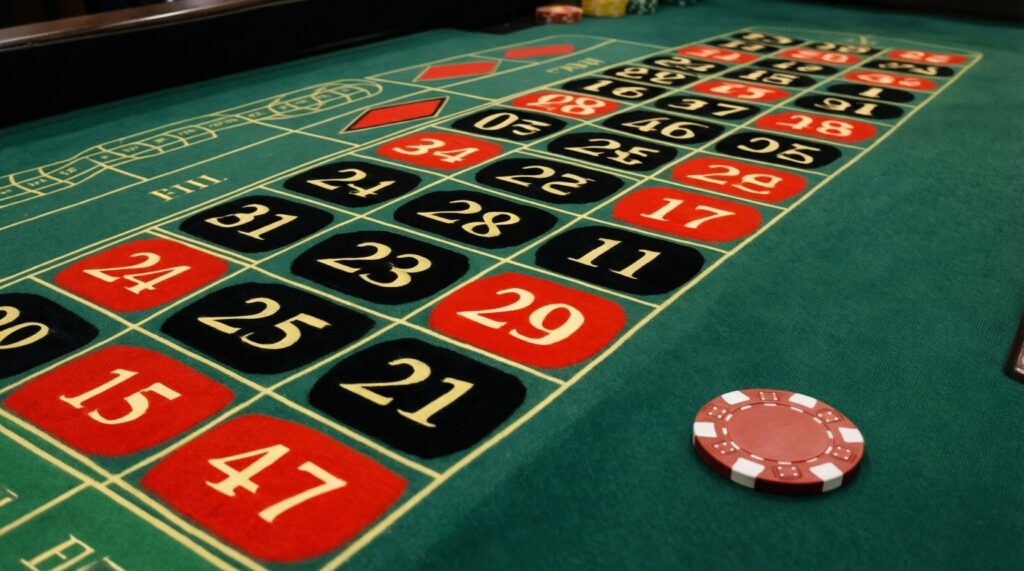
A simple base (Red/Black or Dozen) plus at most one inside shot (one Split or one Street), sized as a small fraction of the base.
Should I use a Martingale on outside bets?
Be cautious: even though outcomes are frequent, progressions can hit table limits and create outsized drawdowns. Flat or lightly structured sizing is more controllable.
How do I decide between Dozens and Columns?
They share the same probability and payout structure on a European wheel. Choose whichever is easier for you to track and pair with your inside coverage without overlap mistakes.
What changes if the wheel is American (double-zero)?
The house edge is higher across the board, so bankroll management matters more. Your selection still hinges on variance, but your stop-loss should be tighter because drift is faster.