

The Gambler's Fallacy in roulette is the mistaken belief that past outcomes (like a long run of red) change the probability of the next spin. "Hot" and "cold" numbers feel predictive, but on a fair wheel each spin is independent. To avoid biased decisions, treat streaks as noise, manage bankroll strictly, and validate any "pattern" with quick data checks.
Debunking the 'hot' and 'cold' number myths
- Myth: "A number is due." Reality: Past misses do not increase its next-spin chance.
- Myth: "Hot numbers keep hitting." Reality: Streaks happen naturally in random sequences without implying a new edge.
- Myth: "Switching after a streak is smart." Reality: Switching is usually emotion-driven, not probability-driven.
- Myth: "Tracking results reveals a winning pattern." Reality: Tracking can describe variance, but it cannot create a player advantage on a fair game.
- Myth: "A best roulette system to win exists if you find the right progression." Reality: Progressions reshuffle risk; they don't remove the house edge.
What the Gambler's Fallacy actually is and why it matters
The Gambler's Fallacy is a cognitive error: after observing a streak, you believe the opposite outcome becomes more likely (for example, "black must come next" after many reds). In roulette, this is especially tempting because outcomes are discrete, memorable, and displayed in a history panel that encourages pattern-hunting.
It matters because the fallacy changes behavior, not odds. Players often increase stakes, abandon pre-planned limits, or chase "due" outcomes-actions that raise volatility and speed up losses even though the underlying probabilities remain unchanged.
Boundary to keep clear: the fallacy is about independent events. If the wheel is biased or the RNG is faulty, outcomes are not independent-but that is a different claim that requires evidence, not intuition.
How cognitive biases create false patterns in roulette

- Pattern recognition on autopilot: the brain prefers "stories" (runs, cycles, rebounds) over randomness.
- Recency bias: the last few spins feel more informative than earlier ones, so you overweight fresh streaks.
- Availability bias: memorable sessions where a "hot" number hit repeatedly dominate your recall.
- Confirmation bias: you remember the times your read of the board "worked" and ignore the times it didn't.
- Illusion of control: changing bets feels like steering outcomes, especially in fast online interfaces.
- Loss-chasing: after a downswing, "due" thinking justifies bigger bets as a "correction."
This is why many players confuse an online roulette strategy (a plan for risk and pacing) with a plan that changes probability. The first is real; the second is usually a bias dressed as math.
Statistical reality: independence, variance, and expected frequencies
On a fair roulette game, each spin is independent: prior spins do not alter the next spin's distribution. Variance then explains why streaks and clusters appear routinely without implying a new edge. Typical situations where players misread variance:
- Long single-color runs: extended red/black streaks that feel "impossible," prompting contrarian bets.
- Clusters of the same dozen/column: a short burst that gets labeled "hot sector," then overbet.
- Repeats of a single number: back-to-back hits that trigger "it's hot," followed by overcommitment.
- Apparent "corrections": when a streak ends, players treat it as proof that "balance returns."
- Session-limited tracking: a small sample (your last 30-100 spins) being treated as a reliable model.
Expected frequencies are long-run averages, not short-run guarantees. In the short run, "weird" sequences are normal; the mistake is converting normal variance into confident predictions.
Practical rules to avoid biased decisions at the wheel
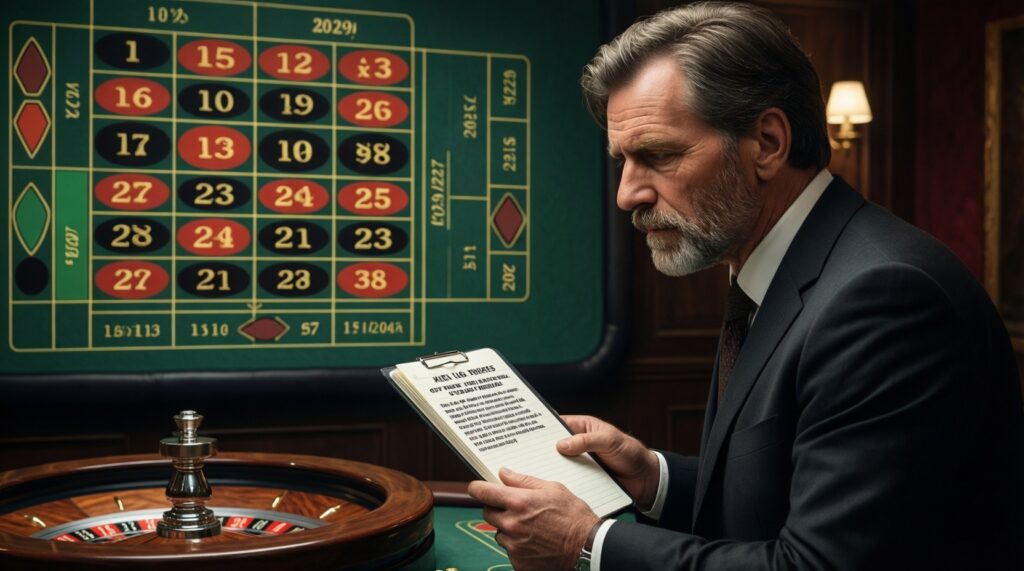
Use rules that constrain impulsive interpretation of the history panel. Treat these as part of your roulette betting strategy: they improve discipline even though they don't change the house edge.
Pre-spin checklist (commit before you see the next result)
- Set a fixed session budget and a hard stop-loss; treat both as non-negotiable.
- Choose a base unit size that you can repeat without scaling due to emotion.
- Define a time/hand limit (for online play: a number of spins) to avoid "one more" spirals.
- Write one sentence for why you are placing the next bet (e.g., "flat betting for entertainment"), not "because it's due."
- Decide in advance whether you will change bet types at all; if yes, specify when (e.g., only at session boundaries).
In-session guardrails (stop bias before it becomes staking)
- Ban the words "due" and "hot" from your decision process: if you catch yourself using them, default to your base unit or pause.
- No progression after losses: Martingale-style scaling is often justified by the fallacy and can force catastrophic bet sizes.
- One adjustment rule: allow at most one planned change per session (for example, switching from even chances to dozens), never multiple reactive flips.
- Separate analysis from wagering: if you want to track spins, do it as observation; do not let tracking dictate stake size.
These rules won't tell you how to win at roulette online in the sense of creating an edge, but they will reduce the most common self-inflicted errors: chasing, overbetting, and story-driven switching.
Evaluating popular betting systems through rigorous logic

- Progressions confuse payout shape with advantage: changing stake sizes can smooth some sessions but cannot flip negative expectation to positive.
- "Hot/cold" systems rely on narrative thresholds: "bet numbers that appeared 3 times in 20 spins" is a rule, not evidence of predictability.
- Stop-win/stop-loss isn't a probability hack: it changes exposure time, not the per-spin odds.
- Backtests often overfit: a system tuned to one history slice tends to fail on the next slice.
- Selection bias in testimonials: people post winning sessions; losing sessions vanish, making the method look stronger than it is.
Use "logic-first" criteria: if a method cannot explain why the next spin's distribution changes, it's not a predictive system. At best, it's a risk-management routine or entertainment structure-useful, but not magic. Many "roulette tips and tricks" become safer when you classify them this way.
Simple tests and data checks to spot real anomalies
If you suspect something beyond normal variance (a biased wheel, a faulty RNG, or a reporting glitch), don't rely on feelings. Run a quick sanity check that separates "streaky but normal" from "data worth escalating."
Quick data test: frequency vs. expectation (lightweight, not a proof)
- Pick one simple category to track (e.g., red vs. black, or one dozen). Avoid tracking many categories at once.
- Collect a meaningful batch from the same table/provider without changing games mid-sample.
- Compute observed frequency and compare it to the theoretical frequency for that category.
- If the deviation looks extreme, repeat with a new batch before drawing conclusions.
Mini-pseudocode you can replicate in a spreadsheet
# Example: tracking red frequency
n = number_of_spins
observed_red = count_of_red_results
p = theoretical_red_probability  # depends on roulette type
expected_red = n * p
deviation = observed_red - expected_red

# Interpretation rule of thumb:
# If deviation flips sign and shrinks as you add more spins, it's likely variance.
# If deviation stays consistently large across separate batches, investigate further.
This kind of check won't turn into a winning predictor, but it can stop you from mistaking ordinary randomness for a signal-and it keeps your "best roulette system to win" search grounded in evidence rather than streak-chasing.
Concise responses to recurring roulette concerns
Are "hot" numbers real in roulette?
On a fair wheel, "hot" is a description of the past, not a predictor of the next spin. Betting because a number hit recently is a psychological impulse, not a probability edge.
Are "cold" numbers more likely to appear soon?
No. A long absence does not increase the next-spin chance. "Due" thinking is the Gambler's Fallacy in its classic form.
Does the history board help build an online roulette strategy?
It can help you track what happened, but it cannot reveal a reliable next-spin advantage on a fair game. Use it for record-keeping, not prediction.
What is the single worst mistake in a roulette betting strategy?
Scaling stakes aggressively because you believe a reversal is "owed." This converts a normal downswing into bankroll-threatening risk.
Is there a best roulette system to win consistently?
Not on a fair roulette game. Systems can structure stakes and session limits, but they do not remove the house edge.
So how to win at roulette online at all?
If "win" means long-run profit, a fair game doesn't offer that via betting patterns. Focus on bankroll discipline, lower-volatility choices, and knowing when to stop.
Which roulette tips and tricks are actually useful?
Practical ones: fixed unit sizing, preset stop rules, avoiding loss-chasing, and tracking your decisions to catch bias. They protect your bankroll from your own impulses.