

Martingale feels powerful in roulette because early sessions often end after a short win, making the recovery logic look reliable. In reality, variance guarantees occasional long losing streaks, and roulette table limits martingale constraints prevent the required doubling, forcing a locked-in loss. This guide troubleshoots why your sequence "stops working" and how to contain damage mid-session.
Why Martingale Feels Powerful at Low Stakes
- Most streaks you experience are short, so the reset-to-base win happens frequently.
- Small early profits create a strong "system works" narrative even when risk is growing.
- Losses are rare but clustered; they arrive as a single large hit rather than many small ones.
- At low stakes, table limits feel far away, so the strategy looks unconstrained.
- Online sessions often end quickly after a win, hiding the long-run exposure of an online roulette strategy martingale.
How the Martingale System Is Supposed to Work
- You place an even-money bet (e.g., red/black) and double after each loss.
- When a win occurs, the win is designed to recover all previous losses plus one base-unit profit.
- You "feel safe" because a single win ends the sequence and you reset to the base bet.
- What you actually see when it goes wrong: you hit a limit, can't double, or your bankroll can't support the next step.
This is the core roulette martingale system explained: it is a recovery ladder, not an edge. It cannot change the house advantage; it only reshapes the distribution of outcomes.
Probability, Variance and the Illusion of Safety

- Read-only check: list your last 50-200 spins and count the longest losing streak for your chosen even-money outcome (including 0/00 as a loss).
- Confirm wheel rules: European (single-zero) vs American (double-zero) changes how often your "even-money" bet loses.
- Verify you are treating 0 (and 00 if present) consistently as a loss for red/black, odd/even, high/low.
- Compute your required sequence length: how many consecutive losses you must survive to reach your typical "quit after +1 unit" goal.
- Check whether you are increasing faster than doubling (progressions like 1-2-4-8-16-32-64 vs 1-3-9...) which accelerates failure.
- Measure exposure: sum of all bets placed up to the next step (your "total at risk" before recovery).
- Inspect session stops: if you frequently stop right after a win, you're sampling only the "good-looking" portion of variance.
- Audit emotional overrides: any "one more double" after hitting a pre-set stop-loss is a hidden rule change.
- Cross-check table constraints: maximum bet, maximum payout, and any platform-specific cap on doubling.
- Confirm there's no side bet leakage (tips, neighbor bets, split coverage) that breaks the clean recovery math.
If you are searching for the best roulette betting system, treat that as a diagnostic red flag: any system without an advantage relies on bankroll and limits, not probability control.
The Mechanics of Table Limits and Their Mathematical Impact
In a pure even-money martingale roulette strategy, you must be able to place the next doubled bet. Table limits (and bankroll limits) turn "eventual recovery" into "forced stop at the worst point." Use the matrix below to isolate the failure mode before changing anything.
| Symptom | Possible causes | How to verify (read-only first) | How to fix (lowest risk first) |
|---|---|---|---|
| You hit the max bet before a win | Table max too low for your base unit; long streak occurred | Compute max reachable step: base × 2n ≤ table max; compare to your longest observed streak | Lower base unit; choose a table with higher max; cap your step count and accept a controlled stop-loss |
| Bankroll can't fund the next double | Underfunded session bankroll; too many simultaneous sequences | Sum required bankroll for N steps: base × (2N − 1); compare to session bankroll | Reduce base; reduce allowed steps; separate "session bankroll" from overall funds |
| Recovery win doesn't restore you to +1 unit | Rounding to table chip sizes; optional side bets; switching bet types mid-sequence | Recalculate exact P/L including chip rounding and all bets placed in the sequence | Use chip sizes that preserve exact doubling; remove side bets; keep one bet type per sequence |
| Online interface prevents quick doubling / misclicks | UI latency; auto-repeat disabled; time pressure | Review bet history for unintended amounts and late bets | Preselect chips; slow the pace (RNG over live if needed); pause after losses to confirm stake |
| Streaks feel "impossible" compared to expectations | Small sample size illusion; selective memory; rule mismatch (00 present) | Track spins and streak lengths over a longer log; confirm wheel type | Adjust assumptions; if American wheel, reduce base/steps further or reconsider the approach |
Simulated Scenarios: When Martingale Breaks (with Table)
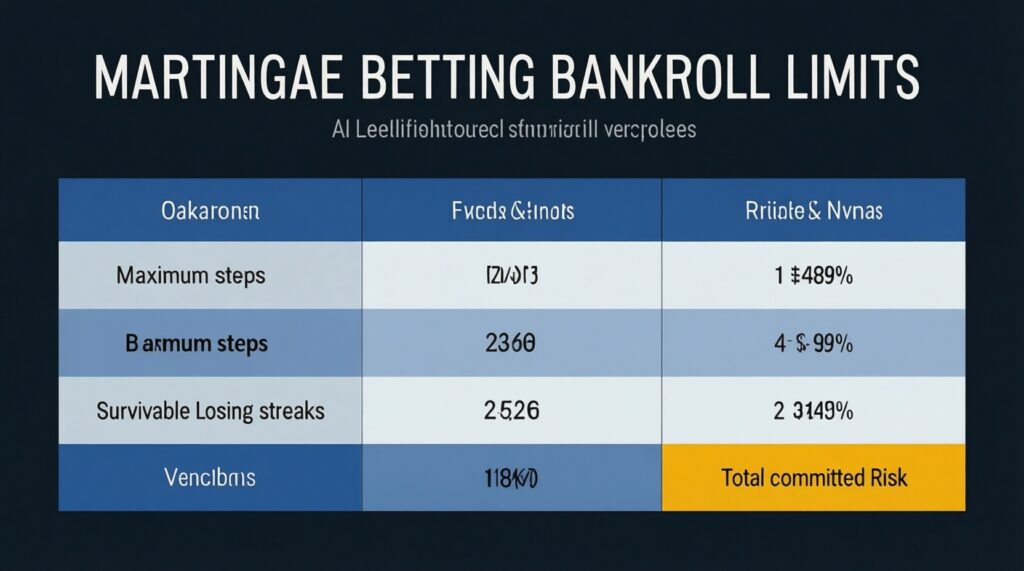
The table below is a compact way to stress-test your plan against limits. It does not predict outcomes; it shows the mechanical breaking point when losses run long enough.
| Session bankroll | Base unit | Table max | Max Martingale step you can place | Losses you can survive before forced stop | Total committed by that point | What breaks first |
|---|---|---|---|---|---|---|
| 2,000 THB | 20 THB | 1,000 THB | Step 6 (20→40→80→160→320→640) | 6 consecutive losses | 1,260 THB | Table max (next would be 1,280) |
| 2,000 THB | 10 THB | 1,000 THB | Step 7 (10→...→640→1,280 not allowed) | 7 consecutive losses | 1,270 THB | Table max (next would be 1,280) |
| 5,000 THB | 20 THB | 2,000 THB | Step 7 (...→1,280) | 7 consecutive losses | 2,540 THB | Table max (next would be 2,560) |
| 5,000 THB | 10 THB | 2,000 THB | Step 8 (...→1,280→2,560 not allowed) | 8 consecutive losses | 2,550 THB | Table max (next would be 2,560) |
- Freeze changes (read-only first): stop increasing stakes for 2-3 spins and record exact bet history and wheel type.
- Confirm the constraint: identify whether you are blocked by bankroll, table max, or chip denomination rounding.
- Cap the ladder: set a hard maximum step count for this session (e.g., stop after step N) and treat it as a predefined loss, not a "temporary setback."
- Reduce base unit immediately: if you must continue, drop base so that your remaining allowable steps fit comfortably under the table max.
- Run single-thread only: never start a second Martingale sequence while one is active; overlapping sequences multiply exposure.
- Switch to flat betting for stabilization: place fixed, small even-money bets for a short block of spins to prevent runaway commitment.
- If you insist on recovery, use a partial-recovery ladder: aim to recover a fraction of losses per win rather than all-at-once; this reduces step growth.
- Stop at the first limit warning: once the next required bet is within one step of the table max, end the sequence and log it as "limit-bound failure."
Troubleshooting Loss Streaks: Rapid Diagnosis and Response
- Escalate to casino/support if bet history shows stakes different from what you selected, late bets, or voided rounds you did not intend (provide round IDs/screenshots).
- Escalate to payment/provider support if you see duplicated debits, delayed crediting of wins, or wallet desync between game and cashier.
- Stop and reassess if you break your own cap once; rule-breaking is a stronger predictor of blow-ups than the streak itself.
- Switch tables only after diagnosing limits: moving to a different max/min without recalculating steps often recreates the same failure.
- Seek responsible gambling help if you are trying to "fix" a loss by increasing session bankroll or chasing beyond planned exposure.
Rollback Plans and Lower-Risk Alternatives
Use this rollback template mid-session before you escalate stakes or change tables. It is designed to be reversible and limit additional variance exposure.
- Rollback to baseline: return stake to base unit (or lower) and stop all progressions for a short cooling period.
- Lock configuration: one bet type only (e.g., red/black), no side bets, no coverage additions, no switching after losses.
- Set two hard stops: (a) max steps per sequence, (b) session stop-loss in units; write them down before the next spin.
- Reduce base to fit limits: ensure base × 2N is comfortably below the table max for your chosen N steps.
- Run a "safe test block": place flat bets for a small number of spins to validate UI, chip sizes, and bet recording.
- Only then consider a gentler progression: partial Martingale (recover half), 1-2-3-4 (linear), or strict flat betting.
- Session close protocol: if you hit your stop-loss or your cap once, end the session-do not restart a new ladder "to get back."
- Post-session review: log the longest losing streak, the step where pressure started, and whether the failure was bankroll-bound or limit-bound.
Practical Concerns Players Ask Most Often
Is the Martingale roulette strategy actually profitable long term?
No. It can produce many small wins, but the occasional forced stop (bankroll or table limit) dominates long-run results because the house edge remains.
What is the single biggest reason roulette table limits martingale fails?
You eventually need a bet size you are not allowed (max bet) or cannot fund (bankroll), which prevents the "one win recovers all" step.
Does European roulette make Martingale safe enough?
It's less punishing than double-zero, but it doesn't remove streak risk or the limit problem. The same mechanical failure still occurs.
How many steps should I allow before stopping?
Pick N based on what fits under the table max with a base you can afford, then treat N as a hard cap. If you can't accept that capped loss, don't run the ladder.
Is online roulette strategy martingale worse than live?
It's not inherently worse, but UI speed, misclicks, and auto-bet behavior can cause unintended stake sizes. Your bet history audit matters more online.
Can I combine Martingale with multiple outside bets to reduce variance?
Combining sequences usually increases exposure and accelerates bankroll stress. If you want lower variance, reduce base and use flat betting instead of parallel ladders.
What's the best roulette betting system if I still want structure?
For structure without explosive risk, use flat betting with strict session limits, or a mild linear progression with a cap. Avoid systems that require unlimited doubling.