
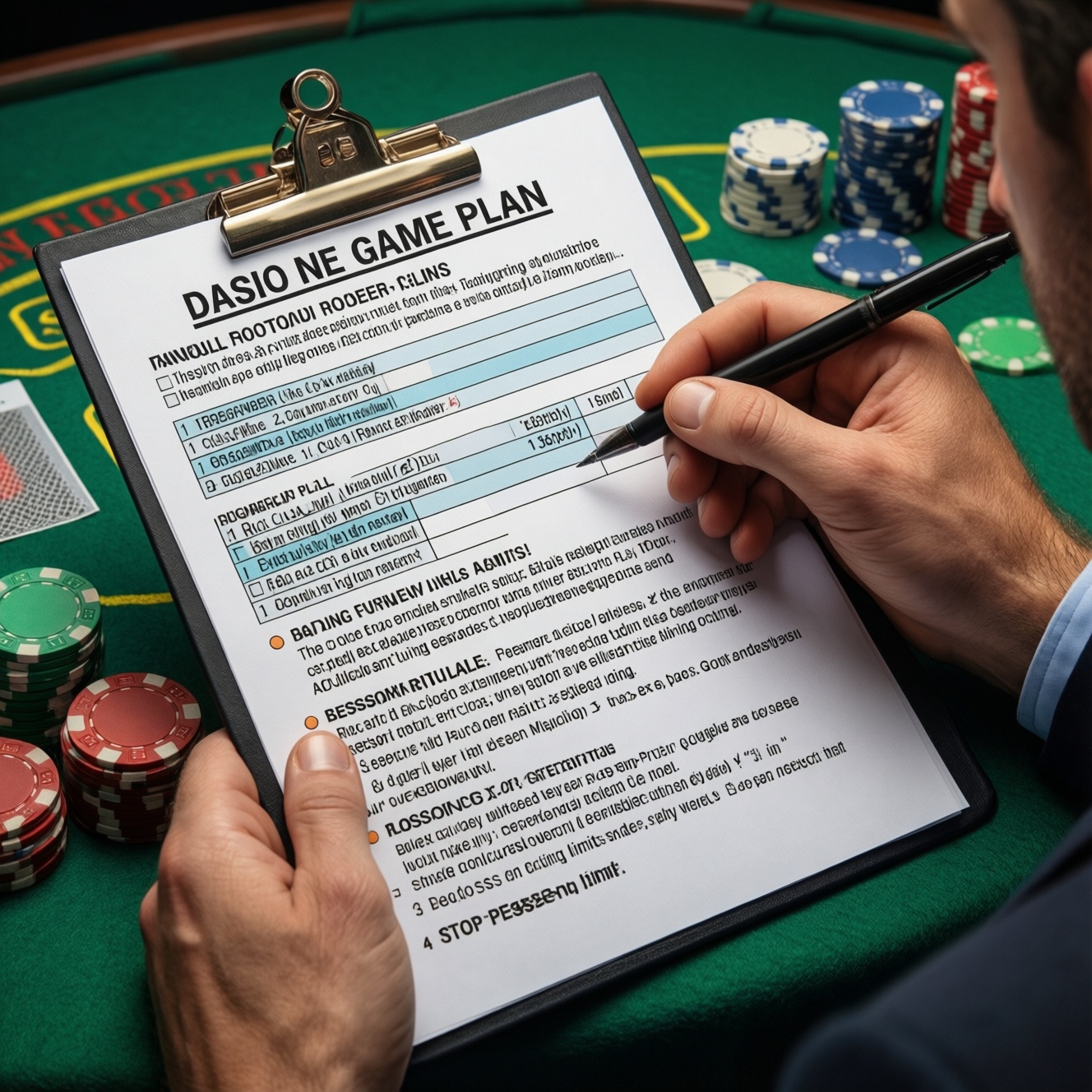
A practical casino game plan is a written routine that defines your game choices, bankroll rules, session structure, risk limits, and tracking so you can execute consistently and review results without chasing losses. Use it to standardize decisions (what to play, how much to bet, when to stop) and to measure progress with simple logs.
Quick blueprint: core components of a casino game plan

- Define your casino game selection rules (what you play, what you avoid, and why).
- Set a bankroll architecture: unit size, staking model, and time horizon.
- Run every visit as a scripted session: pre-check, timebox, and bet sequencing.
- Lock in risk controls: stop-loss, take-profit, and tilt rules you will actually follow.
- Do casino KPI tracking after each session (not "when you feel like it").
- Use casino performance analytics in a weekly review loop to adjust only what the data supports.
Choosing games: expected value, volatility, and edge comparison
This section is the decision filter for your casino game plan. It fits intermediate players who can follow fixed rules and prefer repeatable processes over "gut feel." Skip it if you can't commit to logging results, or if you're currently chasing losses-game selection logic breaks down when discipline is gone.
Selection template (copy/paste)
- Pick 1-2 "primary" games you will play for at least 80% of your sessions.
- Define volatility tolerance: low (smooth swings), medium, high (big swings). Only choose high-volatility if your bankroll rules support it.
- Write an "avoid list" of games you will not play (e.g., anything you don't understand, anything that triggers tilt, or any side bet you can't justify).
- Set an edge policy: assume the casino has an edge unless you have a legitimate, legal advantage method. Your plan should work under that assumption.
Practical "when to stop selecting and start executing" rule
- If you can explain in one sentence why your primary game matches your volatility tolerance and bankroll, stop researching and run 10 logged sessions before changing anything.
Bankroll architecture: sizing, staking models, and target horizons
You'll need: (1) a dedicated bankroll separated from life money, (2) a notes app or spreadsheet, (3) a timer, and (4) access to your casino account history (online) or a way to record buy-ins/cash-outs (land-based). Use THB (or your real currency) consistently.
Bankroll rules you can implement today
- Dedicated bankroll only: money you can afford to lose, isolated from bills and savings.
- Session allocation: cap any single session at 5%-10% of total bankroll (lower if you play high-volatility games).
- Base betting unit: set 1 unit = 0.25%-1% of total bankroll. Keep it constant for a full week of sessions.
- Staking model (choose one):
- Flat: same unit every bet (default for most players).
- Step-up/step-down: change by +1 unit only after a pre-defined trigger (not after emotion).
- Fractional Kelly (conservative): only if you can estimate an edge and variance; otherwise don't use it.
Target horizon that doesn't encourage chasing
- Time horizon: set a review period (e.g., 2-4 weeks) rather than daily "must-win" goals.
- Casino revenue targets (safe framing): treat targets as process goals (number of sessions logged, rules followed) plus a profit cap (take-profit) rather than "I must make X THB today."
Session design: pre-session checklist, timeboxing, and bet sequencing
- Pre-session gate (2 minutes) - Confirm you are playing from a dedicated bankroll, you're not trying to "get even," and you can stop on time. If any answer is "no," skip the session.
- Set timebox and hard stops - Choose a fixed duration (e.g., 45-90 minutes) and write down a stop-loss and take-profit in currency and in units before you place any bet.
- Load your session stake only - Bring/deposit only the amount you allocated for this session (e.g., 5%-10% of bankroll). Avoid topping up mid-session.
- Define bet sequencing rules - Decide your bet size and allowed changes:
- Default: flat stake at 1 unit for the whole session.
- Optional progression: adjust by ±1 unit only after a pre-written trigger (e.g., after 30 minutes, or after hitting a planned profit milestone), never after a single win/loss.
- No "recovery" bets: never jump multiple units to chase a drawdown.
- Run micro-checks every 15 minutes - Ask: "Am I within rules (time, loss, bet size)?" If not, stop immediately and log the reason.
- Close the session with a log - Record buy-in/deposit, cash-out/withdrawal, net result, time, game(s), unit size, and whether you followed rules. Do this before you leave the table/app.
Fast mode (3-5 steps)
- Pick one primary game and ban everything else for the week.
- Set unit = 0.5% of bankroll and keep it flat.
- Timebox 60 minutes with a written stop-loss and take-profit.
- No top-ups; stop at any limit or at the timer.
- Log net result + rule compliance immediately after.
Risk controls: stop-loss, take-profit, and tilt-avoidance rules
- I wrote down stop-loss before playing and I stopped when it hit (no negotiation).
- I wrote down take-profit before playing and I locked it in when it hit.
- I used a hard time limit and ended the session when the timer ended.
- I did not increase bet size to "win it back" after losses.
- I did not add funds mid-session (no reload/top-up rule).
- I avoided playing when tired, angry, or under pressure (tilt gate worked).
- I took a cooldown break (at least 24 hours) after any session where I broke a rule.
- I kept gambling separate from alcohol/other impairing substances.
Performance tracking: metrics, simple spreadsheets and automated logs
Tracking is where "I feel like I'm doing okay" becomes measurable. Your minimum viable casino KPI tracking should let you compute net profit/loss, rule compliance, and exposure by game. Use a spreadsheet or a notes table; if you play online, export account history when available.
Common mistakes that ruin your numbers
- Not recording the unit size, then comparing sessions that had different risk.
- Mixing games in one session without separating results (you can't evaluate casino game selection if everything is blended).
- Ignoring time (a 30-minute session and a 3-hour session aren't comparable without duration).
- Logging only "wins" and forgetting small losses, tips, fees, or bonuses with wagering constraints.
- Changing rules mid-week, then attributing variance to "strategy."
- Overfitting to short streaks (making changes after 1-2 sessions).
- Tracking profit but not compliance (you reward outcomes, not execution).
- Using too many metrics and maintaining none consistently.
Minimal spreadsheet columns (enough for casino performance analytics)
- Date/time
- Game
- Buy-in/deposit (THB)
- Cash-out/withdrawal (THB)
- Net (THB)
- Session minutes
- Unit size (THB)
- Max bet (units)
- Stop-loss hit? (Y/N)
- Take-profit hit? (Y/N)
- Rules followed? (Y/N + note)
Review loop: data-driven tweaks, A/B testing and progression rules
Your review loop decides whether to keep, tweak, or pause the plan. Make changes on a schedule (weekly or bi-weekly), not mid-session. This is where you translate tracking into action without chasing variance.
Four alternatives for improving the plan (use the one that matches your situation)
- Stability-first freeze - Best when you're inconsistent. Keep the same game, unit, and timebox for the next block; only fix rule-breaking behaviors.
- Single-variable A/B test - Best when you have enough logs. Change exactly one variable (e.g., timebox 60 vs 90 minutes) for a defined set of sessions, then compare net and compliance.
- Progression rules with guardrails - Best when you want controlled scaling. Only increase unit size by 10%-25% after a full review period where you followed rules and stayed within stop-loss limits.
- Game rotation policy - Best when you suspect volatility mismatch. Keep bankroll and session rules constant, but rotate one game at a time (primary game only) and log results separately.
Practical questions on executing and adapting your plan
How do I choose a primary game without overthinking?
Pick one game you understand, can play calmly for 60 minutes, and can log cleanly. Commit for a fixed block of sessions before changing.
What's a safe way to set casino revenue targets?
Use process targets (sessions logged, rules followed) and a take-profit cap rather than a daily must-hit number. This avoids chasing behavior when variance is negative.
How often should I update my staking unit?
Update on a schedule (weekly or bi-weekly), not after a single win/loss. If you change the unit, note the date so your tracking stays comparable.
What if I break my stop-loss rule?
End the session immediately and log what triggered the breach. Add a 24-hour cooldown and reduce next session's allocation until you complete several rule-perfect sessions.
Do I need advanced tools for casino performance analytics?
No-start with a simple spreadsheet and consistent columns. Automations help later, but only after you've proven you can log every session.
How many games should be in my casino game plan?
One primary game plus one optional secondary game is enough for most intermediates. More games usually reduces data quality and increases impulsive switching.
How do I know my casino game selection is wrong?
If you repeatedly violate risk limits, feel compelled to chase, or the game's swings exceed your bankroll rules, it's a mismatch. Adjust volatility exposure before changing everything else.