

Progressive jackpots only improve expected value (EV) by the tiny amount your bet contributes to the growing prize multiplied by the chance you win it. A "big prize" can still be negative EV when the win probability is extremely small, when the jackpot is capped, or when the incremental jackpot value you're buying per spin is less than the game's base house edge.
EV Snapshot: when a growing jackpot alters the math
- Progressives add an EV "top-up" equal to (your probability of hitting the jackpot) × (current jackpot value), adjusted for any fixed seed already baked into the base RTP.
- A bigger displayed jackpot does not automatically mean positive EV; the relevant piece is the excess over the reset/seed and any caps.
- For a progressive jackpot online casino game, the breakeven point is a specific jackpot size where the added jackpot EV offsets the base negative EV.
- Even when EV turns positive, variance can dominate; bankroll and stop rules matter more than "value hunting."
- Operational terms (caps, eligibility, max bet requirements, must-be-present rules) often prevent converting theoretical EV into practical EV.
How progressive jackpots are funded and tracked
A progressive jackpot is funded by diverting a defined portion of each qualifying wager into a shared pool; the displayed amount tracks that pool plus any seed/reset amount and sometimes promotional top-ups. This approach can fit intermediate players who can read paytables/terms and model EV, and who can keep disciplined bankroll limits.
Skip progressives when any of the following is true:
- You cannot confirm eligibility rules (minimum bet, max lines, excluded features, bonus-play restrictions).
- The jackpot is capped or "must hit by" in a way you can't quantify from terms or observable behavior.
- You intend to chase by increasing stakes beyond your bankroll plan just to "feel closer."
- You're choosing a game solely because it is marketed as one of the best progressive jackpot slots without checking the incremental EV math.
Integrating jackpot contribution into expected value models
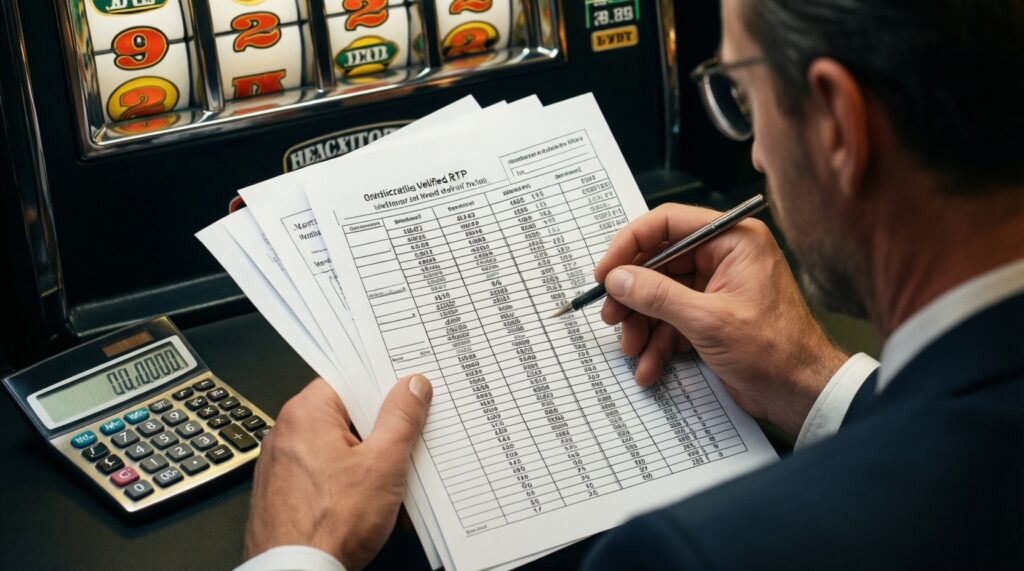
To model EV safely and realistically, you need inputs you can actually verify. Avoid guessing hidden probabilities.
- Base game payout model: either the published paytable with probabilities (rare) or a documented RTP/return figure for the base game excluding the progressive component (often described in terms).
- Jackpot mechanics: current displayed jackpot J, reset/seed value J0 (if stated), any cap Jcap, and qualifying bet rules.
- Hit probability for the jackpot event: p per $1 of qualifying stake (or per spin at a defined stake). If p isn't stated, you can only do scenario analysis, not a precise EV claim.
- Contribution rate (optional but helpful): c (portion of each $1 wager added to the progressive pool). If unknown, you can still model EV using p and the observed J.
- House edge of the non-jackpot portion: h where base EV per $1 is EVbase = -h.
Compact formula (per $1 of qualifying wager):
EVtotal = -h + p × (J − J0)
- Use (J − J0) because the seed/reset is typically already accounted for in the baseline economics (or is not "new value" you are buying by waiting).
- If the terms clearly say the base RTP excludes the progressive entirely, then J0 can be set to 0 for the incremental model.
Practical note for players who play progressive slots for real money: you must model EV per qualifying stake unit that the rules actually count (e.g., max bet only), otherwise your p and your wager unit won't match.
Threshold analysis: jackpot sizes that flip negative EV to positive
-
Define your wager unit and confirm it qualifies.
Make sure your chosen bet size/lines/feature toggles are eligible for the progressive. If eligibility requires max bet, your "per spin" EV must be computed at that max bet, not at a lower test stake.- Check: minimum bet, max bet requirement, excluded bonus buys, excluded free spins, and multi-denomination quirks.
-
Separate base EV from progressive EV.
Write down h (house edge) for the non-progressive part per $1. If you only have an overall RTP figure that already includes the progressive at an assumed average jackpot, treat it as unsuitable for threshold work unless you can reverse-engineer the assumption. -
Set the jackpot "excess value" you are actually buying.
Compute Jexcess = min(J, Jcap) − J0. If there's a cap, anything above it adds no EV. -
Plug in jackpot hit probability as a scenario if it's unknown.
Use p if stated. If not stated, choose a range (e.g., optimistic, neutral, pessimistic) and compute a threshold jackpot for each scenario. This keeps the method safe: you won't accidentally "prove" positive EV using an invented probability. -
Solve for the breakeven jackpot.
Set EVtotal = 0 and solve:Jbreakeven = J0 + h / p
If Jbreakeven is above the cap, the game cannot become +EV under that p and h.
-
Apply real-world constraints before acting.
If the computed threshold looks reachable, sanity-check practical items: bet size volatility, time-on-device, session limits, and whether you can withstand long losing streaks without changing behavior.
Fast mode: 60-second decision algorithm
- Confirm your bet qualifies for the progressive under the current rules.
- Compute Jexcess = min(J, Jcap) − J0.
- Estimate EVtotal = -h + p × Jexcess (or do 2-3 scenarios for p).
- If EVtotal is near zero, treat it as negative after friction (limits, errors, changing terms).
- Only proceed with a fixed bankroll and a stop rule; never "martingale" a progressive.
Worked examples: slot and lottery scenarios with tables
The examples below are illustrative. Replace the inputs with values from the game's terms and your verified assumptions.
Example A (slot-style progressive): one jackpot tier
Assumptions (illustrative): base house edge h = 0.04 per $1; jackpot hit probability p = 1 / 5,000,000 per $1; reset/seed J0 = 50,000; no cap for simplicity.
Breakeven: Jbreakeven = 50,000 + 0.04 / (1/5,000,000) = 50,000 + 200,000 = 250,000.
Below 250,000 the game remains negative EV (in this illustrative scenario), even if it is marketed among the highest paying progressive jackpot slots.
Example B (lottery-style rollover jackpot): rare hit, huge prize
Assumptions (illustrative): ticket price normalized to $1; base EV excluding jackpot -h = -0.50; jackpot win probability p = 1 / 100,000,000; seed J0 = 0.
Breakeven: Jbreakeven = 0 + 0.50 / (1/100,000,000) = 50,000,000.
This shows the core point: "big prizes" can still mean negative EV until the jackpot crosses a very high threshold because p is so small.
| Scenario | Wager unit | Base EV per $1 (−h) | Jackpot hit prob (p) | Excess jackpot term | EV effect of progressive | Breakeven jackpot |
|---|---|---|---|---|---|---|
| Slot-style progressive | $1 qualifying stake | Negative (example: −0.04) | Per $1 (example: 1/5,000,000) | (J − J0) | + p × (J − J0) | J0 + h/p (example: 250,000) |
| Lottery-style rollover | $1 ticket equivalent | More negative (example: −0.50) | Per ticket (example: 1/100,000,000) | J (seed 0) | + p × J | h/p (example: 50,000,000) |
Checklist to verify your result before you act
- I used a wager unit that actually qualifies for the progressive (bet size, lines, denom).
- I used Jexcess (net of reset/seed and caps), not the headline jackpot alone.
- I did not mix "per spin" probabilities with "per $1" probabilities.
- I considered whether my chosen game's progressive is shared network-wide (faster growth) or local (slower growth), without assuming either implies better EV.
- I checked any max win limits that would truncate the jackpot payout.
- I checked whether side bets or feature buys are excluded from progressive eligibility.
- I treated borderline positive EV as negative after practical friction (errors, changing terms, limited playtime).
- I confirmed the online casino progressive jackpot payout rules: presence requirements, identity verification, and any time limits to claim.
Variance, ruin probability and bankroll planning around progressives
- Confusing "positive EV" with "likely profit." A tiny p means outcomes are dominated by long losing stretches even when EV is slightly positive.
- Overbetting to "speed up" jackpot exposure. EV scales linearly with stake, but your risk of bankroll depletion scales brutally with volatility.
- Ignoring bet-qualification rules. Many players compute EV at a low stake, then discover only max bet qualifies.
- Chasing after near-misses. Near-miss design changes feelings, not probabilities; it should not change your threshold.
- Assuming the best progressive jackpot slots are best for EV. "Best" can mean marketing, entertainment, or popularity, not a favorable h/p threshold.
- Not setting a pre-commitment stop rule. Decide in advance: session budget, maximum time, and whether you quit when conditions change (cap reached, terms updated).
- Misreading "highest paying" claims. A game can be described as the highest paying progressive jackpot slots based on occasional huge wins while still being structurally negative EV for typical jackpot sizes.
- Forgetting opportunity cost. If you can play a lower-edge non-progressive option, the progressive must beat that alternative, not merely exceed zero in a fragile model.
Operational limits: caps, time decay and casino countermeasures
If the progressive threshold is unreachable or uncertain, these alternatives are often more practical:
- Pick lower-edge fixed-payout games instead of chasing progressives when you cannot validate p or when caps make Jbreakeven impossible.
- Use promotional overlays (bonuses, cashback) only when terms are clear and you can model the effective EV without relying on an unverified jackpot hit rate.
- Target transparent "must-drop-by" mechanics only if the rule is explicit (published drop range and qualifying conditions). If the range is not explicit, treat it as unknowable.
- For entertainment sessions, cap losses and treat the jackpot as a bonus-especially when you just want to play in a progressive jackpot online casino without doing continuous EV monitoring.
Practical edge cases and short clarifications
Does a larger displayed jackpot always mean better EV?
No. EV depends on the incremental jackpot value you're buying (often J − J0 and subject to caps) times the win probability, not the headline amount alone.
What if I don't know the jackpot hit probability?
Then you cannot claim positive EV; you can only compute breakeven jackpots across a range of plausible p values and decide whether any scenario is realistic under the rules.
Do max bet requirements change the math?

Yes. Your p is tied to the qualifying stake; if only max bet qualifies, compute EV at max bet or treat the progressive EV as zero for smaller bets.
Is "online casino progressive jackpot payout" the same as EV?
No. Payout rules determine whether you can actually collect (eligibility, claim windows, verification), while EV is a mathematical expectation assuming the payout occurs when you win.
Can I infer EV from "best progressive jackpot slots" lists?

Not reliably. Those lists rarely provide the parameters you need (h, p, J0, caps), so treat them as entertainment recommendations, not value evidence.
Does choosing "highest paying progressive jackpot slots" guarantee higher returns?
No. A game can have very large occasional payouts and still have negative EV at typical jackpot sizes if the hit probability is extremely small or the base edge is high.
Should I play longer when the jackpot is near my breakeven?
Only if you can keep stake, time, and bankroll discipline unchanged. If nearing breakeven makes you increase bet size or extend beyond planned limits, the practical risk can outweigh the theoretical edge.