

Blackjack odds shift mainly because rules change how often you get paid more (blackjack payout) and how often the dealer can improve or you can recover (soft-17, doubling, splitting, surrender). If you want better blackjack odds by rules, choose tables where player-friendly options stack together and avoid any single rule that heavily cuts high-value outcomes.
How specific rules shift the player advantage
- If the table pays blackjack 3:2, then your best hands keep their full value; if it pays 6:5, then your long-run return drops even if everything else looks identical.
- If the dealer stands on soft 17, then the dealer stops improving certain totals; if the dealer hits soft 17, then the dealer realizes more equity from A+6 type hands.
- If fewer decks are used (with similar dealing depth), then your strategy is slightly more efficient and certain player actions gain; if more decks are used, then the baseline house edge trends against you.
- If surrender and flexible doubling/splitting are allowed, then you get more "escape hatches" and leverage points; if they are restricted, then you eat more negative-EV forced plays.
- If penetration is deeper (more of the shoe dealt), then outcomes are less "reset" by frequent shuffles and counting-based edges become more feasible; if penetration is shallow, then volatility stays but opportunity shrinks.
Myths about rule impact - headliners debunked
Myth: "Only basic strategy matters; rules are minor."
Reality: Basic strategy is the baseline, but rules set the baseline itself. If two tables both allow perfect play, then the one with weaker rules still yields worse results because the game's payoff map changed.
Myth: "Decks don't matter if you're not counting."
Reality: Even without counting, deck count shifts the frequency of naturals, blackjacks-vs-21 comparisons, and composition-sensitive doubles/splits. If you compare blackjack house edge by number of decks, then you're comparing real structural differences, not superstition.
Myth: "H17 vs S17 is basically the same."
Reality: It's a systematic dealer advantage because it adds a dealer action in a range where the dealer is not yet bust-prone. If the dealer hits soft 17, then more dealer hands improve to strong totals and some pushes turn into dealer wins.
Myth: "6:5 is fine if limits are lower or the table is 'hot'."
Reality: Heat doesn't change arithmetic. If you play long enough, then the reduced premium on your best event (a natural blackjack) dominates any short-term variance.
Dealer stands on soft 17: exact effects on expected value
Soft 17 means the dealer has A+6 (or equivalent soft total) and can't bust by drawing one small card because the Ace can drop from 11 to 1. The rule is:
- If the dealer stands on soft 17 (S17), then the dealer freezes at that total and you keep more wins from dealer "stagnation."
- If the dealer hits soft 17 (H17), then the dealer takes one more card on A+6, creating extra chances to land on 18-21.
- If you're deciding between similar tables, then treat S17 as a meaningful player-friendly upgrade even when other rules match.
- If you see H17, then expect some borderline player doubles to lose a bit of value because the dealer's finish is stronger more often.
- If your goal is "clean" rule selection, then prioritize S17 before chasing side conditions (like minor variations in splitting limits).
In practical terms for dealer stands on soft 17 blackjack odds: if S17 is available at comparable stakes, then it's usually the better default because it reduces the dealer's improvement pathway without costing you any options.
Blackjack payout variations and their EV consequences
The blackjack payout is the single most visible lever because it changes the premium paid on a natural (Ace + 10-value card). This is exactly what players mean when comparing 3 to 2 vs 6 to 5 blackjack payout.
- Low-limit "mass market" tables: If you see 6:5 on the felt, then assume the game is materially worse even if it advertises other friendly rules (like doubling after split).
- Online live dealer lobbies: If you filter by payout first, then you remove the biggest trap quickly; only then compare S17/H17 and surrender.
- High-limit rooms or VIP pits: If the table is 3:2 but adds restrictions (no DAS, no re-splits), then evaluate the package-3:2 is necessary but not always sufficient for the best blackjack rules lowest house edge.
- "Promo" variants: If the game offers bonus side payouts but downgrades the main blackjack payout, then treat the main payout downgrade as the core EV change unless you have a specific, proven side-bet edge.
If you need a quick decision rule: if payout is 6:5, then walk unless you are playing purely for entertainment and accept a worse baseline.
| Rule / table condition | Effect on player odds (direction) | If..., then... recommendation |
|---|---|---|
| Blackjack pays 3:2 | Improves player EV versus reduced payouts | If you can choose, then lock in 3:2 first before comparing secondary rules. |
| Blackjack pays 6:5 | Worsens player EV materially | If it's 6:5, then treat it as a "do not play" flag for serious odds-seeking. |
| Dealer stands on soft 17 (S17) | Improves player EV versus H17 | If you see S17 at similar limits, then prefer it over H17. |
| Dealer hits soft 17 (H17) | Worsens player EV versus S17 | If only H17 is available, then compensate by insisting on 3:2 and strong player options (LS, DAS). |
| Fewer decks (all else equal) | Tends to improve player EV | If penetration is comparable, then prefer fewer decks. |
| More decks (all else equal) | Tends to worsen player EV | If you must play many decks, then prioritize surrender/DAS and avoid 6:5. |
| Late surrender available | Improves player EV | If late surrender exists, then use it on the standard high-loss matchups and avoid "never surrender" ego plays. |
Deck count, penetration and the math of variance
Deck count changes the underlying card distribution and slightly shifts the value of many borderline actions. Penetration (how much of the shoe is dealt before shuffle) affects how stable the environment is for decision-making across many hands.
What improves your long-run position
- If you can choose between similar rulesets, then prefer fewer decks as a baseline (this is the intuition behind comparing blackjack house edge by number of decks).
- If penetration is deeper, then the shoe behaves less like a constant reset; this matters most if you use any counting or shuffle-tracking, but it also reduces "rule noise" from frequent shuffles.
- If you care about bankroll swings, then remember: fewer decks can increase sensitivity to composition, which may slightly change variance patterns hand-to-hand.
Constraints that stop decks from being the only decision factor
- If a single-deck game pays 6:5, then the payout downgrade can outweigh the "single deck" label.
- If the cut card is placed very early (shallow penetration), then the practical value of a good deck count is reduced.
- If doubling/splitting rules are restrictive, then even a good deck count won't rescue the overall package.
Table conditions: surrender, doubling and splitting rules quantified
This is where intermediate players leak EV: not by missing obvious hits/stands, but by overvaluing flashy options and undervaluing the few options that consistently remove downside.
- If late surrender is offered, then it is usually one of the cleanest EV boosts because it caps losses on the worst matchups; if it's not offered, then accept higher forced-loss frequency on those hands.
- If double after split (DAS) is allowed, then your split hands regain leverage; if DAS is not allowed, then some splits lose their upside and your recovery after a split is weaker.
- If re-splitting Aces is allowed, then you reduce the penalty of being dealt multiple Aces; if Aces can't be re-split (and especially if you get only one card per Ace), then treat Ace splits as more constrained value plays.
- If the table limits doubling (e.g., only on certain totals), then your strongest advantage plays are partially removed; if doubling is flexible, then you can press edges when your hand is favored.
- If you're comparing two tables and one offers many "extra" options but pays 6:5, then the extra options rarely compensate for the payout loss in a neutral, non-advantage setting.
Synthesizing rules into a single house-edge model
You can compare tables without memorizing exact decimals by using a simple "rule delta" checklist: start from a baseline ruleset and add or subtract small adjustments in your head. The goal is consistency, not perfect precision.
A practical "if..., then..." selection algorithm
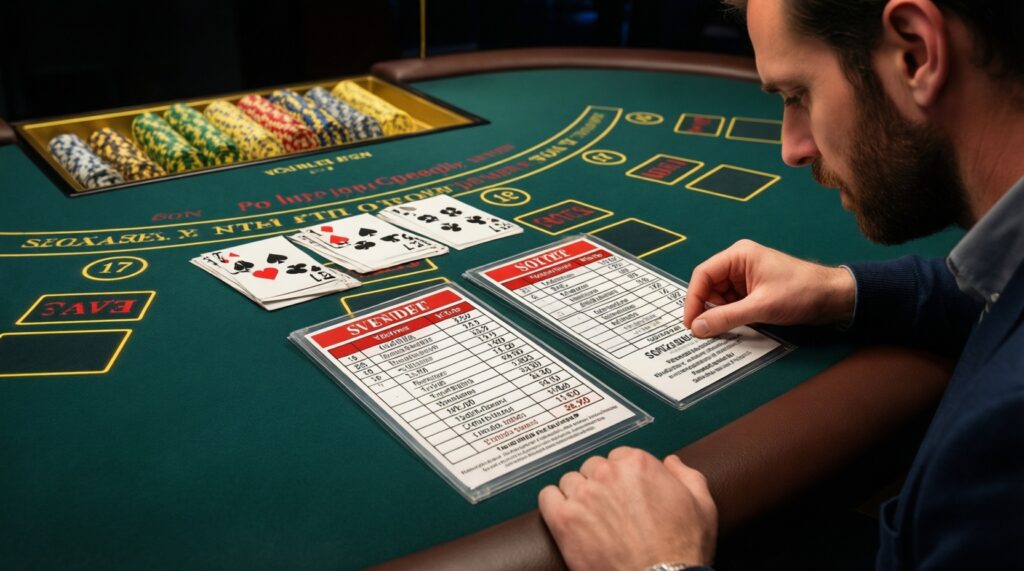
- If blackjack payout is 6:5, then reject the table and stop evaluating.
- If payout is 3:2, then continue and check soft-17: if S17, then mark it as better than H17.
- If surrender exists, then mark the table up; if it doesn't, then require stronger remaining rules to compensate.
- If DAS and re-splits are allowed, then mark the table up; if splitting is heavily restricted, then mark it down.
- If deck count is lower and penetration is reasonable, then prefer it; if deck count is high, then insist on the best remaining rules to offset it.
Mini pseudo-code you can apply in a Thai context (online or travel play)
Use it as a mental model when scanning lobbies or reading table placards:
score = 0
if payout == "6:5": reject
if payout == "3:2": score += 3
if dealer_rule == "S17": score += 1 else score -= 1
if late_surrender: score += 1
if DAS: score += 1
if resplit_aces: score += 0.5
if decks <= 2: score += 1 else if decks >= 6: score -= 0.5
choose table with highest score among similar limits
If you apply this consistently, then you will converge on the best blackjack rules lowest house edge available to you, even when exact posted edges are not provided.
Practical player questions and concise answers
How do I quickly compare blackjack odds by rules without doing math at the table?
If the game is 6:5, then skip it; otherwise prefer 3:2, S17, and late surrender. If two tables are similar, then use DAS and re-splitting Aces as tie-breakers.
What does dealer stands on soft 17 blackjack odds mean in practice?
If the dealer stands on soft 17, then the dealer stops on A+6 instead of drawing, which removes some dealer improvement paths. If the dealer hits soft 17, then expect slightly tougher dealer finishes.
Is 3 to 2 vs 6 to 5 blackjack payout really that important?
Yes: if blackjack pays 6:5, then your best-paying common event is permanently discounted. If it pays 3:2, then your natural retains its intended premium.
How should I think about blackjack house edge by number of decks?
If rules are otherwise the same, then fewer decks generally favor the player slightly. If the multi-deck game compensates with strong player options (S17, surrender, DAS), then it can still be the better choice.
What's the most common intermediate mistake with surrender?
If surrender is available, then not using it on the worst matchups is a leak. If you "never surrender," then you're choosing higher forced-loss frequency for no strategic gain.
If two tables are both 3:2, what rule should I check next?
If one is S17 and the other is H17, then take S17. If both match, then choose the one with late surrender and DAS.