

The Fibonacci betting system in roulette is a negative progression that increases your next wager using Fibonacci numbers after losses and steps back after wins, aiming to recover recent losses with a modest profit. It can feel smoother than Martingale, but volatility still spikes during long losing streaks, and bankroll/stop rules determine whether it remains controlled.
Core conclusions on the Fibonacci roulette progression
- The fibonacci roulette betting system reduces jump size versus doubling systems, but it does not change the game's house edge.
- Progression control comes from strict caps (max step, max loss, max time), not from the sequence itself.
- Most players misunderstand the "two steps back after a win" rule; applying it inconsistently increases risk.
- Use even-money bets (red/black, odd/even) for cleaner sizing; avoid high-variance bets while progressing.
- Long losing runs are where the system breaks down: required bet sizes can exceed table limits or your bankroll.
- If you want a "best roulette betting system fibonacci" experience, treat it as a staking plan for entertainment, not an advantage method.
How the Fibonacci sequence maps to bet sizing
The core idea of a fibonacci progression roulette strategy is simple: your bet size follows Fibonacci units after each loss (1, 1, 2, 3, 5, 8, 13, ...). On a win, most versions move back two steps to reduce exposure while still trying to end a cycle net-positive.
Numeric example (even-money bet, unit = 10 THB): If you lose 10, lose 10, lose 20, then win at 30, you typically step back two positions (from "3" to "1") and bet 10 next, rather than restarting at the beginning. That rule is what keeps the system from escalating as fast as pure "recover everything now" plans.
Who it fits: intermediate players who can track steps accurately and accept that streaks happen.
When not to use it: if you dislike drawdowns, if table limits are tight, if you play fast (mis-tracking risk), or if you're tempted to "override" the progression after losses.
Mathematical rationale: expected value and variance
Fibonacci staking changes the distribution of outcomes (variance), not the expected value (EV). Roulette outcomes remain independent; a progression cannot create a positive EV in a negative-EV game.
- Expected value (conceptually): EV per spin = (probability of win × win amount) − (probability of loss × loss amount). Changing bet size changes the amount, not the underlying probabilities.
- Variance effect: the system clusters many small bets with occasional larger "catch-up" bets; this can feel steady until a losing run pushes you into higher steps.
What you'll need (tools and access):
- A clear unit size you can afford to lose (e.g., 10 THB or 20 THB).
- A notes app or paper to track your current Fibonacci step without guessing.
- A table-limit check before you start (min bet, max bet).
- If you play a fibonacci roulette strategy online casino, ensure the interface shows bet history clearly and that you can place exact unit multiples quickly.
- Optionally, a fibonacci betting system roulette calculator (simple spreadsheet) to precompute the next 10-15 steps in your currency.
Numeric example (simple equation): If your unit is U and your current step is Fk, your next bet is B = U × Fk. With U = 20 THB and F6 = 8, B = 160 THB.
Practical bankroll planning and stop‑loss rules
- Risk you cannot remove: a long losing streak can force bets that exceed your bankroll or the table maximum.
- Operational risk: one tracking error (wrong step, wrong backtracking) can turn a controlled session into an uncontrolled one.
- Behavioral risk: overriding the plan after losses ("one big bet to get even") is how most progressions implode.
- Liquidity risk: playing too many concurrent progressions (multiple outside bets) multiplies exposure.
-
Set your base unit and session budget.
Choose a unit you can repeat many times without stress, then set a hard session budget you will not reload.- Practical guideline: keep the unit small enough that step 8 or 13 is still placeable and emotionally tolerable.
Numeric example: If you can only tolerate a single 200 THB bet, then with a 20 THB unit you should cap at step "8" (20×8=160) and avoid reaching "13" (20×13=260).
-
Pick one bet type and stick to it for the entire cycle.
Use one even-money outside bet (red/black, odd/even, high/low) and don't switch mid-cycle based on "feel".Numeric example: If you start on red, you stay on red for that progression cycle; switching after two losses creates an untracked hybrid strategy.
-
Define your progression rules before the first spin.
Use a clear rule set: after each loss move +1 step; after each win move −2 steps; if you go below step 1, reset to step 1.Numeric example: Steps: 1,1,2,3,5. If you're at "5" and win, you move back to "2" next (two steps back).
-
Set a maximum step (hard cap) and a stop-loss.
Decide the highest Fibonacci number you will play (e.g., stop at 13) and stop the session immediately if you hit it and lose.- This prevents "just one more step" behavior when the next bet becomes disproportionately large.
- If your table limit is lower than your cap, the table limit becomes your real cap.
Numeric example: Cap at 13 units: if you reach 13 and lose, you stop-even if the next number is 21 and you technically "could" bet it.
-
Set a profit target and a time limit.
End sessions quickly when ahead; the longer you play, the more you expose yourself to the streak that breaks your cap.- Use a small profit target in units (e.g., +5 units) rather than "win back everything".
Numeric example: With a 10 THB unit, a +5 unit target is +50 THB; once reached, stop and record the result.
-
Track each spin and record the peak step reached.
Your peak step is the best indicator of whether your unit is too large or your cap is too ambitious.Numeric example: If you frequently peak at 8 or 13 in short sessions, reduce your unit or shorten your session length.
Volatility patterns across streaks and run lengths
Volatility in Fibonacci staking is driven by loss clusters. You may see many small wins, but your risk concentrates when the progression climbs. Treat this checklist as your "session health" monitor.
- You can state your current step instantly without re-counting.
- Your next bet is within both bankroll tolerance and the table max.
- You have not increased the unit size mid-session.
- You are not running multiple Fibonacci progressions on different bets at the same time.
- You have hit neither your max step nor your stop-loss trigger.
- Your last win moved you back exactly two steps (not to "restart" unless your rules say so).
- Your profit target is still realistic; you are not extending play just because you're slightly down.
- Your peak step today is within your planned comfort zone (if it isn't, reduce unit or quit).
Numeric example: If your cap is 13 and you're already at step 8 after a short run, your remaining "risk runway" is small; stopping early is a rational choice, not a failure.
Failure modes: when and why the progression collapses
- Chasing past the cap: continuing to 21/34 units after hitting your planned maximum step.
- Unit inflation: increasing U after losses ("I'll raise the unit to recover faster"), which breaks your bankroll math.
- Wrong backtracking: moving back one step instead of two (or resetting too often), changing the risk profile without noticing.
- Switching targets mid-cycle: changing from red to black (or odd to even) because of perceived patterns.
- Ignoring table constraints: reaching a required bet larger than table max, forcing a stop at the worst moment.
- Multiple simultaneous progressions: placing two or three outside bets each with its own Fibonacci ladder.
- Adding side bets: sprinkling straight-up or dozen bets "for fun" while already in a drawdown.
- No time stop: sessions that drift long enough for a severe streak to appear.
Numeric example: If your table max is 2,000 THB and your unit is 100 THB, you cannot safely progress past 13 (1,300 THB) without risking a forced stop at 21 (2,100 THB) due to limits.
Simulation outcomes and a comparative results table
Without assuming any special edge, comparisons should focus on mechanics: escalation speed, drawdown shape, and how often you collide with limits. If you're searching for the best roulette betting system fibonacci, use this table to choose a plan that matches your risk constraints rather than expecting consistent profit.
| Approach | Escalation after losses | Typical drawdown shape | Limit/cap pressure | When it can be appropriate |
|---|---|---|---|---|
| Fibonacci progression (−2 steps on win) | Moderate (1, 1, 2, 3, 5, 8, 13...) | Often small swings, with occasional sharp spikes | Medium; spikes appear on long streaks | Players who want structured staking and strict stop rules |
| Flat betting (constant unit) | None | Linear; no escalation-driven shock | Low | Bankroll preservation, simplest execution, lowest tracking risk |
| Martingale (double after loss) | Very fast (1, 2, 4, 8, 16...) | Long small gains punctuated by rare, very large losses | Very high; table max hit quickly | Rarely suitable; only for very small units and very strict caps |
| D'Alembert (+1 unit after loss) | Slow, linear | Smoother than Fibonacci, slower recovery | Low to medium | Players prioritizing stability over fast "recovery" attempts |
Numeric example: With a 10 THB unit, Fibonacci reaches 130 THB at step 13, while Martingale reaches 1,280 THB at the 8th bet (10×27). That difference explains why Fibonacci feels calmer-until a streak pushes it into higher steps.
Practical concerns and concise clarifications for users
Does the Fibonacci roulette betting system beat the house edge?
No. It only changes bet sizing over time; it cannot change roulette's underlying probabilities.
What is the correct "win rule" in a fibonacci progression roulette strategy?
A common rule is: after a win, move back two Fibonacci steps; after a loss, move forward one. Use one rule consistently for the whole session.
Is it safe to use a fibonacci roulette strategy online casino with auto-spin?

It's riskier because speed increases tracking errors and makes it easier to overrun your stop-loss. If you use auto-spin, keep it slow and pause after every resolved bet to confirm your step.
What should I do when I hit my maximum step?
Stop the session if you reach the cap and lose. If you reach the cap and win, step back per your rules, but do not raise the cap mid-session.
Can I run two progressions at once (e.g., red/black and odd/even)?
It's not recommended; it multiplies exposure and tracking complexity. If you do it anyway, treat them as separate caps and separate stop-losses.
Do I need a fibonacci betting system roulette calculator?
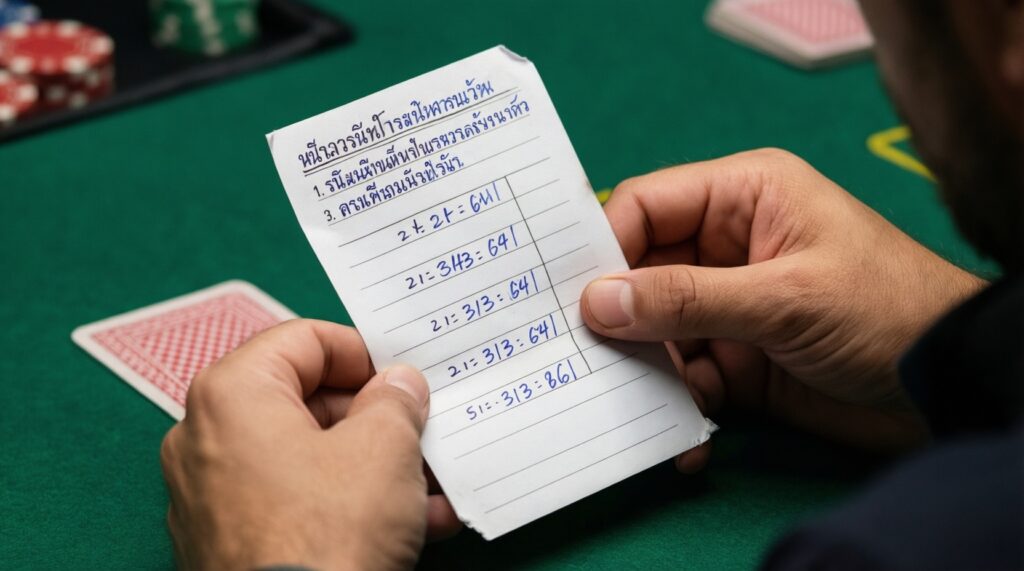
It's optional, but helpful for precomputing bet sizes and avoiding mental math mistakes. A simple list of the next 10 steps in THB is usually enough.
What's the fastest way this strategy breaks down in practice?
Overriding your plan after losses-especially increasing the unit or extending beyond your max step-is the most common failure mode.