
If your goal is the highest long-run value, choose European roulette over American: the single-zero wheel has a lower house edge and higher RTP, so every bet loses less on average. American roulette adds a double zero, which worsens expected value and makes bankroll requirements stricter for the same strategy, especially when you play European roulette online or online roulette real money.
Quick comparative summary for players
- European roulette vs American roulette: the extra 00 in American is the main driver of a worse house edge.
- If you care about expected value (EV) and bankroll efficiency, European is usually the best roulette game European or American.
- For identical bet types, the variance profile is similar, but the negative drift (house edge) is higher in American.
- Betting systems (Martingale/Fibonacci) do not change the edge; they only reshape volatility and risk-of-ruin.
- Prefer rules like La Partage/En Prison when available; they improve EV on even-money bets compared to standard rules.
Wheel mechanics and one-zero difference: what changes between European and American
- Number of pockets: European has 37 (0-36); American has 38 (0-36 plus 00). More pockets with the same payouts means a worse EV.
- Zero structure: Single zero (0) vs double zero (0 and 00) changes the probability mass that beats all non-zero outcomes.
- House edge baseline: The standard edge is structurally baked into the wheel; it is not negotiable via strategy.
- RTP comparison: Higher RTP in European because fewer losing outcomes exist for any given bet type at the same payout schedule.
- Even-money rule variants: Some European tables apply La Partage or En Prison on red/black, odd/even, high/low; American tables less often do.
- Table limits: Lower max limits reduce how far progression systems can run before a forced stop; this matters more on higher-edge games.
- Bet menu consistency: Core bets (inside/outside) are similar, but some side bets (e.g., Top Line in American) are unique and typically high-edge.
- Live vs RNG implementation: Live wheels tend to be clearly labeled (European/American); RNG games may include rule toggles (e.g., En Prison) that materially affect EV.
Numeric house-edge breakdown with illustrative table
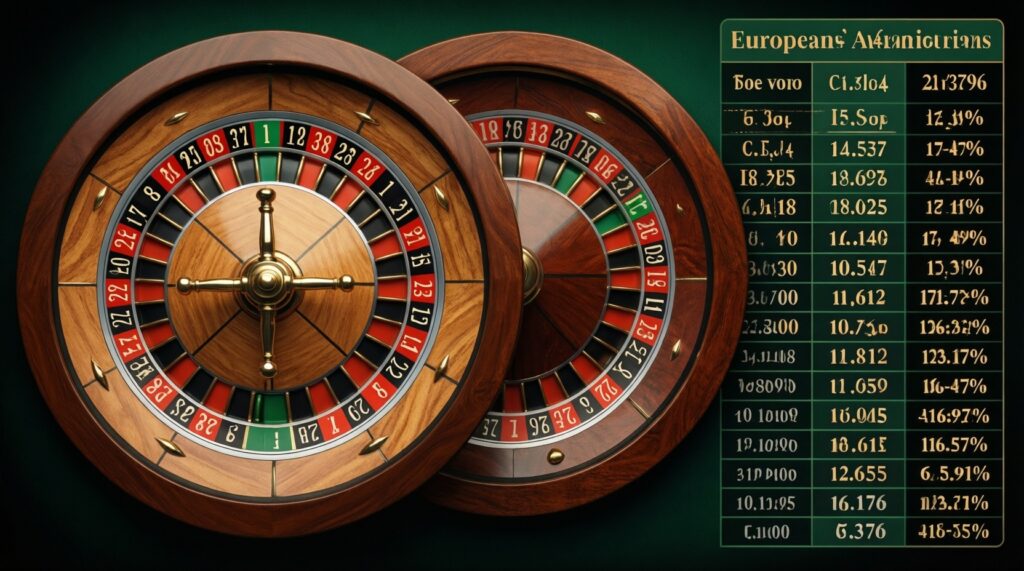
Below is a practical comparison of common roulette configurations you'll encounter when choosing between European roulette vs American roulette. The key metric is house edge (negative expected value per unit wagered) and the implied RTP (100% minus house edge). "Roulette house edge European vs American" is primarily a function of whether there is one zero or two.
| Variant | Who it suits | Pros | Cons | When to choose |
|---|---|---|---|---|
| European (single zero, standard rules) | Most intermediate players optimizing EV | Lower house edge than American; straightforward; widely available live/RNG | Still negative EV; progressions can still fail under variance | Default pick if you want the best roulette game European or American for long-run efficiency |
| European with La Partage (even-money) | Outside-bet focused players | Improves EV on even-money bets; reduces negative drift on red/black etc. | Applies only to even-money bets; not always offered | Choose when your plan is mostly outside bets and you can confirm the rule is active |
| European with En Prison (even-money) | Outside-bet grinders who accept "push-like" mechanics | Similar EV improvement conceptually to La Partage; can reduce immediate losses on zero outcomes | Rule handling differs by casino; can slow sessions and complicate tracking | Choose when you clearly understand the rule and the interface states it unambiguously |
| American (double zero, standard rules) | Players prioritizing availability or specific US-style layout comfort | Common in some venues; familiar layout for American-market players | Higher house edge than European; faster bankroll decay for the same bet mix | Choose only if European isn't available or if your bankroll/limits compensate for the worse EV |
| American with Top Line / Five-number bet (0, 00, 1, 2, 3) | Novelty/side-bet seekers (not EV-driven) | Simple "special" bet; high hit frequency relative to some inside bets | Typically among the worst-value roulette bets; increases overall house edge of your session | Avoid if your goal is value; consider only for entertainment with a strict loss cap |
| French/European-style (single zero) labeled "French Roulette" | Players seeking clear rule disclosure and classic procedures | Often pairs with La Partage/En Prison options; clear table identity | Not guaranteed to include favorable rules-must verify | Choose when you can confirm single-zero plus the even-money rule variant in the table info |
How edge differences alter common betting systems (Martingale, Fibonacci, flat)

- If you use Martingale on even-money bets, then European (ideally with La Partage/En Prison) reduces the long-run loss rate per spin; it does not remove the tail risk of hitting table limits or a long losing streak.
- If you use Fibonacci (or any slower progression), then the American wheel's higher negative drift makes "recovery" statistically harder over long sessions; you'll need stricter stop-loss rules to control risk-of-ruin.
- If you play flat betting, then the difference between European and American expresses cleanly as EV per spin; pick European to maximize RTP when you play european roulette online.
- If you mix inside bets (straights/splits) with outside bets, then variance is dominated by your bet type while EV is dominated by the wheel; moving from American to European improves EV without changing payouts, so it's the easiest "strategy upgrade."
- If you chase losses by increasing stake size after a bad run, then the higher house edge in American accelerates bankroll drawdowns; switch to European and cap stake escalations to reduce exposure to negative drift.
Player personas: tactical recommendations for conservative, opportunistic, and professional players
- Identify your primary objective: maximize RTP, maximize entertainment time, or pursue high-volatility outcomes.
- Choose wheel first: select single-zero before thinking about systems; treat "roulette house edge European vs American" as a fixed parameter.
- Verify rules in the table info: confirm 0 vs 00; check whether La Partage or En Prison applies and to which bets.
- Pick a bet mix consistent with your variance tolerance: outside for lower variance, inside for higher variance; don't confuse variance with advantage.
- Set bankroll and stop rules: predefine stop-loss and stop-win; don't rely on a progression to "guarantee" recovery.
- Check limits and pace: ensure max bet supports your plan (progressions need headroom); faster spin rates amplify EV loss per hour.
- Decide where you'll play: live vs RNG; if you plan online roulette real money, prioritize clear labeling, rule transparency, and stable limits.
Conservative value-seeker (time-on-table, controlled variance)
- Choose European single-zero; prioritize La Partage/En Prison if you mainly bet even-money.
- Use flat betting or very mild sizing rules; cap losses per session and avoid Martingale at tight max limits.
- Track results by "units" rather than money to keep discipline consistent across tables.
Opportunistic mixer (outside base + occasional inside shots)
- Still start with European; treat American as a fallback, not a preference.
- Keep the outside bet as the bankroll anchor; allocate a small, pre-set portion for inside bets to avoid stealth overexposure.
- Define a hard cut-off for "inside chasing" after a miss streak; don't let variance push you into progression spirals.
Professional-style grinder (process-driven, EV-first)
- Select European with the most favorable disclosed rules; avoid high-edge side bets (notably the American Top Line).
- Standardize a repeatable session protocol: fixed unit size, fixed spin count/time cap, and consistent bet set for cleaner EV/variance monitoring.
- Prefer slower pace and stable limits; faster games increase expected loss per hour even when "luck feels good."
Session planning, variance expectations and short‑term probability scenarios
- Confusing short-run streaks with edge: a hot run does not mean you found the best roulette game European or American; the edge remains fixed.
- Ignoring game pace: more spins per hour means more exposure to negative EV; it matters when you play european roulette online at high speed.
- Overusing progressions: Martingale/Fibonacci shift loss distribution toward rare, large drawdowns; they do not improve RTP.
- Not checking rule toggles: some games switch between standard and La Partage/En Prison; assume nothing unless stated in the info panel.
- Mixing high-edge side bets into a "low-edge plan": adding Top Line or other specials can dominate your session EV even if most wagers are outside bets.
- Letting table limits dictate outcomes: progressions often fail because you hit max bet or your bankroll cap before the statistical "recovery" happens.
- Changing unit size mid-session: this increases variance and makes stop rules ineffective; predefine a unit and keep it constant.
- Playing tired or rushed: decision errors (misclicks, wrong bet placement, impulsive doubling) add avoidable losses beyond house edge.
Regulatory practice, casino placement and when to prefer each wheel
For EV-focused play, European single-zero is the better default, especially online where you can filter and consistently play European roulette online with clear rules. American roulette can be reasonable when it's the only available live table you prefer, or when limits, pacing, and bankroll are set for entertainment rather than value-particularly if you still want online roulette real money but can't access single-zero options.
Targeted player questions and concise answers
Is European roulette always better than American roulette for expected value?
Yes in standard rules: the single-zero wheel has a lower house edge and higher RTP than the double-zero wheel. Strategy cannot reverse that structural difference.
What is the practical meaning of "roulette house edge European vs American" during a session?

It's the average loss rate per unit wagered over time. Higher house edge means faster bankroll decay at the same stake size and spin volume.
Does Martingale work better on European than American?
European reduces the long-run loss rate, but Martingale still carries tail risk from long losing streaks and table limits. It becomes "less bad," not advantageous.
When I play european roulette online, what should I verify before betting?
Confirm the wheel is single-zero (0 only), then check whether La Partage or En Prison is active and for which bets. Also verify min/max limits and bet placement rules.
Is American roulette ever the best roulette game European or American for a serious player?
Only in constrained situations, such as when European isn't available or when a specific table's limits/pacing fit your disciplined plan better. EV is still worse on the double-zero wheel.
Does playing online roulette real money change the house edge?
The edge is determined by the game rules (single vs double zero and rule variants), not by whether it's online. Online mainly changes pace, availability, and how clearly rules are disclosed.