
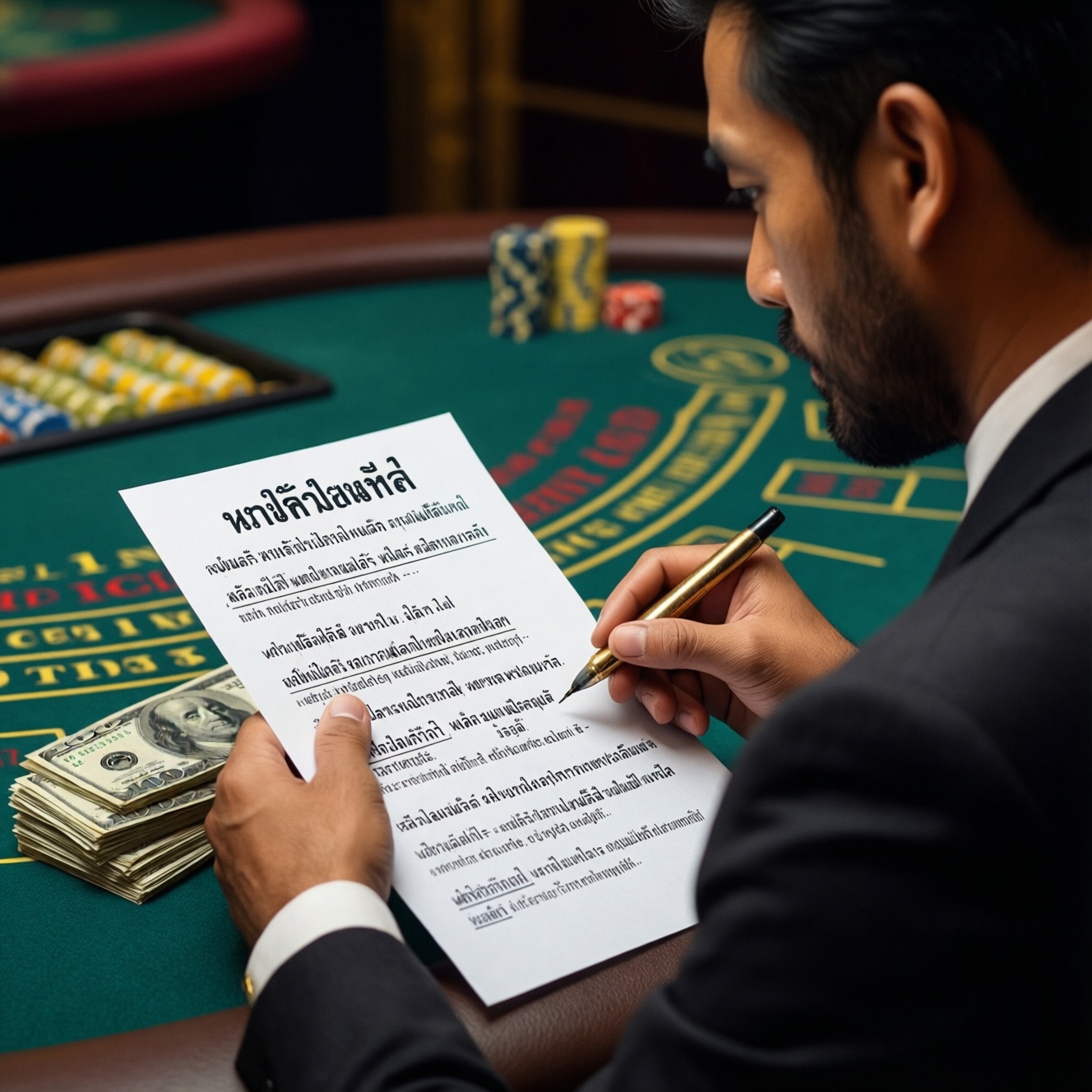
A solid casino game plan is a written set of limits for money, time, and decisions you follow before your first bet. In Thailand, where online and travel play can blur boundaries, pre-setting a session budget, stop-loss, time cap, and exit rules reduces impulsive chasing and keeps entertainment costs predictable across wins and losses.
Pre-Session Summary for Safe, Smart Play

- Decide your total bankroll (money you can afford to lose) and separate it from daily expenses.
- Set a session budget, a maximum loss (stop-loss), and a hard "no top-ups" rule.
- Pick a time window, schedule breaks, and define an end-of-day cutoff.
- Choose games/tables with rules you understand; avoid high-volatility formats when tilted or tired.
- Preset base bet size, scaling limits, and "pause conditions" (fatigue, alcohol, emotions).
- Write two exits: profit lock and loss stop; track results and review within 10 minutes after the session.
Define Your Bankroll, Session Budget, and Maximum Loss
This structure fits intermediate players who already know the games and want consistent control over spending and pace. It is the core of practical casino bankroll management: you decide the limits first, then you play inside them.
- Good fit when: you can keep gambling funds separate; you can walk away on time; you want repeatable sessions.
- Do not use this plan when:
- you are trying to recover losses or pay bills with gambling wins;
- you feel pressured (socially or emotionally) to keep playing;
- you can't stop adding funds once the session starts.
Simple definitions to write down:
- Bankroll: total amount reserved for entertainment gambling over a period (week/month), not needed for life expenses.
- Session budget: the portion of bankroll you bring to one session (cash or a preloaded balance).
- Maximum loss (stop-loss): the amount you will lose at most in that session before leaving.
Example scenarios (pick one style and commit):
- Conservative: Bankroll 20,000 THB for the month; session budget 2,000 THB; stop-loss 1,500 THB; stop-win 1,000 THB.
- More aggressive (higher variance exposure): Bankroll 20,000 THB; session budget 4,000 THB; stop-loss 3,000 THB; stop-win 2,000 THB.
Translate Long-Term Objectives into Session-Level Targets
You need a few practical tools to convert "I'll be careful" into actions. This is where many players quietly break their own rules because they never defined numbers or triggers.
- A notes app or paper card: to store your limits and read them before betting.
- A timer: phone timer or watch for scheduled breaks and the session end.
- A simple "casino budget calculator" setup: any basic spreadsheet or calculator to split bankroll into session budgets and to pre-calc stop-loss/stop-win amounts.
- Access to responsible gambling tools and limits: deposit limits, wager limits, loss limits, reality checks, and cooling-off/self-exclusion (use what your venue/operator offers).
- Identity/payment separation: one dedicated wallet/card or a fixed cash envelope so you cannot "accidentally" reload.
Write your target as behavior, not outcome: "I will play 90 minutes, take two breaks, and leave at -1,500 THB or +1,000 THB," not "I will win 2,000 THB."
Plan Session Duration, Breaks, and End-of-Day Rules
Risks and limits to acknowledge before you start (risk-aware):
- Variance can produce short-term streaks; don't interpret them as a "system working."
- Fatigue and alcohol reduce judgment; treat them as automatic stop triggers.
- Chasing losses is a predictable failure mode; pre-commit to a stop-loss that ends the session.
- Changing stakes under stress is the fastest way to break a budget; cap any scaling in advance.
-
Set your session window (start and hard stop time).
Pick a realistic duration you can complete without extending "just a little." Put the end time in a timer alarm and commit to leaving even if you are up.
- Common intermediate rule: 60-120 minutes max per session.
- If you're traveling or in a social group, set a "leave solo" plan so you're not trapped by others' pace.
-
Schedule breaks you cannot negotiate away.
Breaks are not "only if I'm losing." They are mandatory resets that reduce tilt and impulsive stake changes.
- Example: 5-10 minutes off the table every 30-40 minutes.
- During the break: check budget remaining, hydration, and emotional state.
-
Define your end-of-day rule (no second session by default).
Decide in advance whether you allow a second session. A clean default is one session per day; a second session requires a full reset and must use a separate pre-set session budget.
- Rule suggestion: "No second session after a stop-loss day."
-
Write a stop-loss, stop-win, and "no top-ups" commitment.
This is the operational version of how to set a gambling budget. If you hit stop-loss or stop-win, you end the session-no exceptions and no "re-buy" from another pocket.
- Stop-loss ends the session even if you believe you have an edge.
- Stop-win locks entertainment value and avoids giving winnings back through overplay.
-
Create a short "casino session planning checklist" you read out loud.
Before the first bet, confirm: budget loaded, timer set, stakes chosen, exits written. This takes 20 seconds and prevents the most common "I forgot" failures.
- If any item is missing (limits not set, funds not separated), delay play.
Select Games and Tables by House Edge and Volatility
- I understand the rules well enough to explain them in one minute without guessing.
- I can identify the main payout structure and what makes the game high-volatility (bonus features, side bets, long-shot payouts).
- I will avoid optional side bets unless they are explicitly inside my session budget and bet-size rules.
- I have checked table limits (minimum/maximum) and they fit my preset base bet and stop-loss.
- I will not switch to faster games (or higher stakes) just because I'm down.
- I will not play new variants while tired, emotional, or drinking.
- I have a "walk-away alternative" if conditions are bad (crowding, pressure, uncomfortable environment).
- I can track results without confusion (simple net profit/loss after each break is enough).
Preset Bet Sizes, Scaling Rules, and Risk Thresholds
- Mistake: sizing bets by emotion ("small when scared, big when confident"). Fix: pick a base bet you can repeat for the full session budget.
- Mistake: raising stakes to "get even." Fix: any increase must be pre-planned and capped (for example, max 2 steps up, then reset).
- Mistake: betting faster after a loss. Fix: enforce a pace rule (pause 10-20 seconds; breathe; confirm next bet size).
- Mistake: letting table minimums force you into oversized bets. Fix: change tables/games or end the session-do not "adapt" by risking more than planned.
- Mistake: using progressive systems without a hard loss limit. Fix: if you use any progression, tie it to a strict stop-loss and a maximum number of steps.
- Mistake: counting winnings as "free money." Fix: winnings are still real money; they must follow the same stop rules.
- Mistake: "one last bet" loops at the end time. Fix: your timer ends betting, not just "thinking about leaving."
- Mistake: mixing multiple games with different speeds and volatility. Fix: choose one primary game per session; switching requires a full break and re-check of limits.
Exit Criteria, Tracking Results, and Post-Session Review
If the standard plan feels too strict or doesn't match how you play, use one of these safer alternatives (each still needs a budget, a time cap, and an exit rule):
- Single-envelope cash session (best for in-person play): bring only the session budget in cash; leave cards at home/hotel; when cash is gone, session ends.
- Platform-enforced limits (best for online): set deposit/loss/time limits and reality checks; rely on operator tools to prevent "just one more reload."
- Micro-session structure (best for tilt-prone players): split one session budget into 2-3 short blocks with mandatory breaks; if you break a rule once, you stop for the day.
- Buddy accountability (best for social environments): tell a friend your stop-loss and end time; they confirm you leave when triggers hit.
Tracking (minimal but effective): write starting balance, end balance, biggest bet size used, and which rule was hardest to follow. Keep it short; the goal is behavior control, not perfect accounting.
Concise Clarifications on Risk, Rules, and Practical Edge Cases
Should my stop-loss equal my session budget?

Not necessarily. Many players set stop-loss slightly below the full session budget to avoid "spending it all because it's there," leaving a buffer for transport, food, or simply to reduce damage from tilt.
What's the simplest way to stop top-ups mid-session?
Separate funds physically or digitally: one cash envelope or one preloaded balance only. If you still can reload, activate operator limits or leave cards/accounts inaccessible during play.
Do I need a stop-win if my goal is entertainment?
Yes, because overplaying when up often turns a good session into a long, risky one. A stop-win is a time-and-emotion control tool, not a prediction of how often you'll win.
How do I pick a base bet size quickly?
Choose a size you can repeat without pressure for the full planned duration, then cap any increases. If the table minimum is too high for that, switch tables/games rather than resizing your plan.
Is changing games during a session ever fine?
It's fine only after a break and a full re-check of limits (time remaining, stop-loss distance, and table minimums). Switching impulsively after losses is a red flag-treat it as a pause trigger.
What if I hit stop-loss early but still have time left?

Time remaining is irrelevant; the session is over. Use the remaining time for a non-gambling activity and log what triggered the faster-than-expected loss.
How do I handle a "free bet" or bonus credit?
Treat it like real money for behavior: it still consumes time, attention, and can trigger chasing. Decide in advance whether bonuses are inside the same stop-time and stop-loss framework or used in a separate micro-session.