

To pick the best blackjack table for your win odds, prioritize rules that reduce the house edge: dealer stands on soft 17 (S17), blackjack pays 3:2 (not 6:5), fewer decks when other rules are equal, and player-friendly options like late surrender and doubling after split. Then adjust basic strategy to the exact rule set.
How specific rule changes move the player edge
- 3:2 payout is usually the biggest single rule improvement you can choose at a glance; 6:5 is a strong negative shift.
- S17 beats H17: when the dealer stands on soft 17, many dealer "escape" draws disappear, improving your expectation.
- Fewer decks is generally better, but only if the payout and S17/H17 are not worse.
- Late surrender (when offered) is a meaningful player-friendly lever if you actually use it.
- Doubling and splitting permissions often decide between two otherwise similar games.
- Rule combinations matter more than any single headline; build a quick rule matrix before sitting down.
S17 vs H17: quantifying the dealer soft‑17 effect on win rate
If you're asking กติกาแบล็คแจ็ค S17 กับ H17 ต่างกันอย่างไร, it's this: under S17 the dealer must stand on A-6, while under H17 the dealer must hit. H17 creates extra dealer improvement chances (and some extra busts), but the net effect typically favors the house.
Use these criteria to choose between two tables when S17/H17 is the main difference:
- Blackjack payout (3:2 vs 6:5) takes priority over S17/H17 when you must trade one for the other.
- Number of decks: fewer decks strengthens player blackjacks and some doubling/splitting outcomes, making S17 even more attractive.
- Whether surrender exists: late surrender can partially "compensate" for H17 if you use it correctly.
- Double rules: "double on any two" is better than restricted doubling, especially in H17 where some totals play differently.
- Double after split (DAS): supports aggressive but correct splitting lines; valuable in both S17 and H17.
- Resplit limits (including aces): resplitting improves your long-run results; lack of it hurts more in shoe games.
- Dealer peek / hole card: if the dealer checks for blackjack early, it reduces some high-variance losses on doubles/splits.
- Table conditions (online speed, cut card penetration hints, side-bet distractions): these don't change rules, but they change your error rate-which can dominate small rule differences.
Number of decks: from single‑deck to eight‑deck - probabilities and practical consequences
If you're deciding แบล็คแจ็คจำนวนสำรับกี่สำรับดีที่สุด, the practical answer is: fewer decks is usually better when the payout and key rules are equal. In real casinos (including many online lobbies), rules often worsen as deck count goes down, so you must compare the full package.
| Variant | Who it suits | Pros | Cons | When to choose |
|---|---|---|---|---|
| Single-deck | Disciplined strategy users; players who can slow down and avoid tilt | Typically best raw odds when rules are truly "classic"; easier mental tracking | Often comes with trade-offs (worse payout or restricted doubles) in modern offerings | Choose if it still pays 3:2 and has decent double/split rules |
| Double-deck | Intermediate players wanting strong odds without extreme rule compromises | Often a "sweet spot" for rules availability; good balance of variance and edge | Rule sets vary widely; must read the fine print | Choose when it offers 3:2 plus S17 or good surrender/doubling options |
| Four-deck | Balanced bankroll players; those prioritizing stable gameplay | Common in online; typically consistent rules across tables | Less favorable than fewer decks if everything else is equal | Choose when it's the best available 3:2 + S17 combination |
| Six-deck | Most mainstream casino/online players | Wide availability; often includes surrender and DAS in some rooms | Small drift against the player versus fewer decks | Choose when it's 3:2, avoids 6:5, and has surrender/DAS |
| Eight-deck | Players who value table availability and consistent speed | Easy to find; rule cards are usually standardized | Least favorable among common variants when all else is equal | Choose only if it compensates with strong rules (S17 + surrender + liberal doubles) |
Payout formats (3:2 versus 6:5): direct EV calculations and break‑even shifts
If your question is แบล็คแจ็ค 3:2 กับ 6:5 แบบไหนดีกว่า, the actionable guidance is simple: prefer 3:2 almost every time. A 6:5 payout reduces the value of your strongest natural win (a blackjack), which is hard to "win back" via minor rule perks.
Scenario-based recommendations (use these as decision rules):
- If one table is 3:2 and the other is 6:5, then pick 3:2 even if it uses more decks, unless the 3:2 table has multiple severe restrictions (no DAS, no surrender, very restrictive doubling).
- If you see an online lobby advertising คาสิโนออนไลน์แบล็คแจ็คจ่าย 3:2, then shortlist those tables first and compare S17 vs H17 and surrender next.
- If you are a variance-sensitive player (you hate swings), then still avoid 6:5; it reduces the payoff of your "free" high-value events and can worsen your long-run recovery after downswings.
- If a 6:5 table offers tempting side bets or "boosted" bonuses, then treat that as a separate gamble and do not count it as making the base game comparable to 3:2.
- If your only available live table is 6:5 and you're choosing between playing or not playing, then consider lowering stakes or switching to another game format/table where 3:2 is available.
Ancillary rules that alter strategy: doubling, splitting, surrender and resplit permutations
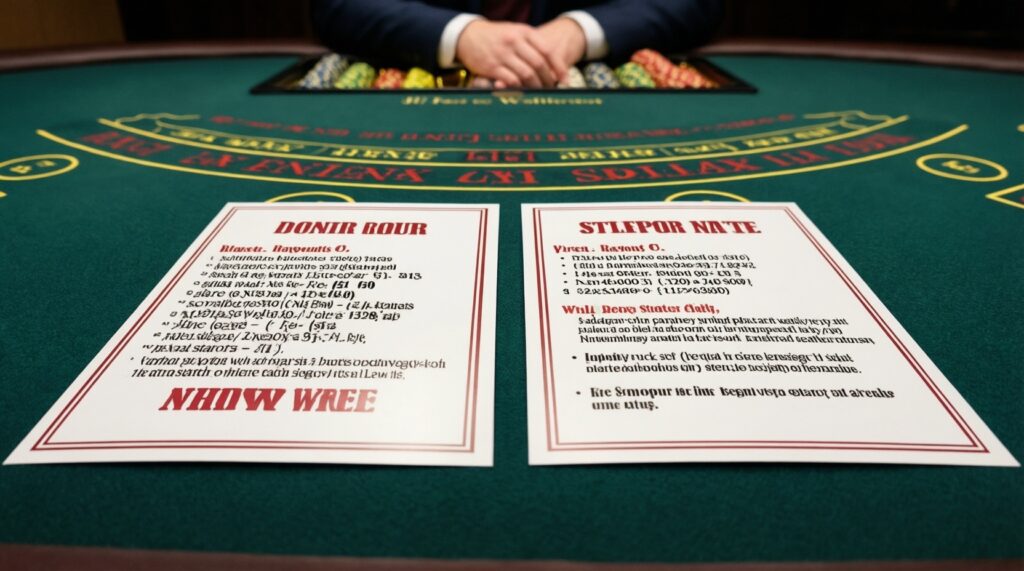
Use this fast selection algorithm when comparing two rule cards (or two online table info panels):
- Filter out 6:5 first unless there is no 3:2 option at all in your session.
- Pick S17 over H17 when payout is equal.
- Choose "double on any two" over restricted doubling (like "10-11 only").
- Prefer DAS (double after split); it increases the value of correct splits.
- Prefer late surrender if offered; commit to using it (otherwise it's "fake value").
- Prefer resplit options (including whether aces can be resplit); more flexibility is generally better.
- Only then use deck count as a tiebreaker between otherwise similar rules.
Aggregating rules into a matrix: how combinations change expected value (table recommended)

Most selection mistakes happen when players evaluate a single headline rule and ignore the bundle. Common errors to avoid:
- Choosing "single-deck" while ignoring that it pays 6:5 or restricts doubling heavily.
- Assuming H17 is "good because the dealer can bust more," without accounting for the dealer's improved completion of soft hands.
- Comparing deck count across tables with different blackjack payouts (3:2 vs 6:5) and treating it as a fair comparison.
- Overvaluing minor perks (like small rule quirks) while missing major ones (payout format, surrender, DAS).
- Failing to adjust basic strategy for the exact rule set (H17 and surrender meaningfully change some key decisions).
- Using side bets to justify a worse base game; side bets typically increase complexity and error rate.
- Ignoring "dealer peek/hole card" differences, which can change how painful doubles/splits are against dealer aces/tens.
- Choosing faster online tables that increase your misplays-small rule advantages vanish if your decisions degrade.
| Rule change | Direction for player | Typical impact size (qualitative) | One-line action |
|---|---|---|---|
| Blackjack payout: 3:2 → 6:5 | Worse | Large | Avoid 6:5 as your default; treat 3:2 as a baseline requirement. |
| Dealer rule: S17 → H17 | Worse | Small to medium | If forced into H17, be stricter about selecting strong double/surrender rules. |
| Decks: fewer → more (all else equal) | Worse | Small | Use deck count as a tiebreaker after payout and S17/H17. |
| Add Late Surrender | Better | Small to medium | Only value it if you will actually surrender the correct spots. |
| Allow DAS (Double After Split) | Better | Small | Prefer tables with DAS, especially when splitting is common in your game. |
| Restrict doubling (any two → limited) | Worse | Medium | Do not "pay" for fewer decks with bad doubling rules. |
Translating rules into practice: bankroll, bet sizing and adjusted basic strategy per rule set
For a conservative player aiming for lower swing, the best fit is usually a 3:2 table with the cleanest rules you can find (ideally S17) and steady flat bets; for a balanced player, prioritize 3:2 + S17/H17 choice + surrender/DAS and use small step-ups only when fully focused; for an aggressive player, choose the strongest rule bundle (still avoiding 6:5) and size bets only within a pre-set loss limit-because overbetting turns "สมัครเล่นแบล็คแจ็คออนไลน์ได้เงินจริง" into a bankroll management problem, not a rules problem.
Typical rule questions players ask before sitting at a table
Is S17 always better than H17?
When payout and other rules are equal, S17 is generally the better choice for the player. If S17 comes with 6:5 or severe restrictions, the package can still be worse.
How do I quickly spot a bad table online?
Look for 6:5 payouts, restricted doubling, and missing DAS/surrender. In many lobbies, the fastest filter is simply avoiding 6:5 first.
Should I always choose fewer decks?

No-use deck count as a tiebreaker after payout and core rules. A worse payout or restricted doubles can outweigh the benefit of fewer decks.
If a site says คาสิโนออนไลน์แบล็คแจ็คจ่าย 3:2, is that enough to choose it?
It's a strong start, not the full decision. Still verify S17 vs H17, doubling rules, DAS, surrender, and resplit limits.
Do I need a different basic strategy for H17?
Yes, some hit/stand/double choices shift under H17 and with surrender availability. Playing "one chart for everything" is a common leak.
Can a beginner realistically win money online (สมัครเล่นแบล็คแจ็คออนไลน์ได้เงินจริง)?
It's possible to reduce the house edge by choosing good rules and playing accurately, but variance is real and short sessions prove little. Treat it as disciplined advantage-seeking, not guaranteed income.