
Blackjack insurance is a side bet offered when the dealer shows an Ace; it pays 2:1 if the dealer has blackjack, but it is usually negative for the player. In practice, the default action is simple: decline insurance unless you have reliable information (card counting or verified composition) indicating the dealer's blackjack chance is high enough.
Core conclusion on taking insurance in blackjack

- ประกันแบล็คแจ็คคืออะไร: a separate wager (up to half your main bet) against the dealer having blackjack when an Ace is showing.
- Most players should treat insurance as a standalone bet, not "protection," and decline it by default.
- If you cannot estimate the dealer's blackjack probability, don't buy insurance; the offered payout is usually not fair.
- Insurance can get close to break-even only when the remaining deck is unusually rich in tens (a situation skilled counters can detect).
- "Even money" on a player blackjack is effectively insurance; it is usually a worse choice than taking the normal blackjack payout.
- For วิธีเล่นแบล็คแจ็คออนไลน์ ให้ได้เปรียบ, focus on rules, limits, and bet sizing; insurance rarely improves your long-run results unless the game allows meaningful advantage play.
How blackjack insurance works and what it pays
Insurance is offered only when the dealer's upcard is an Ace. You may place an additional bet up to 50% of your original wager. The casino then checks the dealer's hole card for a ten-value card (10/J/Q/K).
If the dealer has blackjack, the insurance bet pays 2:1 and your main hand loses (unless you also have blackjack, resulting in a push on the main bet under common rules). If the dealer does not have blackjack, the insurance bet loses immediately and your main hand continues normally.
This is why the question "ควรซื้อประกันในแบล็คแจ็คไหม" is best answered by treating insurance as a separate gamble with its own odds, not as a defensive move that improves your main-hand decisions.
Mathematics behind the insurance bet: expected value and house edge

- What must be true for insurance to be fair: since it pays 2:1, you need the dealer to have blackjack at least 1/3 of the time (probability ≥ 33.33%) for break-even.
- Simple probability anchor: with many unseen cards, the dealer needs a ten-value in the hole. If the chance of a ten-value is around 4/13 (about 30.77%) in an "average" mix, that is below 1/3, so the bet is unfavorable.
- Short EV example (per 1 unit of insurance): EV = P(BJ)·(+2) + (1 − P(BJ))·(−1). If P(BJ)=0.3077, EV ≈ 0.3077·2 − 0.6923·1 ≈ −0.0769. That is a negative expectation.
- Key takeaway for action: unless you have evidence P(BJ) > 1/3, insurance is a losing proposition over time.
- Important boundary: the correct decision depends on the remaining card composition, not on your hand total. Your 12, 16, or 20 does not change the dealer's hole-card probability.
Why insurance is generally a losing proposition for the player
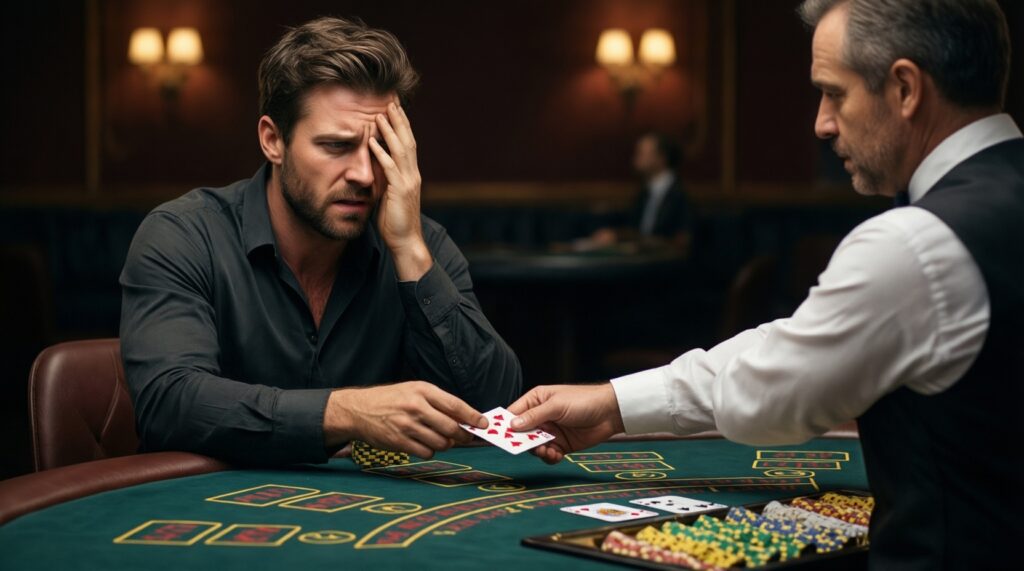
These are the most common real-table situations where players lose value with insurance (and why "แบล็คแจ็ค ประกัน คุ้มไหม" is usually answered with "no"):
- Using insurance as emotional protection: buying it because you "don't want to lose to dealer blackjack" ignores that you are paying an overpriced premium.
- Taking insurance based on your hand strength: "I have 20, so insure" is a logic trap; insurance does not depend on your total, only on the chance of a ten in the hole.
- Confusing insurance with correct play on 16 vs Ace: the right hit/stand choice is separate from the insurance decision; mixing them usually compounds mistakes.
- Overvaluing table myths: beliefs like "Aces are hot" or "dealer always has it" are not actionable evidence about remaining tens.
- Online speed decisions: in online blackjack, players often click insurance automatically; unless you have a verified edge mechanism, this is negative long-run.
Situations where insurance can approach break-even
- Ten-rich remaining shoe: if you have a credible method to estimate that the probability of a ten-value in the hole exceeds 1/3, insurance becomes reasonable.
- Late-shoe composition effects: after many low cards have been removed, the density of ten-value cards can rise enough to make insurance close to fair.
- Transparent composition games: in rare formats where you can infer or observe enough of the remaining cards (not typical for most TH casino conditions), you may justify insurance.
- Limitations you must accept: you cannot "feel" break-even; you must estimate P(BJ) with discipline.
- Rule text does not create value: knowing กฎประกันแบล็คแจ็ค คาสิโน helps you avoid procedural errors, but it does not change the payout math.
- Many online titles block advantage methods: continuous shuffling, hidden penetration, and restricted data typically prevent reliable composition estimation.
Counting and conditional strategies that justify taking insurance
- Correct principle: insurance is primarily a count-based decision; you take it when your information implies P(dealer ten in the hole) > 1/3.
- Common myth: "Always take even money on blackjack." Even money equals insurance on your blackjack; without a count-based reason, it usually sacrifices long-run value compared to standard blackjack payout.
- Common mistake: "I'm already behind, so I'll insure." Chasing variance does not improve expectation; it often worsens it.
- Misapplied 'gut counting': casually noticing a few low cards is not enough; you need a consistent method and enough remaining cards for the estimate to be meaningful.
- Conditional shortcut that is actually valid: if you are an advantage player and your count system has an insurance index, follow it exactly; do not blend it with basic strategy totals.
Practical decision rules for real table play
Use this as an in-play checklist focused on actions, not theory:
- If you are not counting (or cannot estimate composition): decline insurance every time. That answers "ควรซื้อประกันในแบล็คแจ็คไหม" for most players.
- If you have blackjack and the table offers even money: treat it as insurance; default to decline unless your method says the dealer is > 1/3 to have blackjack.
- If you are counting and have a defined insurance trigger: take insurance only when your trigger indicates tens are sufficiently concentrated (your trigger should correspond to P > 1/3).
- Never let your hand total decide insurance: decide insurance first (based on dealer-Ace hole-card odds), then play your hand normally.
Mini-case (fast mental flow): Dealer shows Ace → Ask "Do I have a reliable estimate that the hole card is ten-value more than 1 in 3?" → If no, press "No Insurance" → Continue with normal decisions (hit/stand/double/split) as usual.
Common practical objections and quick clarifications
If I have 20, isn't insurance smart protection?
No-your 20 does not change the dealer's hole-card probability. Insurance is priced as a separate bet and is usually negative unless the remaining deck is ten-rich.
Is "even money" on my blackjack different from insurance?
It is effectively the same bet: you lock a 1:1 payout in exchange for giving up the normal blackjack payout if the dealer doesn't have blackjack. Default to declining unless you can justify insurance mathematically.
Do casino insurance rules change the math?
The key math driver is the 2:1 payout versus the true chance of a ten in the hole. Most กฎประกันแบล็คแจ็ค คาสิโน do not make the payout fair; they mainly define procedure.
Can I decide insurance based on "lots of small cards already came out"?
Only if you track it consistently with a counting/composition method. Casual observation is unreliable and tends to overestimate how favorable the shoe is.
Does insurance help me reduce variance even if EV is worse?
It can change short-term swings, but you are paying for that with negative expectation. For most intermediate players, that trade-off is not worth it.
In online blackjack, is taking insurance ever part of วิธีเล่นแบล็คแจ็คออนไลน์ ให้ได้เปรียบ?
Rarely. Unless the game exposes enough information to estimate composition (uncommon), insurance remains a negative side bet you should skip.