
For long-term results in blackjack, your highest-impact moves are: play a correct blackjack basic strategy for every hand, avoid negative-rule tables, use disciplined bet sizing, and apply a few controlled deviations only when you have reliable information. A blackjack strategy chart is the base; everything else is edge protection and error reduction.
High‑Impact Moves at a Glance
- Lock in correct decisions with a memorized blackjack strategy chart (hard totals, soft totals, pairs).
- Choose rule sets that reduce the house edge (payouts, dealer action on soft 17, resplit rules).
- Keep bets stable and small relative to bankroll; avoid "progressions" that amplify variance.
- Double and split aggressively when basic strategy says so; these are your highest-EV levers.
- Use counting-lite only as a betting/seat-time filter, not as a reason to freestyle plays.
- For online blackjack strategy, prioritize low-speed error control (interface, pace, limits) over "reads".
Understanding Expected Value and House Edge in Blackjack
Use this approach if you already know the core blackjack rules and strategy and can execute decisions consistently under time pressure. It's ideal for intermediate players who want to minimize leakage (decision errors, poor tables, oversized bets) rather than chase short-term swings.
Skip it (or simplify) when you're tired, distracted, playing with money you can't afford to lose, or forced into unfamiliar side bets/rules. EV gains are small and fragile; mistakes erase them quickly.
| Prep checklist | Why it matters |
|---|---|
| Know your goal: reduce errors, not "win every session" | Keeps decisions aligned with expected value (EV) instead of emotions. |
| Understand variance and downswings | Prevents bet-chasing and strategy drift after losses. |
| Commit to zero side bets | Side bets often dominate your results and typically worsen EV. |
| Pick a stop condition (time or loss cap) | Reduces fatigue errors, which are a major hidden cost. |
Comparison table: moves that actually move the needle
| Move | EV impact (direction) | When to apply | Common misuse to avoid |
|---|---|---|---|
| Accurate basic strategy (all hand types) | Strong positive vs. "intuitive play" | Always; baseline for the best blackjack strategy | Using partial charts or "rules of thumb" |
| Table/rule selection (payouts, S17/H17, DAS) | Positive | Before you sit; re-evaluate if conditions change | Ignoring rules because limits are higher or seats are open |
| Doubling down when the chart says | Positive | High-probability advantage situations (e.g., 11 vs many dealer upcards) | Doubling "to get even" or doubling bad totals |
| Splitting pairs correctly | Positive | Pairs with strong improvement potential (especially A,A and 8,8) | Never-splitting or over-splitting small pairs into strong dealer upcards |
| Bet sizing discipline | Positive (risk control) | Every hand; especially after wins/losses | Martingale or escalating after losses |
| Counting-lite (tracking "high card rich" feel) | Small positive if used conservatively | As a trigger to leave bad shoes / avoid increasing mistakes | Inventing deviations without a real count and indices |
Basic Strategy Deviations: When to Break the Chart
Deviations only help when the information quality is high (rule clarity, consistent dealing, stable conditions). If you can't quantify the situation, default to the blackjack strategy chart-precision beats creativity.
| Prep checklist | What you need |
|---|---|
| Correct chart for the exact rules | Deck count, dealer hits/stands soft 17, double rules, surrender availability. |
| One deviation set only | Pick a tiny set you can execute perfectly (don't mix systems). |
| Consistency test | Run 50-100 practice hands; if you miss decisions, drop deviations. |
| Stable environment | Deviations are not for chaotic tables, multi-tasking, or high-speed online play. |
High-signal deviation examples (use only if you are sure)
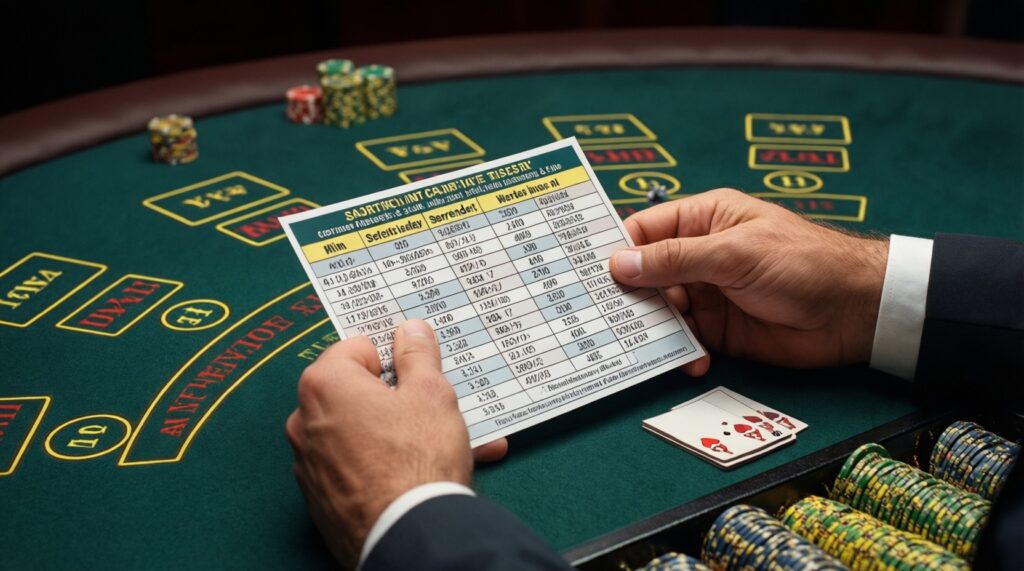
- Rule-driven changes: If surrender is available, some borderline hands become "surrender" instead of hit/stand (rule knowledge, not guesswork).
- Penetration/conditions-driven restraint: When you notice you're making mistakes, treat "deviation" as "return to chart + lower stakes" instead of adding complexity.
- Online-specific adjustment: In online blackjack strategy, prioritize avoiding misclicks and timing pressure; a perfect basic strategy beats a sloppy "advanced" line.
Optimal Bet Sizing and Bankroll Preservation
| Prep checklist (do this before you play) | Target outcome |
|---|---|
| Set a session bankroll you can lose without impact | Prevents emotional betting and tilt decisions. |
| Pick a base unit you can repeat for many hands | Reduces ruin risk and protects against variance. |
| Decide your max bet in advance | Stops "one big hand" behavior. |
| Choose a pace (hands/hour) you can execute cleanly | Minimizes errors; critical for online blackjack strategy. |
| Write down 2 rules you will not break | Example: "No side bets" and "No bet progression." |
-
Define your base unit and cap it
Choose a flat base bet you can sustain through a long negative run. Set a hard maximum (for example, "never more than X units") and treat it as a rule, not a suggestion.
- If you feel tempted to increase stakes after losses, lower the unit instead of raising it.
- If table minimum forces you too high, change tables-not your discipline.
-
Use flat betting unless you have a quantified edge
Without a real advantage signal, increasing bet size increases variance without improving EV. Flat betting is often the "best blackjack strategy" for intermediates because it keeps execution clean.
- Do not use Martingale or any progression system; it changes risk, not odds.
-
Adjust only for conditions you can verify
If rules worsen (e.g., poorer payouts, no DAS, higher minimums) or distractions rise, your correct response is to reduce stakes or leave. EV is fragile; protect it by controlling conditions.
-
Control session length to protect decision quality
Fatigue creates misplays that erase the value of a correct blackjack basic strategy. Use a time limit or a "mistake trigger" (leave after two noticeable errors).
-
Track only what matters: errors and rule set
After each session, note the table rules and whether you followed the blackjack strategy chart exactly. Improvement comes from reducing misplays and bad table selection, not from remembering "hot/cold" streaks.
Maximizing Value with Doubling Down and Splitting
| Prep checklist | What to confirm at the table |
|---|---|
| Know double rules | Double on any two cards vs. restricted doubles (e.g., only 9-11). |
| Know split rules | DAS (double after split), resplit limits, split aces handling. |
| Memorize the pair/soft sections of your chart | Most costly errors happen here, not on hard totals. |
- When the chart says double, you do it immediately-no "wait for a good feeling."
- You can explain, in one sentence, why the double is correct (you're converting advantage into extra money, not gambling harder).
- You split A,A and 8,8 when the chart indicates, even if it "feels risky."
- You avoid "revenge splits" (splitting small pairs into strong dealer upcards without chart support).
- You do not split tens unless you are explicitly following a tested system with real indices (most intermediates should never do this).
- After splitting, you still follow the same blackjack strategy chart for each resulting hand (no improvisation).
- You never double a hand you would prefer to hit/stand based on emotion (e.g., doubling because you're down).
- You re-check that table rules match your chart; otherwise you revert to the closest correct chart you know or leave.
Practical Counting‑Lite Techniques for Consistent Wins

| Prep checklist | Safe scope (counting-lite) |
|---|---|
| Decide your purpose | Use as a risk filter (when to leave / reduce stakes), not as a license to invent plays. |
| Pick one simple signal | Example: "Does the shoe feel rich in tens/aces lately?" (very rough) and act conservatively. |
| Keep behavior consistent | Avoid sudden, obvious bet jumps; prioritize longevity and error-free play. |
| Stick to base strategy | Your blackjack basic strategy remains the decision engine. |
- Using counting-lite to justify deviations: Without a true count and indices, your "read" is noise-default to the blackjack strategy chart.
- Bet spreading too aggressively: Large jumps magnify variance and scrutiny while not being supported by precise edge estimates.
- Tracking too many things: If you monitor discards, dealer habits, and side bets, your decision accuracy drops.
- Ignoring game speed: Fast dealing (especially online) increases misclicks and missed doubles/splits-slow down or lower stakes.
- Confusing short streaks with composition changes: A few low cards in a row is not a reliable advantage signal.
- Failing to reset after distraction: If you lose the "thread," stop tracking and return to pure basic strategy immediately.
- Letting the count override bankroll rules: Even if you think conditions improved, your pre-set max bet still applies.
Choosing Tables and Rules That Shift the Odds in Your Favor
| Prep checklist | What to check before buying in |
|---|---|
| Scan the felt/signage (or game info online) | Payouts, deck count, surrender, double rules, resplit rules. |
| Match chart to rules | Your blackjack strategy chart must fit the exact rule set. |
| Confirm side-bet pressure | Choose dealers/tables that don't constantly push side bets (less distraction). |
| Choose conditions you can execute | Pace, seat position, and limits that keep your decisions accurate. |
Practical alternatives and when to use them
- Lower-minimum tables with stable rules
Use when you're training perfect execution or recovering from a downswing; error-free play matters more than stakes. - Rule-superior tables even if limits are slightly higher
Use only if you can keep your base unit small relative to bankroll; don't let a higher minimum force oversized bets. - Live dealer vs. RNG online blackjack
Choose the format where you misclick less and can follow the blackjack rules and strategy precisely; consistency is your edge. - Shorter sessions across multiple tables
Use when fatigue is your main leak; rotating reduces autopilot errors and keeps your "A-game" active.
Common Practical Concerns and Quick Answers
Do I need to memorize the entire blackjack strategy chart?
Yes, if you want reliable long-term results. At minimum, memorize pairs and soft totals because most expensive errors happen there.
Is card counting required for the best blackjack strategy?
No. For intermediates, correct blackjack basic strategy plus strong table selection and bankroll control usually beats sloppy counting.
Which matters more: rules or my decisions?
Your decisions come first; a single persistent mistake can outweigh small rule differences. After that, pick the best rule set you can find and match your chart to it.
How should I adjust my online blackjack strategy to reduce mistakes?
Slow down, avoid multi-tabling, and reduce stakes if you misclick or time out. Use a chart reference during practice until decisions are automatic.
Should I ever deviate from the blackjack strategy chart without a true count?
Rarely. Without quantified information, deviations are mostly guesswork; stick to the chart and focus on execution quality.
Are side bets part of optimal blackjack rules and strategy?
For most players, no. Side bets add volatility and distraction, and they often worsen your overall EV even when the base game is played well.