
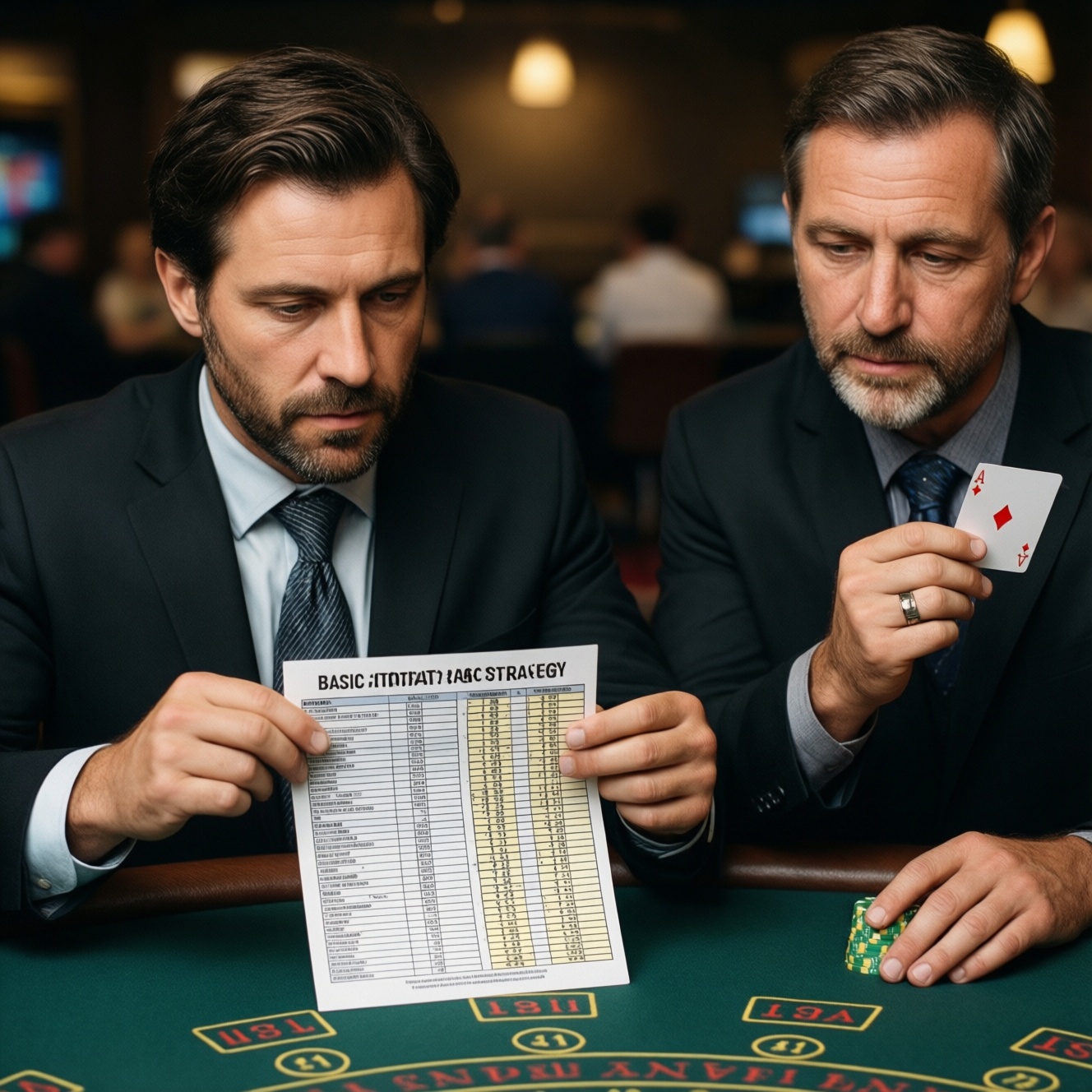
A blackjack basic strategy table is a decision chart that tells you the mathematically best action (hit/stand/double/split/surrender) for each hand versus the dealer upcard, under stated rules. Use it to standardize choices and reduce avoidable mistakes, whether you play in a casino or on คาสิโนออนไลน์แบล็คแจ็ค-without relying on hunches.
Core Principles Behind the Basic Strategy Table
- It assumes you play every hand independently and choose the action with the best expected value for that situation.
- The "right" move depends on rules (H17/S17, DAS, surrender, deck count), so the table must match your game.
- Hard totals, soft totals, and pairs are treated differently because their risk and flexibility differ.
- Doubling is about maximizing value when you are slightly ahead and can lock in one extra bet.
- Surrender (when offered) is a controlled loss used only in the worst spots.
- Memorization is optional; fast, accurate table-reading is usually enough to play correctly.
How the Basic Strategy Table Is Constructed: Probabilities and Assumptions

The table is derived by comparing the expected value of each legal action (hit/stand/double/split/surrender) for every player hand against each dealer upcard, using the game's rules and a model of the remaining cards.
- Best fit for: intermediate players who want consistent, repeatable decisions and a reliable "default" in live play or an app.
- Not worth using (briefly): if you can't confirm the rules (e.g., unknown surrender/DAS/H17 settings), or if you're not allowed to reference a chart and you haven't practiced enough to avoid time-pressure errors.
In Thai search, you'll often see ตารางเบสิคสเตรทจีแบล็คแจ็ค or แบล็คแจ็ค basic strategy ไทย; both usually refer to the same concept, but the correct chart still depends on the rule set.
Reading the Table: Interpreting Hands, Dealer Upcards, and Actions
To use a basic strategy chart reliably, you need three things: the game rules, a chart that matches them, and a consistent way to classify your hand.
- Rule details (must confirm): number of decks, dealer hits/stands on soft 17 (H17/S17), double rules, DAS (double after split), and whether late surrender is allowed.
- A matched chart: printed card, phone note, or an แอปตารางแบล็คแจ็ค basic strategy that clearly states the rule variant.
- Hand classification:
- Hard total: no ace counted as 11 (or you'd bust if counted as 11).
- Soft total: at least one ace counted as 11.
- Pair: first two cards same rank (e.g., 8-8).
- Action legend: H=Hit, S=Stand, D=Double (if not allowed, usually Hit), P=Split, R=Surrender (if not allowed, follow the fallback shown in your chart).
Quick hard-totals reference table (common multi-deck baseline)

This table is a practical starting point for hard totals under a common baseline (multi-deck; dealer checks for blackjack; doubling allowed on first two cards). If your table differs (H17/S17, surrender, DAS), use it only as a learning scaffold and defer to the exact chart for your rules.
| Player hard total | Dealer 2-3 | Dealer 4-6 | Dealer 7-A | Default action note |
|---|---|---|---|---|
| 5-8 | H | H | H | Too low to stand; improve first. |
| 9 | H (often D vs 3-6) | D | H | Double mainly when dealer is weak. |
| 10 | D | D | H (often D vs 7-9) | Don't double into strong dealer tops unless chart says so. |
| 11 | D | D | D (sometimes exception vs A depending on rules) | Usually your best doubling spot. |
| 12 | H | S | H | Stand only against dealer 4-6 in many charts. |
| 13-16 | S vs 2-6 | S | H vs 7-A | "Stiff" totals: stand vs weak, hit vs strong. |
| 17+ | S | S | S | Protect made hands; avoid bust risk. |
Hard Hands: Exact Rules for Hit, Stand, Double, and Surrender
Prep checklist (before you play):
- Confirm whether the dealer is H17 or S17, and whether late surrender is offered.
- Confirm if DAS (double after split) is allowed and any double restrictions (e.g., only on 9-11).
- Choose the matching chart (print it or open it) and learn the action legend (H/S/D/P/R).
- Decide your "fallback" rules: if D isn't allowed, you will follow your chart's alternative (commonly Hit); if R isn't allowed, follow the non-surrender action.
- Practice recognizing hard totals instantly (especially 12-16) without recounting.
-
Classify the hand correctly as HARD.
If counting an ace as 11 would bust you, treat the hand as hard. Example: A-6-10 is a hard 17 (not soft).
-
Read dealer upcard and map it to "weak" or "strong".
For most charts, dealer 4-6 is the weak zone (more dealer bust risk), while 7-A is the strong zone. This mental grouping speeds up decisions under time pressure.
-
Follow the hard-total lane: 5-8 always hit, 17+ always stand.
These edges are stable across many rule sets, so they're safe anchors when you're still learning table-reading.
-
Use "stiff total" handling for 12-16.
Against dealer 4-6, you often stand to let the dealer break; against 7-A, you often hit because standing loses too often.
- Do not "auto-stand" on 12 just because it feels safe; 12 is one of the most misplayed totals.
-
Double only when your rules allow it-and only in the chart's windows.
Doubling is powerful but brittle: if doubles are restricted (or DAS changes split lines), your correct move can change. If your chart says D and doubling is disallowed, use the chart's fallback (commonly Hit).
-
Use surrender sparingly and only when it exists in your game.
Late surrender (if offered) is typically reserved for a few worst-case hard totals versus strong dealer upcards. If surrender is not allowed, do not invent it-use the chart's alternate action instead.
Many people search วิธีเล่นแบล็คแจ็คให้ชนะ; basic strategy is not a guarantee to win sessions, but it is the standard method to make the most correct, repeatable decisions for the rules you're playing.
Soft Hands and Pair Splits: When to Be Aggressive or Conservative

Use this checklist to verify you are applying the table correctly for soft totals and pairs (the two areas where players most often "feel" the wrong move).
- I treat A-2 through A-6 as soft and look for double opportunities versus dealer 4-6 (depending on my exact chart).
- I avoid standing too early on soft hands; many soft totals are designed to be played aggressively because they can't bust on one hit.
- I know whether my game is H17/S17; soft-hand doubles can shift between these rule sets.
- I never split 10s in standard basic strategy; I only do it if I'm intentionally deviating (not recommended for normal play).
- I generally split A-A and 8-8 per most charts, and I understand the table's exceptions if surrender/DAS rules differ.
- If DAS is allowed, I re-check my pair-split lines because DAS often makes more splits profitable (and changes some follow-up doubles).
- I don't "make up" a split because it looks symmetric; I use the exact pair row from the chart.
- When unsure, I pause and re-classify: soft vs hard vs pair-most mistakes come from misclassification, not from misreading the action.
Deviations from Basic Strategy: Counting, Composition, and Rule Variations
- Using the wrong chart for the rules: mixing an S17 chart into an H17 game (or ignoring surrender/DAS) is the fastest way to break correctness.
- Not applying the "fallback" rule consistently: if doubling is unavailable, you must know whether your chart expects Hit or Stand as the substitute.
- Misreading soft hands as hard (and vice versa): especially hands like A-7, A-6-10, or A-2-9.
- Assuming "dealer 6 is always good for me" without checking the row: weak dealer upcards help, but your exact total still matters.
- Confusing pair splits with hard totals: 8-8 is not a hard 16 decision; it's a pair decision first.
- Composition-dependent overconfidence: "I have 16 made of 10+6 so I should..." is not basic strategy; that's a separate (advanced) concept.
- Counting-based deviations without a plan: card counting requires a calibrated index system; random deviations usually reduce EV.
- Speed-induced errors online: fast-click habits in คาสิโนออนไลน์แบล็คแจ็ค cause mis-hits and missed doubles-slow down until the process is automatic.
Practical Drill: Using a Table Under Time Pressure (Checklist + Quick Exercises)
Choose one of these practice approaches depending on where you play and how you learn best.
- Flash-drill (5 minutes): shuffle a deck, deal yourself two cards and a dealer upcard, then call out "hard/soft/pair + action" before you touch chips or click.
- Cluster drill (stiff totals): repeatedly practice hard 12-16 versus dealer 2-A until you can answer without scanning the whole chart.
- App-assisted repetition: use an แอปตารางแบล็คแจ็ค basic strategy or trainer mode set to your exact rules; stop immediately when you miss, and restate the rule ("stiff vs strong dealer = hit").
- Table-card simulation: hold your printed ตารางเบสิคสเตรทจีแบล็คแจ็ค at the same angle/position you'd use live, and practice locating rows/columns in under two seconds.
Common Tactical Clarifications Players Ask About
Does basic strategy guarantee profit or a winning session?
No. It improves decision quality under a defined rule set, but short-term outcomes still vary and depend on luck and betting variance.
Why does the correct move change between H17 and S17 rules?
When the dealer hits soft 17 (H17), the dealer's final outcomes shift slightly, which can change the best action in some borderline soft doubles and a few other spots.
If doubling is not allowed on my table, what do I do when the chart says "D"?
Use the chart's stated fallback (commonly Hit, sometimes Stand). If your chart doesn't show fallbacks, don't guess-get a chart specific to your table rules.
What is late surrender, and when should I use it?
Late surrender lets you forfeit half your bet before playing out the hand (after the dealer checks for blackjack). Use it only in the specific matchups shown in your surrender-enabled chart.
Should I always split Aces and 8s?
In most standard basic strategy tables, yes, because the alternatives perform worse over time. Confirm with your exact rules and chart, especially around resplitting and post-split restrictions.
Is it okay to use a basic strategy chart on my phone?
Online it's usually practical; in some live venues it may be restricted. If you can't reference it, practice until you can execute the core lines from memory.
Are Thai charts ("แบล็คแจ็ค basic strategy ไทย") different from English ones?
The language isn't the difference-the rule assumptions are. A Thai-labeled chart is correct only if its deck/H17/S17/DAS/surrender settings match your game.