

For blackjack, basic strategy beats gut feeling because it removes decision noise and keeps your expected value (EV) close to the mathematical optimum. Most edge loss comes from repeatable mistakes (misplays, rule confusion, bankroll drift), not from one dramatic hand. Use a blackjack basic strategy chart plus light practice to minimize avoidable EV leakage.
Quantified summary: how much edge you sacrifice with common errors
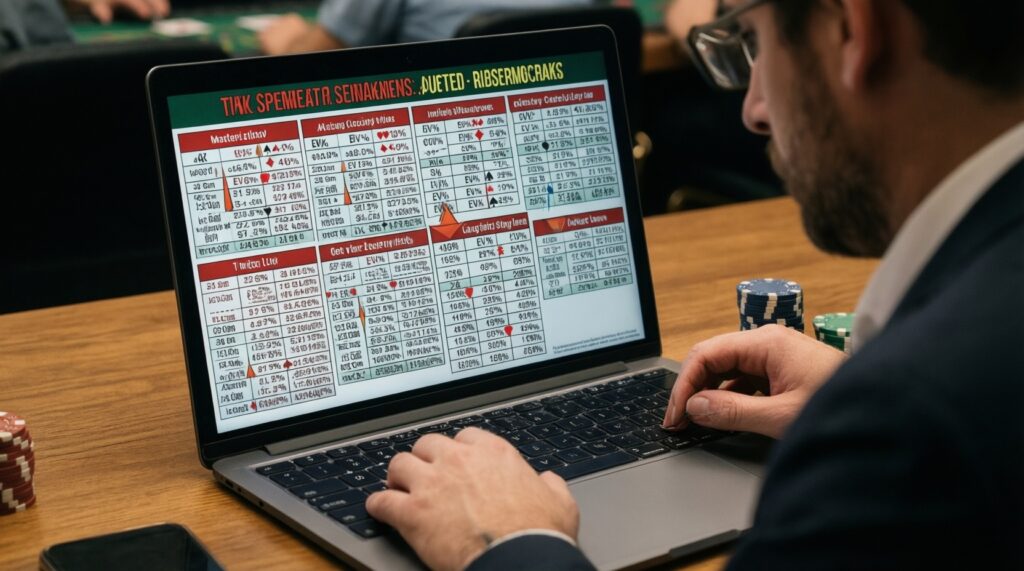
- Track EV as percentage points: edge lost = EV(baseline basic strategy) − EV(your actual play).
- The biggest leaks are usually systematic: repeating one wrong decision in a frequent spot compounds faster than rare "hero" calls.
- If your sessions show high decision variance (same spot, different action), gut-driven play is likely dominating results.
- Your target should be decision consistency: the same hand vs the same upcard should produce the same action unless rules or counts change.
- For online blackjack basic strategy, most measurable losses come from misreading table rules and autoplay/tempo errors, not from "bad luck."
How systematic strategies establish and protect expected edge
Use these criteria to choose between strict basic strategy, "basic strategy + controlled deviations," and gut-led play. The goal is not perfection; it is repeatable EV.
- Rule fit: Your strategy must match the table's rules (dealer hits/stands soft 17, surrender, double rules, splits, blackjack payout). A mismatched chart is a built-in leak.
- Decision repeatability: Can you execute the same action for the same state (hand, upcard, rules) every time?
- Error observability: Can you log hands and audit decisions afterward (screenshots/hand history notes for online)?
- Training pathway: You should be able to improve via a blackjack strategy trainer (drills on the highest-frequency hands).
- Speed tolerance: Online pace punishes hesitation; choose a method you can execute under time pressure without guessing.
- Variance management: Your bankroll sizing and session rules must prevent "tilt bets" that distort EV tracking.
- Scope control: Separate "baseline" (pure basic strategy) from "add-ons" (count-based deviations, composition-dependent lines). Mixing them ad hoc creates hidden bias.
- Compatibility with compliance/restrictions: In Thailand, access and legality can vary by operator and jurisdiction; prioritize transparent, licensed platforms if you play online.
Cognitive traps and behavioral mistakes that quietly shave off returns
These are the most common ways intermediate players donate EV while feeling "in control." The best countermeasure is to convert each trap into a rule you can execute quickly.
| Variant | Who it fits | Pros | Cons | When to choose |
|---|---|---|---|---|
| Strict basic strategy | Casual player; anyone rebuilding discipline | High consistency; easy to audit; best baseline for learning | Requires rule-specific chart; feels "mechanical" | When your goal is to stop bleeding EV and stabilize results |
| Basic strategy + pre-committed deviations (only a few) | Data analyst; process-driven trader mindset | Small controlled improvements possible; still auditable | Requires clear triggers; easy to overfit if you add too many | After you can execute strict basic strategy at speed with low errors |
| Gut-led "pattern play" | Rarely appropriate; mostly entertainment-driven | Feels adaptive; reduces boredom | Low repeatability; hard to audit; prone to hindsight bias | Only when you explicitly accept entertainment value over measurable EV |
| Tilt-responsive play (chasing, martingale-like impulses) | Fits nobody who cares about EV | Short-term emotional relief | Bankroll risk spikes; EV tracking becomes meaningless | Never as a "strategy"; treat as a stop-signal to end the session |
| Rule-confused play (wrong chart for rules) | Online-first players who table-hop | None (it's accidental) | Systematic, repeatable EV loss; persists unnoticed | When you do not verify rules before sitting-fix this first |
| Autopilot multitasking (rushed clicks, missed options) | Busy professionals playing on mobile | Fast; low effort | Misclicks, missed doubles/surrenders; inconsistent decisions | If you cannot focus, reduce stakes or stop-don't "auto" big decisions |
Edge lost (%) by mistake type and persona: measurement template
The table below is a fill-in template for your own tracking. It avoids guesswork and lets you compute blackjack odds basic strategy vs mistakes using your logs (or simulated hands). Put your measured numbers in each cell.
| Mistake type | Professional trader persona (process + risk controls) | Data analyst persona (measurement + iteration) | Casual player persona (low time, low friction) |
|---|---|---|---|
| Wrong action on common totals (e.g., 12-16 vs dealer 7-A) | Edge lost: ____% (from audit sample) | Edge lost: ____% (A/B vs baseline) | Edge lost: ____% (trainer error rate × frequency) |
| Missed double/surrender opportunities | Edge lost: ____% (tag missed options) | Edge lost: ____% (event-based logging) | Edge lost: ____% (reduce speed, use prompts) |
| Wrong chart for the table rules | Edge lost: ____% (rule checklist failures) | Edge lost: ____% (separate by rule set) | Edge lost: ____% (avoid table-hopping) |
| Bet sizing drift (tilt, "get even" behavior) | Edge lost: ____% (bankroll rule violations) | Edge lost: ____% (variance vs plan) | Edge lost: ____% (cap stakes per session) |
| Multitasking / misclicks / timeouts online | Edge lost: ____% (error flags per 100 hands) | Edge lost: ____% (latency + error correlation) | Edge lost: ____% (play slower tables) |
Practical note for Thailand-based players: if you search for the best online blackjack casino, treat "best" as the one whose rules, game speed, and transparency you can verify and log. Strategy quality depends on rule clarity and auditability as much as on the house edge.
When and why gut calls can beat rules - evidence-based scenarios

Gut does not reliably beat a correct chart. It can, however, outperform your misapplied rules in a few operational scenarios where the "rule" you are using is wrong or incomplete.
- If your chart does not match the table rules, then slowing down and using conservative, consistency-first decisions can beat fast, wrong "chart play" until you switch to the correct chart.
- If time pressure causes frequent misclicks online, then simplifying your decisions (even if slightly suboptimal) can beat rushed "optimal" intentions that you execute incorrectly.
- If you are tilting, then a gut-level stop decision (end session immediately) beats any continued "disciplined" plan you will not actually follow.
- If you cannot recall a spot confidently, then choosing the action you can execute consistently and later verify (log it, check trainer afterward) beats guessing a memorized line and reinforcing wrong memory.
- If your objective is entertainment and fixed loss-limits, then limited gut choices inside strict bankroll caps can "beat" rules in terms of experience-just don't label it EV-optimized.
Operational errors and rule-misapplications that cost measurable edge
Use this quick selection algorithm to choose your next step and stop donating EV through avoidable process failures.
- Lock the rules: write down the exact rule set of the game you play most (including payout, soft 17, double/split limits, surrender).
- Select the matching baseline: use one blackjack basic strategy chart that explicitly matches those rules; stop mixing charts between tables.
- Run a 30-minute drill: use a blackjack strategy trainer focused on your top three error categories (commonly: hard 12-16, soft totals, pair splits).
- Create two stop rules: (a) maximum stake drift from plan, (b) maximum decision errors per session (e.g., any "I guessed" counts as an error).
- Log minimal data: for each "uncertain" hand, record player total/soft/pair, dealer upcard, your action, and whether the option existed (double/surrender).
- Review and patch: convert the most frequent wrong spot into a single flashcard-style rule; repeat until errors drop.
- Only then add deviations: if you want more edge, add a tiny, pre-committed set of deviations with clear triggers-never "live inventing."
Estimating lost edge: metrics, A/B tests and confidence intervals

Common measurement mistakes that make players misread blackjack odds basic strategy vs mistakes and attribute variance to "intuition."
- No true baseline: you compare "gut sessions" to "chart sessions" without verifying the chart matched the rules in both.
- Changing multiple variables: stakes, game speed, alcohol/fatigue, and table rules shift at the same time-your A/B is not interpretable.
- Sampling only memorable hands: you review dramatic swings rather than frequent decision nodes where small EV leaks accumulate.
- Outcome-based grading: you label a decision "good" because it won, not because it matched your chosen policy.
- Ignoring error rate: you measure results but not misplays per 100 hands; execution quality is the main differentiator between systems.
- Underpowered comparisons: you draw conclusions from too few hands; instead, focus on decision accuracy and process KPIs while building sample size.
- Not segmenting by game type: you mix live-dealer, RNG, different limits, and different rule sets in one dataset.
- Confidence intervals misunderstood: you treat "not losing" as proof of edge; use intervals to express uncertainty, not to declare victory.
- Selection bias in table choice: you play "gut" only when tired or bored; you're measuring fatigue, not intuition.
Persona trade-offs: implications for traders, analysts, and hobbyists
Best fit for a professional trader persona is strict basic strategy with hard stop rules and tight rule verification, because it prioritizes process control and prevents risk-of-ruin behavior. Best fit for a data analyst persona is basic strategy plus a small set of pre-committed deviations, because it stays measurable and supports A/B iteration. Best fit for a casual player persona is strict basic strategy with simplified table selection and slower pace, because it minimizes execution errors without extra cognitive load.
Concise practitioner clarifications and rapid answers
Do I need a different blackjack basic strategy chart for different tables?
Yes. If the rules change, the optimal actions can change, and using the wrong chart becomes a systematic leak.
Is a blackjack strategy trainer worth it for intermediates?
Yes, if it targets your highest-frequency errors. You want fewer "guessed" decisions under time pressure.
Can gut feeling ever beat correct basic strategy?
Not consistently. Gut can only "beat" your play when your "strategy" is misapplied (wrong rules, misclicks, tilt) and gut helps you simplify or stop.
How do I measure blackjack odds basic strategy vs mistakes without overthinking?
Track decision accuracy and a small set of mistake tags (wrong action, missed double, wrong rules). Compare against a baseline session where you reliably used the correct chart.
What is the biggest hidden mistake in online blackjack basic strategy?
Rule mismatch and speed errors. Players often table-hop, assume rules are the same, and then play a memorized line that no longer fits.
How should I choose the best online blackjack casino for strategy practice?
Choose a platform where rules are clearly disclosed, the pace is manageable, and you can keep consistent logs. If you can't verify rules, you can't verify edge.
What should I do right after I notice tilt?
End the session immediately and record the trigger. Any continuation usually converts bankroll drift into "strategy" and destroys measurement.