
Basic blackjack strategy is a decision table that tells you when to Hit, Stand, Double, or Split based on your hand and the dealer upcard, aiming to maximize expected value (EV) over many hands. Use it as a default playbook for standard casino rules, then apply small rule tweaks rather than guessing in the moment.
Core decision rules at a glance
- Use the chart as your baseline; deviate only when a known rule change or a clear table exception applies.
- Hard totals: stand on strong made hands, hit weak totals against strong dealer upcards.
- Soft totals: be more aggressive with doubling because you cannot bust on one card.
- Pairs: split high-leverage pairs (especially A,A and 8,8) and avoid "feel-based" splits.
- If doubling is not allowed, default to Hit (sometimes Stand) exactly as the chart notes.
- When unsure at the table: follow the "hard total" line (not the soft/pair line) that matches your current hand.
Foundations of basic strategy and how EV drives choices
สูตรเล่นแบล็คแจ็ค Basic Strategy is essentially "play the hand that loses the least or wins the most on average," not "play to win this one hand." It fits intermediate players who already know rules, payouts, and hand types (hard/soft/pairs), and want repeatable decisions under time pressure.
Do not rely on a chart if:
- You are playing a side-bet-driven approach (the main hand's EV logic is different from side bet variance management).
- The game has unusual rules you cannot confirm (unknown hit/stand on soft 17, restricted doubling, or nonstandard payouts).
- You cannot manage variance emotionally or financially; basic strategy improves EV, but short-term swings remain.
Interpreting the Hit/Stand/Double/Split decision table
You need (1) the table version that matches your rules, (2) a quick way to classify your hand, and (3) a consistent fallback when an action is unavailable. Players often search for ตาราง Basic Strategy แบล็คแจ็ค or Basic Strategy แบล็คแจ็ค ตาราง Hit Stand Double Split; treat any chart as "correct only for its stated rules."
What to have ready before you play
- Rule confirmation: H17 vs S17, number of decks, double rules (any two vs 9-11 only), whether double after split (DAS) is allowed, and whether surrender exists.
- A readable chart: phone wallpaper or printed card (if allowed). Many people look for ดาวน์โหลดตารางแบล็คแจ็ค Basic Strategy; if you do, verify the rule header on the chart before using it.
- Action fallback: if the table says Double but doubling isn't allowed, usually Hit; if it says Split but splitting isn't allowed, follow the non-pair hard/soft rule.
Quick-lookup decision table (common baseline: multi-deck, dealer stands on soft 17, double on any two, DAS allowed, no surrender)
Legend: H = Hit, S = Stand, D = Double (if not allowed, usually Hit), P = Split (if not allowed, play as a hard/soft total).
| Player hand | Dealer 2 | 3 | 4 | 5 | 6 | 7 | 8 | 9 | 10 | A |
|---|---|---|---|---|---|---|---|---|---|---|
| Hard 5-8 | H | H | H | H | H | H | H | H | H | H |
| Hard 9 | H | D | D | D | D | H | H | H | H | H |
| Hard 10 | D | D | D | D | D | D | D | D | H | H |
| Hard 11 | D | D | D | D | D | D | D | D | D | H |
| Hard 12 | H | H | S | S | S | H | H | H | H | H |
| Hard 13-16 | S | S | S | S | S | H | H | H | H | H |
| Hard 17+ | S | S | S | S | S | S | S | S | S | S |
| Soft 13-14 (A,2-A,3) | H | H | D | D | D | H | H | H | H | H |
| Soft 15-16 (A,4-A,5) | H | H | D | D | D | H | H | H | H | H |
| Soft 17 (A,6) | H | D | D | D | D | H | H | H | H | H |
| Soft 18 (A,7) | S | D | D | D | D | S | S | H | H | H |
| Soft 19+ (A,8+) | S | S | S | S | S | S | S | S | S | S |
| Pair A,A | P | P | P | P | P | P | P | P | P | P |
| Pair 10,10 | S | S | S | S | S | S | S | S | S | S |
| Pair 9,9 | P | P | P | P | P | S | P | P | S | S |
| Pair 8,8 | P | P | P | P | P | P | P | P | P | P |
| Pair 7,7 | P | P | P | P | P | P | H | H | H | H |
| Pair 6,6 | P | P | P | P | P | H | H | H | H | H |
| Pair 5,5 | D | D | D | D | D | D | D | D | H | H |
| Pair 4,4 | H | H | H | P | P | H | H | H | H | H |
| Pair 3,3 | P | P | P | P | P | P | H | H | H | H |
| Pair 2,2 | P | P | P | P | P | P | H | H | H | H |
Doubling down: expected-value thresholds and bankroll-aware limits
Doubling is where EV and risk management collide: it can be correct, but it also increases variance by concentrating more money into a single decision. Use this risk-aware checklist before you "auto-double."
- Only double when you can still execute your session plan (bet sizing, stop-loss, time limit).
- Avoid doubling if you are emotionally tilted; a correct double made in tilt often triggers further mistakes.
- Confirm the rule: if "double only on 9-11" applies, do not force doubles from a different chart.
- If the table says Double and the casino limits doubling after split (no DAS), treat some doubles as Hits instead.
-
Classify the hand correctly (hard vs soft)
If you hold an Ace counted as 11 without busting, it's a soft hand; doubling windows differ heavily for soft totals. Misclassifying A,7 as "18" without the "soft" context is a common error. -
Check the dealer upcard first
Doubling is typically strongest when the dealer shows a weak upcard (often 3-6) and weakest into 10/A. If you skip this step, you'll double into the dealer's highest-strength range. -
Follow the table cell exactly, then apply the allowed-action fallback
If the chart says D, double; if doubling is not allowed for that hand, use the chart's implied fallback (usually Hit).- Example: hard 11 vs dealer A is often not a double under many rulesets; treat it as Hit when your chart indicates.
- Example: soft 18 vs 9 is commonly a Hit (not a Stand) in many baseline charts; don't "freeze" just because it feels like 18 is strong.
-
Use a bankroll-aware limit when conditions are noisy
If rules are unclear or distractions are high (online multi-table, live-chat pressure), you may choose a conservative "no-double" safety mode for the session.- Risk-aware alternative: replace marginal doubles with the chart's next-best low-variance action (often Hit on soft hands, Stand on some made hands).
- Do this as a pre-commitment rule, not ad hoc mid-hand.
-
Record the miss, not the outcome
After the round, note: "I doubled incorrectly on soft 17 vs 2" rather than "my double lost." EV learning improves from decision accuracy, not short-run results.
Pair splitting: profitable splits, exceptions, and safety plays
Splitting is powerful because it reshapes one weak combined hand into two better-defined hands. Use this checklist to verify you're applying splits consistently, especially under time pressure in สอนเล่นแบล็คแจ็ค Basic Strategy สำหรับคาสิโนออนไลน์ settings (fast dealing, auto-stand timers, or multi-table play).
- I always split A,A and 8,8 regardless of the dealer upcard (unless the game's rules explicitly prohibit it).
- I never split 10,10; I treat it as a made hand and play it as a hard 20.
- I split 9,9 against dealer 2-6 and 8-9, and I stand against 7, 10, and Ace.
- I split 2,2 / 3,3 / 7,7 against dealer 2-7, otherwise I hit.
- I split 6,6 against dealer 2-6, otherwise I hit.
- I treat 5,5 as a hard 10 (double rules apply), not as a split.
- I only split 4,4 against dealer 5-6 (and only if DAS is allowed); otherwise I hit.
- If resplitting aces is restricted, I adjust expectations and avoid chasing losses with bigger bets on later hands.
Rule and deck adjustments: how H17/S17, decks, and penetration change the table
- Using an S17 chart in an H17 game (or vice versa): the biggest practical impact is on several soft-hand decisions (especially soft doubles); confirm the rule before trusting your soft-total row.
- Forgetting DAS (double after split): some pair splits become less attractive without DAS (notably 4,4 plays), so a chart mismatch shows up as repeated "why can't I double here?" moments.
- Mixing "double any two" with "double 9-11 only": your table will recommend doubles you are not allowed to take; pre-decide the fallback (usually Hit) to avoid hesitation.
- Assuming surrender exists: if your mental chart includes surrender cells but the table/game does not, you'll misplay stiff hands by standing too often instead of hitting.
- Not tracking which table you're using: if you keep multiple charts (single-deck vs multi-deck), label them clearly so you don't cross-use them mid-session.
- Overreacting to "deck penetration" without a counting plan: penetration matters mainly for advantage play; for basic strategy, stick to the correct rule-set chart rather than inventing deviations.
- Misreading the dealer upcard in online UI: live casino camera angles can hide a 6 vs 8; if uncertain, slow down and confirm before acting.
- Applying pair rules after a hit: once you hit and change the hand composition, you are no longer in the "pair" row; immediately switch to hard/soft total logic.
Training protocol: timed drills and error-reduction when using the chart
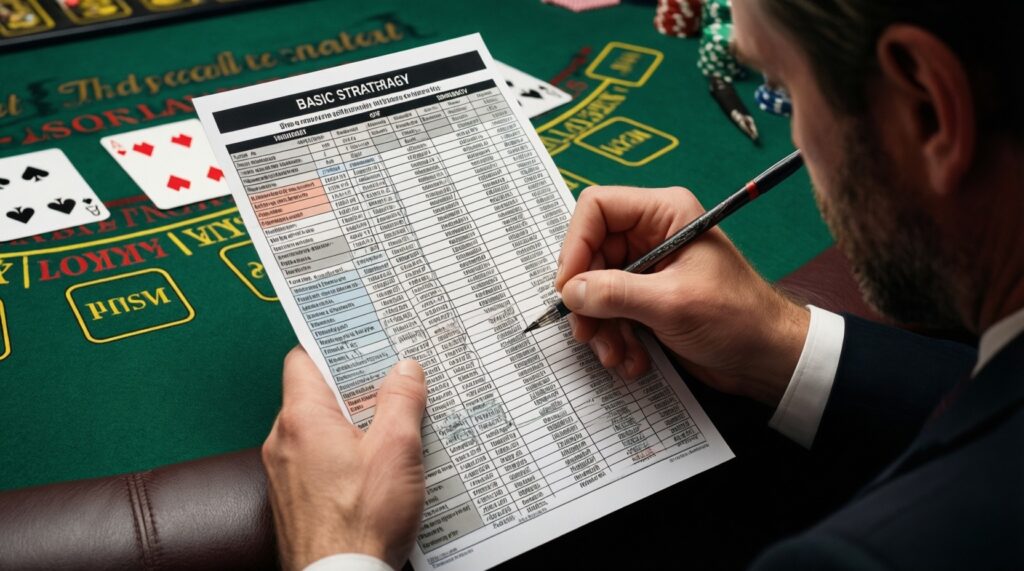
If you want fast, reliable decisions (the practical point of a chart), train in short bursts and measure errors by category (hard/soft/pair, plus dealer upcard). This is also the most realistic way to internalize a chart you found as ตาราง Basic Strategy แบล็คแจ็ค so you can use it without freezing.
Alternatives you can use depending on your constraints
-
Minimal-memory "stiff-hand anchor" method
If you struggle with memorization, learn hard 12 and hard 13-16 vs dealer 2-A first; this removes many high-frequency mistakes quickly. -
Soft-total doubling micro-drills
If you frequently misplay A,2 through A,7, drill only soft totals against dealer 2-A for 5 minutes, focusing on when doubling is recommended. -
Pairs-only split drill with DAS toggle
If you switch casinos/tables often, practice pair decisions twice: once assuming DAS, once assuming no DAS, so your "allowed actions" reflex stays clean. -
Conservative session mode
If you play tired or distracted, pre-commit to a safety mode: follow the chart for Hit/Stand/Split, but replace marginal doubles with the fallback action for that cell. This reduces variance and prevents rushed doubling errors.
Practical concerns players ask about in play
Can I use one chart for every casino?
Only if the rules match. At minimum, confirm H17/S17 and doubling restrictions, then use the corresponding table.
What if the chart says Double but the table doesn't allow it?
Use the chart's fallback for that cell (commonly Hit). Decide this before you start so you don't improvise under pressure.
Do I always split A,A and 8,8?
Yes in standard rulesets, because those splits reshape very poor/awkward hands into higher-quality starting points. If the casino restricts splitting, follow the hard/soft total rules after the restriction.
Is basic strategy different for online live casino?
The decisions are the same for the same rules, but execution is harder due to timers and UI. That's why a readable chart and pre-chosen fallbacks matter more online.
Should I change plays after a losing streak?
No-streaks are variance. Changing decisions usually reduces EV more than it reduces risk.
How do I stop making "soft hand" mistakes?

Say out loud (or mentally) "soft" whenever you have an Ace counted as 11, then consult the soft row. Most errors come from treating soft totals like hard totals.
When is it okay to ignore the chart for a safer play?
If you pre-commit to a conservative mode for bankroll or tilt control, you can replace some doubles with the fallback action. Don't override splits like A,A or 8,8 based on fear.