

To stop chasing losses, replace "win it back now" decisions with pre-committed rules: fixed risk per trade, daily loss caps, forced cooldowns, and a recovery protocol after drawdowns. You will still feel urgency, but your process prevents impulsive sizing and revenge trades by limiting exposure and requiring a deliberate reset before the next position.
Core behavioral rules to prevent chasing losses

- Decide risk limits before the session; never negotiate them mid-trade.
- One loss does not change your edge; only position size and rule-breaking do.
- After a rule break, stop trading immediately and run a reset routine.
- Use "if-then" commitments (triggers → actions) to bypass willpower.
- Measure discipline (rule adherence), not only profit and loss.
- Automate what you can: bracket orders, max position limits, alerts.
Why chasing losses starts: cognitive biases and emotional drivers
- Use this guide if: you increase size after losses, widen stops, move targets, or feel compelled to "fix the day" with one trade.
- Pause and simplify if: you are sleep-deprived, angry, or trading money you cannot afford to lose-your best "strategy" then is capital protection, not optimization.
Chasing losses is usually a mix of loss aversion, recency bias, and ego protection. The mind treats a loss like an unfinished task, so it seeks immediate closure. If you've taken a คอร์สจิตวิทยาการเทรด or read a หนังสือจิตวิทยาการลงทุน, you already know the theory-this page focuses on enforceable behaviors.
Self-talk script (use verbatim): "My job is to execute the plan, not to recover today. I recover by staying solvent and consistent."
Settable risk limits: defining stop-loss, position-sizing and daily caps
Prepare these items before you trade:
- Written risk policy (one page): max risk per trade, max loss per day, max loss per week, and when trading stops.
- Position-sizing method: a simple formula you can execute fast (risk-based sizing is preferred).
- Stop-loss placement rule: where a trade is proven wrong (structure-based), not where "it hurts less."
- Platform controls: bracket orders (entry + stop + target), alerts, and hard limits if available in your โปรแกรมเทรดพร้อมระบบบริหารเงินทุน.
- Account segregation (optional but powerful): separate "strategy account" from "experiment account" to prevent emotional cross-contamination.
Example rule set: "I risk a fixed fraction of my account per trade; I stop for the day after hitting my daily loss cap or after two rule violations-whichever happens first." If you need help implementing the mechanics, a คอร์สบริหารความเสี่ยงในการเทรด can be useful, but only if it results in explicit, testable limits.
Pre-trade rituals and commitment devices to enforce discipline
-
Write today's hard stops (60 seconds)
Before the first trade, write: max loss for the day, max number of trades, and your cooldown rule. Put it where you will see it (sticky note or the first line of your trading journal).
- Non-negotiable line: "If daily cap is hit, I stop trading and switch to review mode."
-
Pre-commit the order structure
Use bracket orders or an OCO (one-cancels-other) setup so the stop is placed automatically. If your platform cannot automate, you must place the stop immediately after entry-no exceptions.
-
Run a 3-question trade filter
Answer out loud before clicking:
- "Where is my invalidation level (stop)?"
- "What is my planned risk in currency terms?"
- "What condition makes me skip this trade?"
-
Set a revenge-trade tripwire
Define a trigger that signals emotional hijack. A simple one: "Any urge to double size after a loss = no new trade for 20 minutes."
- Optional: ask a โค้ชเทรดหุ้นส่วนตัว to help you define your personal tripwires and keep you accountable.
-
Prepare a micro-reset script for losses
After any losing trade, read: "Loss logged. Next trade only if my checklist is green." Then stand up, drink water, and re-check the market condition you trade best.
-
Lock in size for the session
Set your base position size once. If you change size, it must be due to a pre-defined volatility rule-not because you are "down today."
Fast mode: the 60-second anti-chase algorithm
- Write today's daily loss cap and the exact stop-trading condition.
- Trade only with a pre-placed stop (bracket/OCO) and fixed risk per trade.
- After any loss: 20-minute timeout + re-run the 3-question filter.
- After any rule break: stop trading for the day and do a review.
Real-time interventions: breathing, timeouts and forced automation
Use this checklist during the session (especially after a loss). If you fail any item, you do not place the next trade yet.
- I can state my stop level and risk amount without hesitation.
- I am not increasing size to "get back to even."
- I have not moved a stop further away after entry.
- I completed a 60-90 second slow-breath cycle before re-entering the market.
- I took a physical break (stand up, step away from the screen) after the last loss.
- I am trading my A-setup only; anything else is a pass.
- My next trade is within daily cap limits even if it loses.
- My platform protections are on (brackets, alerts, max size limits if available).
Breathing protocol (simple): inhale slowly through the nose, exhale longer than the inhale, repeat for about one minute. The goal is to slow impulse speed, not to "feel positive."
Structured recovery plan after a drawdown: step-by-step actions
Common mistakes that keep traders stuck in a chasing-losses loop:
- Switching strategy to match recent pain: changing timeframe or instrument immediately after losses.
- "One big trade to fix it" thinking: oversized bets framed as efficiency.
- Making back losses the primary goal: replacing process goals with P&L goals.
- Removing stops or widening them: converting a planned loss into an uncontrolled one.
- Overtrading to feel productive: frequent low-quality entries to reduce anxiety.
- Revenge trading against a specific symbol: treating the market like a person who "owes you."
- Skipping review: you repeat the same error because it stays unnamed.
- Returning at full size too soon: confidence has not recovered, but risk is already maxed.
Recovery script (use after a bad day): "Today is data. Tomorrow I trade smaller until I show clean execution again."
Tracking discipline: metrics, review cadence and corrective experiments
If your current approach still leads to chasing losses, use one of these alternatives depending on your situation:
- Rule-adherence scorecard (best for intermediates)
Track 5-8 rules (stop placement, sizing, cooldowns, A-setup only). Review weekly and fix the single rule with the worst compliance first. - "Two-week micro-experiment" cycles (best when you keep tweaking)
Change one variable for two weeks (e.g., mandatory 20-minute timeout after any loss), then keep or discard it based on discipline improvement. - External accountability (best after repeated relapses)
Work with a โค้ชเทรดหุ้นส่วนตัว or peer review partner who checks your journal and enforces consequences for rule breaks. - Tool-based enforcement (best when willpower fails)
Adopt a โปรแกรมเทรดพร้อมระบบบริหารเงินทุน setup that enforces max size, auto-stops, and session lockouts.
Short solutions to common trader dilemmas
I keep doubling my size after a loss. What do I do today?
Freeze size for the entire session and set a hard rule: after any loss, a mandatory cooldown before the next entry. If you can't follow it, stop trading for the day.
Should I move my stop to avoid getting stopped out?
No-moving a stop further away after entry is a chasing-losses behavior. If the stop was wrong, exit and redesign the setup for the next trade.
I hit my daily loss cap early. Can I trade smaller to recover?
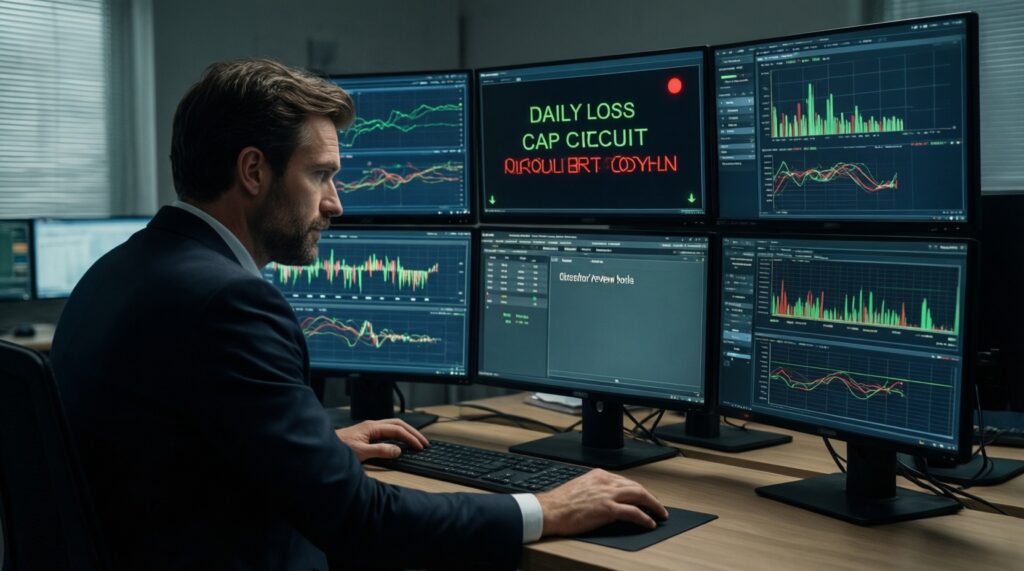
Not the same day. A daily cap is a circuit breaker; once hit, you switch to review mode and resume on the next session with reduced size.
How do I know it's emotion and not a valid "adjustment"?
If the change was not written before the session, treat it as emotion. Valid adjustments come from pre-defined rules (e.g., volatility-based sizing), not from P&L pressure.
Is journaling necessary if I already understand psychology from a คอร์สจิตวิทยาการเทรด?
Yes-understanding is not enforcement. A journal turns vague feelings into specific triggers and measurable rule adherence.
What's the fastest way to regain confidence after a drawdown?
Trade smaller and focus on perfect execution for a fixed number of sessions. Confidence returns from repeated clean process, not from a single big win.
Should I switch to automated trading to prevent chasing losses?
If you already have a tested strategy, automation can reduce impulsive overrides. If you don't have tested rules, automation just speeds up mistakes.