
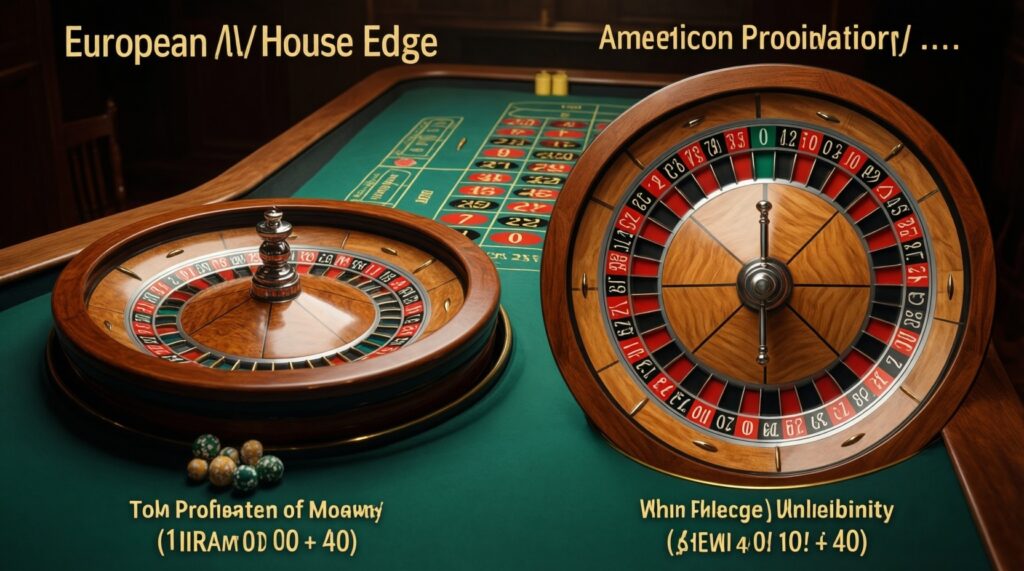
European roulette generally offers a lower house edge than American roulette because it has one zero instead of two. That single design difference changes the expected loss per unit bet, which should drive your game choice, staking size, and session length. For most players deciding "เล่นรูเล็ตแบบไหนดี ยุโรปหรืออเมริกัน", European is the more cost-efficient baseline.
How House Edge Shapes Betting Decisions
- A lower house edge reduces your average loss rate, letting your bankroll last longer under the same variance.
- House edge is driven by wheel layout; changing betting "systems" does not change the underlying expected value.
- With the higher edge, American roulette punishes long sessions and recovery betting more quickly.
- When budgets are tight, the best "strategy" is choosing the lower-edge game and sizing bets conservatively.
- Premium bankrolls buy you time and entertainment, not a positive expectation; game selection still matters.
Wheel Layout and Its Effect on Odds
If you're comparing รูเล็ตยุโรป vs อเมริกัน ต่างกันยังไง, focus on the wheel mechanics that directly alter probabilities and payouts.
- Number of zero pockets: European has 0; American has 0 and 00. More zero pockets increases the casino edge.
- Total pockets: European uses 37 pockets; American uses 38. This changes every win probability by changing the denominator.
- Payout structure stays "fixed": Most bets pay as if there were 36 numbers; the extra pocket(s) create the edge.
- Outside bets and zero behavior: On both wheels, 0 (and 00) typically makes red/black, odd/even, and high/low lose (unless special rules apply).
- Rule variants: Some tables apply "la partage" or "en prison" on even-money bets (common in some European contexts), reducing loss impact on zero.
- Table limits: Minimums and maximums can force suboptimal staking, especially for low-budget players.
- Speed and friction: Faster spins and side bets increase hands per hour and can increase losses even if the edge is unchanged.
- Bet availability: Some venues push higher-edge side bets; your strategy should decide in advance what you will ignore.
Numeric Comparison: European vs American House Edge
Below is the math-derived comparison behind the common questions รูเล็ตยุโรป house edge เท่าไหร่ and รูเล็ตอเมริกัน house edge เท่าไหร่. House edge comes from the zero pocket(s), not from player decisions.
Compact odds and expected value snapshot
| Wheel | Pockets | Zero pockets | Win probability on a 1-number bet | House edge (derived) | EV per $1 wager (derived) |
|---|---|---|---|---|---|
| European | 37 | 0 | 1/37 | 1/37 | −1/37 |
| American | 38 | 0, 00 | 1/38 | 2/38 | −2/38 |
Which option to choose (practical comparison)
| Variant | Who it fits | Pros | Cons | When to choose |
|---|---|---|---|---|
| European roulette (single-zero) | Most intermediate players; budget-first sessions | Lower built-in cost per bet; better for longer play | Still negative EV; can encourage overplaying because it "feels" fairer | Default pick when you have a choice and want the best baseline expectation |
| American roulette (double-zero) | Players optimizing for availability rather than cost | Often easier to find in some venues; same bet menu | Higher built-in cost; recovery systems collapse faster | Only if it's the only wheel available and you reduce stakes/session length |
| European roulette with even-money half-loss rules (if offered) | Players sticking to red/black, odd/even, high/low | Softens the impact of a zero outcome on even-money bets | Usually applies only to even-money bets; not universal | If you see the rule posted clearly and your plan is mostly even-money betting |
| European roulette (single-zero) + strict "no side bets" policy | Budget-first players who tend to chase promotions/bonuses | Keeps your average edge closer to the wheel's baseline | Less variety; requires discipline | If your goal is maximizing time-on-bankroll and reducing unnecessary edge |
| American roulette + micro-stakes + entertainment pacing | Premium bankrolls or "night out" play where cost is acceptable | Lets you participate with controlled burn rate | Still the priciest baseline among the two wheels | If you must play American but want to control loss rate via low unit sizing |
Expected Value Examples with Common Bets
Use expected value (EV) to translate "house edge" into what your strategy is really buying: time and variance, not profit. EV is computed as EV = (P(win) × profit) − (P(lose) × stake).
-
If you bet straight-up numbers, then European loses less per $1 than American (same volatility, different cost).
Example (straight-up, $1 stake, payout profit = $35):- European: EV = (1/37 × 35) − (36/37 × 1) = (35 − 36)/37 = −1/37.
- American: EV = (1/38 × 35) − (37/38 × 1) = (35 − 37)/38 = −2/38.
-
If you mainly play even-money outside bets, then wheel choice still matters; the bet type does not remove edge.
Example (red/black, $1 stake, payout profit = $1; ignoring special rules):- European: P(win)=18/37, P(lose)=19/37 → EV = (18/37 × 1) − (19/37 × 1) = −1/37.
- American: P(win)=18/38, P(lose)=20/38 → EV = (18/38) − (20/38) = −2/38.
-
If you use dozens/columns as a "middle volatility" choice, then the edge remains the same; only variance changes.
Example (column, $1 stake, payout profit = $2):- European: P(win)=12/37, P(lose)=25/37 → EV = (12/37 × 2) − (25/37 × 1) = (24 − 25)/37 = −1/37.
- American: P(win)=12/38, P(lose)=26/38 → EV = (12/38 × 2) − (26/38 × 1) = (24 − 26)/38 = −2/38.
-
If your bankroll is low, then prioritize European + smaller units; if your bankroll is premium, then prioritize rules and pacing, not escalation.
Budget-first: choose the single-zero wheel and keep a fixed unit so a short losing run doesn't force you into "recovery" bets.
Premium: you can afford higher variance (e.g., more inside bets), but the wheel's EV still caps your long-run expectation. -
If your goal is specifically "กลยุทธ์เล่นรูเล็ตยุโรป ลดความได้เปรียบเจ้ามือ", then the only reliable lever is game/rule selection plus avoiding extra-edge bets.
You cannot negotiate the wheel math with a staking pattern; you can only avoid worse conditions (double-zero, side bets, high speed).
Strategic Adjustments for Low-Budget Players
- Select the wheel first: pick European (single-zero) whenever available; treat American as "higher fee per spin."
- Set a unit size: use a base unit of 1-2% of your session bankroll per spin (choose 1% if you tend to chase losses).
- Choose one bet category per session: either even-money (lowest swing) or columns/dozens (medium swing). Avoid mixing with straight-ups "for excitement."
- Cap exposure per spin: keep total chips on the layout ≤ 2 units (example: two outside bets, or one column bet).
- Predefine a stop-loss: end the session at 10-20 units down (tighter for American roulette).
- Predefine a stop-win: lock results at 10-15 units up to prevent giving back gains during high-speed play.
- Remove accelerators: skip side bets, skip "neighbor" packages, and avoid raising unit size after losses.
Risk Profiles: Volatility, Streaks and Bankroll Stress
- Assuming "outside bets are safe": they have lower variance, but they still carry the same wheel edge.
- Using American roulette for long sessions: higher edge compounds faster with more spins.
- Chasing with recovery systems: Martingale-like progressions increase bet size faster than most bankrolls and table limits allow.
- Ignoring total exposure: placing multiple "small" bets can quietly raise your per-spin risk beyond your plan.
- Confusing streaks with signals: streaks are expected in random sequences; changing bets doesn't change the wheel.
- Overweighting short-term wins: a brief profit doesn't imply an edge; it's variance around a negative EV.
- Not reading rules: special zero-handling rules can materially change even-money outcomes; assuming them without confirmation is costly.
- Playing faster than your decision speed: speed increases "spins per bankroll," which increases expected loss per hour.
Practical Betting Plans: Flat, Spread and Recovery Models

Best for budget-first control is a flat, single-unit plan on European roulette, keeping total exposure to 1-2 units per spin. Best for players who want slightly more action without jumping to inside-bet volatility is a spread plan (one column or one dozen) with the same fixed unit. If you insist on recovery models, the least damaging approach is a tight, capped progression on European only, with a hard stop once you hit your cap.
Practical Concerns Players Ask About
Does switching from American to European roulette really change my long-run results?
Yes, because the number of zero pockets changes the expected loss per unit wager. Your variance can look similar, but the average cost per spin is lower on the single-zero wheel.
Can any betting system overcome the house edge?
No. Staking systems redistribute variance and bankroll stress, but the expected value is set by the wheel and payout schedule.
What's the simplest answer to "เล่นรูเล็ตแบบไหนดี ยุโรปหรืออเมริกัน"?
Choose European (single-zero) when you have access to both. If only American is available, lower your unit size and shorten your session.
Should I focus on inside bets or outside bets if my budget is small?
Outside bets are usually easier on bankroll swings, so they fit small budgets better. Just keep the unit small and avoid adding multiple extra bets per spin.
Do columns/dozens reduce the house edge compared with straight-up bets?
No, the house edge is the same across standard bets on the same wheel. Columns/dozens mainly change volatility and hit frequency.
How do I apply "กลยุทธ์เล่นรูเล็ตยุโรป ลดความได้เปรียบเจ้ามือ" in practice?

Pick single-zero, avoid side bets, and keep fixed units with strict session limits. That reduces unnecessary extra edge and prevents loss-chasing.