
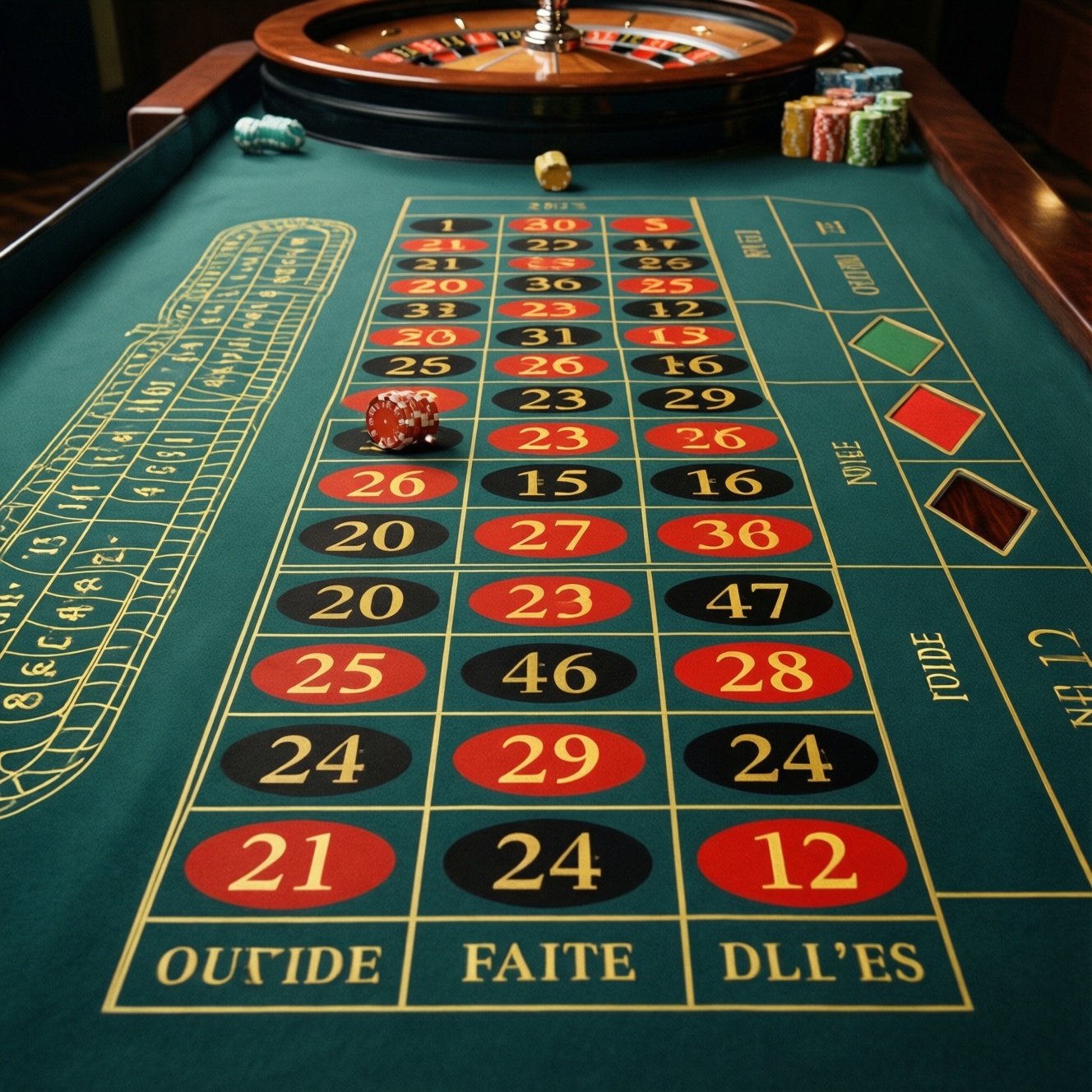
Outside (วงนอก) and inside (วงใน) roulette bets usually share the same long-run expected value (EV) on the same wheel; the practical difference is volatility: inside bets swing harder with rarer hits and bigger payouts, while outside bets hit more often with smaller payouts. The best choice depends on risk tolerance and bankroll discipline.
At-a-glance EV and Variance Summary
- For the same roulette wheel rules, EV is driven by the house edge, not by whether you play outside or inside.
- Inside bets concentrate outcomes: fewer wins, larger payouts, higher variance per unit staked.
- Outside bets smooth outcomes: more frequent wins, smaller payouts, lower variance per unit staked.
- "Best" is profile-dependent: Conservative players usually prefer outside-heavy; Aggressive players may allocate a small inside "shot" portion.
- A mixed "bet portfolio" can target a preferred swing level without changing the underlying EV.
- Bankroll rules (stop-loss, win cap, sizing) often matter more than the bet label itself.
Mathematical EV: Inside vs Outside Bets Compared
If you're asking เดิมพันรูเล็ต วงนอก วงใน ต่างกัน, the clean mathematical answer is: mainly in payout structure and variance, not in EV (assuming correct payouts and the same wheel). Use these criteria to choose what fits your goal and constraints:
- Wheel type & rules: European vs American (single vs double zero) shifts EV for every bet; confirm before choosing a style.
- Payout correctness: Verify published payouts (even-money, 2:1, 35:1, etc.). EV depends on payout matching true odds.
- Hit frequency preference: Do you want frequent small wins (outside) or rare big wins (inside)?
- Volatility tolerance: How large a drawdown can you emotionally and financially accept?
- Session objective: Entertainment time-on-table (often outside) vs "jackpot-style" excitement (inside).
- Bankroll size vs minimum bet: If table minimum is high relative to bankroll, inside-heavy play becomes fragile.
- Tracking & execution risk: Inside layouts increase misclick/misplacement risk and complexity.
- Promotion constraints: Some bonuses exclude certain bets; align stake types with wagering rules.
Core formula (useful for "สูตรคำนวณ EV รูเล็ต"): for a 1-unit stake, define p as win probability and b as net payout (profit) in units. Then EV = p·b − (1−p)·1. Different bets change p and b, but the house edge (set by wheel/rules) largely determines the final EV across standard bets.
Volatility and Risk: Measuring Variance per Bet Type

To answer "รูเล็ต ความผันผวน (volatility) คืออะไร" in practical terms: volatility is how widely your results swing around the average. A common metric is variance: Var(X) = E[X²] − (E[X])². Higher payout + lower hit frequency typically increases variance for the same stake.
| Variant | Who it fits | Pros | Cons | When to choose |
|---|---|---|---|---|
| Even-money outside (Red/Black, Odd/Even, 1-18/19-36) | Conservative, time-on-table, low-stress sessions | High hit frequency; simple execution; typical payout 1:1; usually lower variance than inside bets | Small wins; long-run EV still negative due to house edge | When you want smoother swings and easier bankroll control (common in กลยุทธ์เดิมพันรูเล็ต วงนอก) |
| Dozens (1-12, 13-24, 25-36) | Balanced players who want moderate swings | Medium hit frequency; typical payout 2:1; clearer "range" thesis than single numbers | Variance higher than even-money; still vulnerable to streaks | When you want a middle ground between outside steadiness and inside punch |
| Columns (2:1 columns) | Balanced players who prefer structured coverage | Medium hit frequency; typical payout 2:1; easy to combine with even-money overlays | Can create uneven exposure if you stack many bets; variance moderate | When you want portfolio-style coverage without going fully inside-heavy |
| Straight-up single number (inside) | Aggressive, thrill-seeking, small "shot" allocation | Large payout potential; typical payout 35:1; strong excitement per unit risked | Low hit frequency; high variance; long losing streaks are common | When you explicitly accept high swing and cap the stake as a small slice of your session |
| Split (two numbers, inside) | Aggressive but slightly more controlled than straight-ups | Better hit frequency than single number; typical payout 17:1 | Still high variance; can encourage overbetting after misses | When you want "inside feel" with a bit more coverage |
| Street (three numbers, inside) | Balanced-to-aggressive with layout discipline | Higher hit frequency than splits; typical payout 11:1 | Variance remains high relative to outside bets; easy to drift into many overlapping streets | When you want targeted coverage without chasing a single number |
| Corner (four numbers, inside) | Balanced players who want inside-style payouts with more coverage | Higher hit frequency among classic inside bets; typical payout 8:1 | Still swingy; can be mis-staked physically/online if careless | When you want inside exposure but need slightly smoother outcomes than straight-ups |
Portfolio Construction: Mixing Inside and Outside Stakes

Mixing stakes doesn't "fix" EV, but it can match a preferred volatility profile while keeping execution simple. Use "if..., then..." rules to build a repeatable allocation:
- If you want maximum stability, then keep most of the stake on even-money outside bets and avoid stacking multiple inside bets in the same spin.
- If you prefer a balanced ride, then pair one outside bet (1:1) with one medium-volatility bet (a dozen or a column) and cap total exposure per spin.
- If you want occasional big hits without constant stress, then allocate a small fixed "shot budget" to one inside bet (corner/street/split) and never increase it after losses.
- If your bankroll is tight relative to table minimum, then avoid inside-heavy plans; use fewer simultaneous bets and prioritize outside coverage to reduce drawdown speed.
- If you notice execution mistakes (misclicks, wrong spots), then simplify to 1-2 repeatable bets per spin before adding any inside components.
Persona-based recommendations (practical starting points)
- Conservative (low swing): outside-heavy (even-money); optionally add a single dozen/column only if you can tolerate moderate variance.
- Balanced (controlled action): one even-money + one dozen/column; consider a tiny, fixed inside "shot" only if bankroll rules are strict.
- Aggressive (high swing, capped risk): a small outside anchor for rhythm + a limited inside allocation (corner/street/split/straight-up) with hard stop rules.
- System-tester (likes tracking): choose one stable base bet and one experimental add-on; log spins and outcomes to avoid "vibes-based" switching mid-session.
Bankroll Strategies: Kelly, Flat Betting, and Fractional Kelly
This is the practical decision path for วิธีจัดการเงินทุน (bankroll) เดิมพันรูเล็ต, focusing on sizing rather than "prediction."
- Confirm you have a real edge. If you can't justify positive EV (rare in roulette), assume negative EV and prioritize risk control over growth.
- Pick a unit size. Set 1 unit so that a normal losing streak won't force you to quit early (units should feel boring, not painful).
- Default to flat betting for negative-EV play. Same total stake per spin is the most stable baseline for entertainment sessions.
- Use Kelly only when EV is genuinely positive. Full Kelly is aggressive; if uncertain, do not "Kelly" a guess.
- If you insist on Kelly-style sizing, go fractional. Use a small fraction to reduce estimation error risk and drawdowns.
- Add session limits. Define a stop-loss and a win cap in units; stop when either hits to prevent tilt-driven sizing changes.
- Lock the portfolio. Predefine your outside/inside mix and keep it unchanged for a fixed block of spins before reviewing.
Simulation Insights: Expected Outcomes Across Profiles
Even without running your own code, you can predict common failure modes from EV and variance behavior. These are the mistakes that most often sabotage "best option" decisions for intermediate players:
- Confusing hit rate with profitability: frequent outside wins can still lose money long-term, and rare inside hits don't "prove" an edge.
- Chasing variance: switching to inside bets after losses (or doubling) increases drawdown risk without improving EV.
- Overstacking bets: placing many simultaneous inside wagers feels diversified but often just raises total stake and volatility.
- Progressions on negative EV: martingale-style sizing can create catastrophic session risk even if it "wins often."
- Ignoring table rules: not checking wheel type and payout rules makes EV comparisons meaningless.
- Letting emotions pick the mix: changing the portfolio mid-session based on recent streaks amplifies volatility.
- Misreading short samples: a brief run can make inside betting look amazing or terrible; the distribution is naturally lumpy.
- Bankroll-unit mismatch: using a unit too large turns moderate variance bets into "all-in feeling" outcomes.
Practical Rules: Table Selection, Bet Sizing, and Exit Triggers
Best for Conservative profiles is usually a simple outside core with flat sizing and strict limits; best for Balanced profiles is an outside anchor plus one structured 2:1 bet with a capped total stake; best for Aggressive profiles is a small, fixed inside "shot" budget layered onto a controlled base-chosen after confirming rules, minimums, and a clear stop-loss/win-cap plan.
Quick Practical Answers to Common Strategy Doubts
Do outside and inside bets have different EV on the same wheel?
Usually no: standard roulette bets are priced so the house edge applies broadly across bet types. The real difference is volatility and hit frequency, not EV.
What does "roulette volatility" mean in decision-making?
It means how large and how fast your results swing around the average. Inside bets tend to be more volatile because wins are rarer but larger.
Is an outside-bet strategy automatically safer?
It is typically lower variance per unit, so sessions feel smoother. It's not "safe" in the sense of positive EV; long-run expectation remains negative under normal rules.
When should I include a straight-up number in my portfolio?
Only when you explicitly want high variance and can cap it as a small, fixed portion of your total stake. Never increase the straight-up size after misses.
Should I use Kelly staking in roulette?
Only if you have a verified positive edge, which is uncommon in roulette. Otherwise use flat betting or very conservative sizing rules to manage downside.
How many different bets should I place per spin?

For most intermediate players, 1-2 repeatable bets per spin reduces execution errors and keeps volatility understandable. Add complexity only after consistent tracking and discipline.