

To trade with discipline, set your stop-loss (SL) and take-profit (TP) before entry, tie both to market structure and volatility, and size the position so a stopped-out trade costs a fixed, small amount of your account. This is the practical core of ตั้ง stop loss take profit without emotional overrides.
Core principles for disciplined Stop‑Loss and Take‑Profit planning
- Define one invalidation point (SL) and one objective (TP) before you enter; no "decide later."
- Place SL where your trade idea is proven wrong, not where the loss feels smaller.
- Set TP where the market is likely to react (previous swing, range edge), not at random percentages.
- Use position sizing so the same setup risks the same money across different volatility conditions.
- Automate exits with orders/alerts to reduce impulsive manual decisions.
- Track outcomes by R-multiples (reward-to-risk) to judge edge, not by single-trade P&L.
Defining realistic profit targets from market structure and timeframes
- Match TP to your trading horizon. If you enter on a 15m chart, your first TP should typically align with a nearby 15m/1h structure level; for swing trades, use daily/weekly structure.
- Pick "reaction zones," not single-price fantasies. Previous swing high/low, range boundaries, and supply/demand zones are practical TP areas.
- Use a simple template for วิธีตั้งเป้าหมายกำไร take profit: "TP = next major opposing structure level on the next higher timeframe."
- When it fits: trending markets (higher highs/higher lows or lower highs/lower lows), clean ranges, or catalysts where structure is respected.
- When not to do fixed TP: extremely news-driven spikes, illiquid instruments with wide spreads, or when you cannot define clear structure (choppy, noisy conditions). In these cases, consider trailing rules (covered later).
Calculating stop‑loss levels: volatility, support/resistance, and percentage methods
- Market access: a broker/exchange that supports stop orders (spot, margin, futures, CFDs) and shows order history.
- Chart tools: ability to plot support/resistance and an ATR (Average True Range) indicator, or a volatility proxy.
- Basic calculator: phone calculator or spreadsheet; this is your เครื่องคำนวณ stop loss take profit in the simplest form.
- Required data: account size, maximum risk per trade, entry price, SL price, instrument tick size/contract specs, and fees.
- Method A: Structure-based SL (recommended). Place SL beyond the level that invalidates the setup (below support for longs, above resistance for shorts), plus a small buffer for noise.
- Method B: Volatility-based SL (ATR). Example template: "SL distance = 1.0-2.0 × ATR (timeframe of entry) away from entry, in the direction that invalidates the trade."
- Method C: Percentage SL (use carefully). "SL = entry ± X%." Only reasonable if volatility is stable; otherwise you'll get stopped too often or risk too much.
One-line template for วิธีตั้งจุดตัดขาดทุน stop loss: "SL goes past the invalidation level + buffer, then position size is adjusted so money risk stays constant."
Sizing positions to keep portfolio risk within limits

- Decide your fixed risk per trade (money or % of equity) before choosing position size.
- Confirm the real SL distance in price terms (including spread and a realistic buffer).
- Know the instrument's contract value (especially for futures/CFDs) to avoid sizing errors.
- Plan for worst-case execution (slippage) during fast moves and around announcements.
-
Set a maximum risk per trade.
Choose a fixed amount you can lose per trade without breaking your plan (money or %). This is the foundation of เทคนิคบริหารความเสี่ยง ตั้ง stop loss สำหรับเทรด.- Keep it consistent across trades so results are comparable.
-
Define entry, SL, and TP prices (not vibes).
Write them down before clicking buy/sell. If you can't define a clear invalidation point, skip the trade.- Long: SL below invalidation support; Short: SL above invalidation resistance.
-
Compute SL distance in price units.
Formula: SL_distance = |Entry − SL|. Add expected costs: spread + typical slippage (especially on lower liquidity pairs). -
Calculate position size from risk and SL distance.
Core formula (spot/linear products): Position_size = Risk_amount ÷ SL_distance.- Example: Account 100,000 THB, risk 500 THB, entry 50.00, SL 49.00 → SL_distance = 1.00 → position size = 500 units (before fees/contract specifics).
- Futures/CFDs: convert SL_distance into money per contract using contract value/tick value, then size = Risk_amount ÷ (money risk per contract).
-
Validate reward-to-risk before placing the trade.
Formula: R:R = (TP − Entry) ÷ (Entry − SL) for longs (use absolute values). If R:R is weak for your strategy, reduce size? No-adjust levels or skip the trade. -
Place orders and record the plan.
Submit SL and TP as orders (or conditional orders) immediately after entry, then log: setup, timeframe, entry, SL, TP, risk, and rationale.
Order types and conditional rules to automate exits
- SL is a stop market (higher certainty of exit) or stop limit (price control but risk of no fill) depending on liquidity and volatility.
- TP is typically a limit order placed at the target zone.
- Use OCO (One-Cancels-the-Other) or equivalent so SL and TP are linked and you don't accidentally keep the other leg after exit.
- For partial exits: split TP into 2-3 limits (e.g., TP1 at nearest structure, TP2 at extended level) while keeping one protective SL for the remaining size.
- For trailing: use a trailing stop or "move SL to break-even after X R" rule only if it matches your backtested behavior.
- Automation checklist (pass/fail):
- SL order is live and visible on the order book immediately after entry.
- TP order is live and aligned with a marked structure zone, not a random number.
- SL and TP are linked via OCO/conditional logic (or you have a written manual fallback).
- Order type matches conditions: stop market for fast markets; stop limit only if fills are reliably achievable.
- Position size matches your risk formula after fees/spread assumptions.
- You verified contract/tick value (futures/CFDs) so "risk per point" is correct.
- Alerts are set for: entry filled, SL moved, TP hit, SL hit, and order rejected.
- There is a contingency plan if platform/broker fails (phone close-out, secondary device, or hard stop on broker side).
Behavioral rules to stick to SL/TP during winning and losing streaks
- Moving SL farther away "to give it room." If the setup is invalidated, accept the loss; widening SL breaks the risk model.
- Canceling TP because price is going your way. Use predefined trailing rules; don't improvise mid-trade.
- Taking profit early out of fear. If you systematically cut winners, your R-multiples collapse even with a high win rate.
- Revenge sizing after a loss. Keep risk per trade constant; don't "make it back" by increasing size.
- Overconfidence after wins. Stick to the same entry criteria and risk cap; winning streaks are not proof of invincibility.
- Ignoring liquidity and spreads. SL/TP must account for spread widening (common around sessions/announcements).
- Not respecting timeframe. Setting a tiny SL on a higher-timeframe trade is a mismatch; noise will stop you out.
- Trading without a written plan. If you can't write entry, SL, TP, and risk in one minute, you're not prepared.
Evaluating performance: backtests, edge metrics, and a trade journal routine
- R-multiple review (fast, practical). Track each trade as +R or −R where 1R = your initial risk. Use it when comparing different SL/TP rules across instruments.
- Rule-based replay/backtest. Manually replay charts with the same SL/TP logic (structure/ATR/percent) to see if exits are consistent with the setup type.
- Trade journal with "decision audit." Log whether you followed the plan (yes/no), what you changed, and why. Use it when discipline is the main bottleneck, not strategy ideas.
- Alternative exit style: trailing-only. Use when trends are strong and fixed targets frequently cut the move; define trailing rules in advance (e.g., trail below swing lows) and judge by R distribution.
Practical troubleshooting for SL/TP setups and common edge cases
My stop-loss gets hit by a wick and price reverses. What should I change?
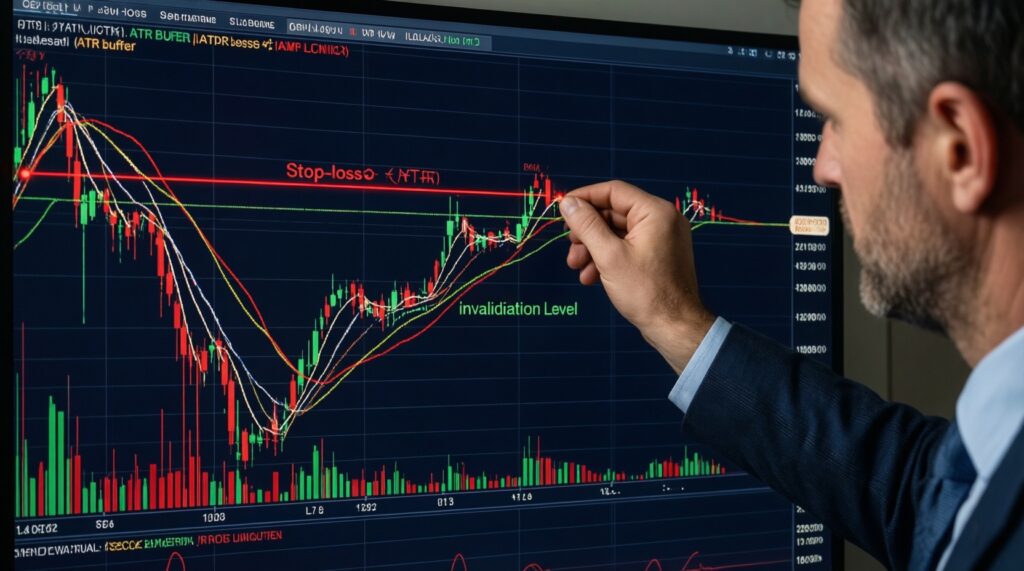
Move SL beyond the true invalidation level and add a volatility buffer (e.g., a fraction of ATR). If your SL is inside normal noise, the placement is wrong-not your discipline.
Should I use stop market or stop limit for SL?
Use stop market when you must exit reliably (fast markets, news risk). Use stop limit only if liquidity is stable and you accept the risk of not getting filled.
How do I set TP in a range-bound market?
Place TP near the opposite range boundary or the next reaction zone, and avoid targets in the middle where price often churns. Consider scaling out: TP1 mid-range, TP2 near the edge.
What if the required SL is too wide and position size becomes tiny?
That's a valid "no trade" signal: the setup doesn't fit your risk constraints. Reduce leverage/size, change timeframe to a cleaner structure, or wait for a better entry-not a tighter SL.
Can I move SL to break-even after price moves in my favor?
Yes, if it's a predefined rule that you've tested (e.g., after +1R). If moving to break-even repeatedly cuts winners, it may reduce expectancy.
My broker triggers SL/TP differently than my chart. Why?
SL/TP triggers use the broker's execution price (bid/ask), spreads, and sometimes different price feeds. Always account for bid/ask: long SL typically triggers on bid, short SL on ask.
What's the simplest routine to enforce discipline daily?
Before entry: write entry/SL/TP/risk; after exit: record result in R and whether you followed rules. If rule-following is below your standard, reduce trading frequency until compliance improves.