

House edge is the built-in cost of playing: over many bets it pushes your average result below break-even. To choose between roulette, blackjack, and slots, compare (1) the rules that set the edge, (2) how volatile results feel, and (3) how much control skill gives you. Then pick the lowest-edge rules you can actually follow.
Critical metrics to compare before wagering
- Rule-driven edge: wheel type (roulette), table rules (blackjack), RTP/hold (slots).
- Volatility: how "swingy" outcomes are; determines bankroll stress more than edge alone.
- Player control: can correct decisions materially reduce losses (blackjack) or not (roulette/slots).
- Transparency: can you verify rules/RTP easily in the lobby or paytable.
- Bet structure: flat bets vs. progressions; whether payouts match true odds.
- Session pacing: hands/spins per hour changes how fast edge realizes.
- Limits & side bets: side bets often add hidden edge even when the base game is acceptable.
Roulette house edge: wheel types, bets and probability mechanics
If you're analyzing House Edge รูเล็ต, treat roulette as a probability-and-payout problem. The "best" roulette choice is usually the wheel with fewer zero pockets and bets whose payouts are closest to true odds (none are perfect on standard wheels).
- Wheel type (zero count): fewer zero pockets generally means lower house edge. Prefer single-zero wheels over double-zero when available.
- How payouts are defined: compute edge from rules: EV = (win probability × win profit) − (loss probability × stake). House edge is −EV as a fraction of stake.
- Inside vs outside bets: outside bets feel smoother (lower volatility) but do not automatically improve the edge on the same wheel.
- "Special" rules: rules like half-loss or "share" outcomes on zero can change EV on even-money bets; confirm which rule is active.
- Bet coverage: avoid complex coverage that increases total stake without changing EV (it can increase variance and loss rate per hour).
- Zero handling: understand exactly what happens on zero for even-money bets (lose all, lose half, or other house rule).
- Table pace: faster spins increase the speed at which the edge shows up in your results.
- Rule visibility in online lobbies: on คาสิโนออนไลน์ รูเล็ต แบล็คแจ็ค สล็อต, confirm wheel type and special rules before placing any chips.
Quick calculation example (from the posted rules): On a single-zero wheel, a straight-up number hits with probability 1/37 and typically pays 35:1 profit. EV per 1 unit bet = (1/37 × 35) − (36/37 × 1) = −1/37. That negative EV is the house edge for that bet on that wheel.
Blackjack house edge: rule variations, basic strategy and card counting effects
When comparing House Edge แบล็คแจ็ค, the game is unique because decisions matter. The base rules set the "starting" edge, basic strategy can reduce it versus random play, and counting only matters if the rules, penetration, and heat allow it (rare online).
| Variant | Who it fits | Pros | Cons | When to choose |
|---|---|---|---|---|
| Classic blackjack with full basic-strategy availability | Intermediate players willing to follow a chart | Most "skill leverage"; mistakes are measurable and fixable | Requires discipline; deviations increase losses quickly | Choose when you can play slowly and consistently |
| Dealer stands on soft 17 (S17) | Players optimizing rules | Generally more player-friendly than dealer-hits-soft-17 | Not always offered; may come with other trade-offs | Choose when comparing two otherwise similar tables |
| Double after split allowed (DAS) | Players comfortable with splits and doubles | Improves outcomes on many split situations | More decision points; more room for errors | Choose if you actually follow basic strategy for split hands |
| Resplitting pairs permitted (incl. some resplit rules) | Bankrolls that can handle occasional larger exposure | Better recovery on pair-heavy shoes | Can increase short-term variance and total money on the felt | Choose if table limits and bankroll tolerate multi-hand exposure |
| Reduced blackjack payout (e.g., not the traditional premium) | Players who prioritize game availability over value | Easy to find in some casinos | Typically worsens expected value materially | Avoid unless it's the only option and you lower stakes |
| Side bets (Perfect Pairs, 21+3, etc.) | Entertainment-first players | High "hit" excitement; clear bonus outcomes | Often carries a higher house edge than the base game | Only as a small, pre-capped "fun budget," not a core strategy |
- Basic strategy: treat it as the minimum viable tool. If you can't follow it reliably, blackjack loses its main advantage over roulette/slots.
- Card counting: conceptually can shift EV, but in many online formats (CSMs, frequent shuffles, limited penetration) the practical impact is small or zero.
- Rule-audit habit: before you sit, scan payout, soft-17 rule, doubling rules, splitting rules, surrender availability, and any side-bet temptation.
Slot machines explained: RTP, hold, volatility and casino-side advantages
For House Edge สล็อต, you don't outplay the math-your control is selecting better-configured games and managing volatility. Slots are designed so the casino advantage is embedded in RTP/hold and amplified by pace and bonus-feature variance.
- If the slot shows RTP clearly and it meets your threshold (for example, you only play titles listed at RTP ≥ 96%), then shortlist it; otherwise, skip and move on.
- If you hate long losing streaks, then avoid high-volatility slots even when RTP looks fine; pick lower volatility so your session risk matches your bankroll.
- If you are bonus-hunting, then cap spins and predefine a stop-loss because bonus-driven volatility can cluster losses before features trigger.
- If you're tempted to raise bet size after near-misses, then switch games or stop: near-misses are not predictive and increase loss rate via higher stake per spin.
- If you are choosing between two similar games, then prefer the one with transparent paytable, stable RTP disclosure, and fewer "must-buy feature" prompts.
Side-by-side table: expected return and variance for common bets
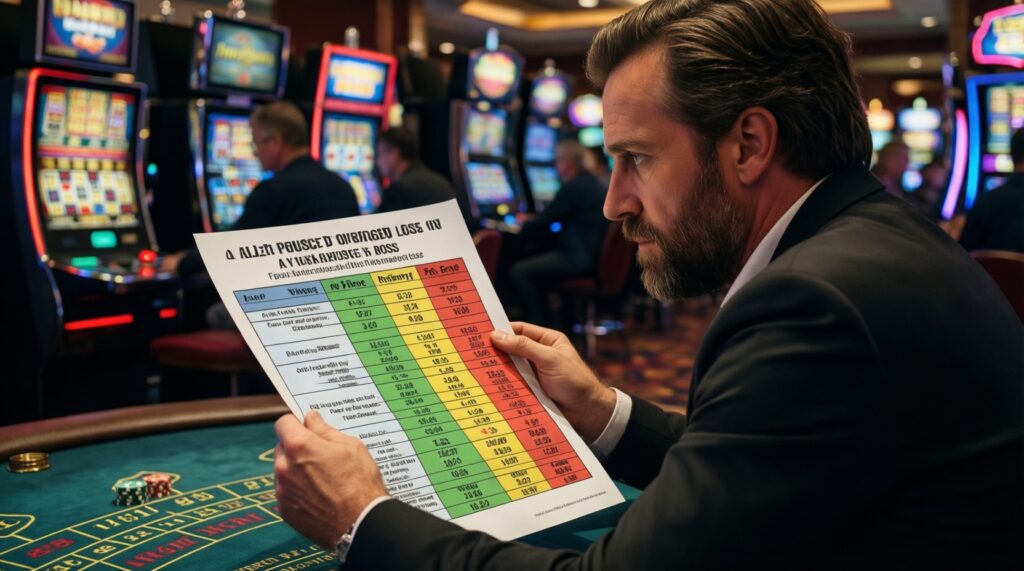
Use this as a practical comparison framework, not a promise. The "Example house edge" column shows how to translate an edge into an expected loss; for blackjack and slots, plug in the edge/RTP from the exact table/game you are considering.
| Game | Common bet type | What mainly sets the edge | Example house edge used for illustration | Illustrative expected loss per 1,000 units wagered | Typical variance feel (qualitative) |
|---|---|---|---|---|---|
| Roulette | Even-money outside bet | Zero pockets + special zero rules | Computed from wheel rules (e.g., single-zero: 1/37) | 1,000 × (1/37) ≈ 27 units | Medium (frequent small wins/losses) |
| Blackjack | Flat betting, basic strategy | Table rules + your decision accuracy | Example only: 0.5% if rules are favorable and play is accurate | 1,000 × 0.005 = 5 units | Medium (swings from doubles/splits) |
| Slots | Fixed stake per spin | RTP (hold) + volatility model | Example only: RTP 96% implies 4% hold | 1,000 × 0.04 = 40 units | From low to very high (game-dependent) |
- Confirm the rule set (wheel type / blackjack rules / slot RTP) before you start.
- Estimate the edge: roulette by calculation; blackjack by rule profile + your strategy accuracy; slots by RTP (hold = 1 − RTP).
- Classify volatility you can tolerate: low, medium, high.
- Pick the bet type that matches your volatility tolerance (outside bets; flat blackjack; low-volatility slots).
- Set a stake cap per decision (e.g., keep each bet small relative to bankroll so variance doesn't force tilt).
- Exclude side bets and progressions unless they are explicitly budgeted as entertainment.
- Re-check conditions if you switch tables/games; in online lobbies rules can differ by provider.
Decision tree: selecting the game and bet based on risk profile and rules
These are the selection mistakes that most often cause players to pick the wrong game, even when they "know" about house edge.
- Choosing roulette based on bet coverage: covering more numbers feels safer but doesn't improve expected value; it usually just increases how fast you lose per hour.
- Ignoring wheel type: failing to check single-zero vs double-zero is a direct EV leak in House Edge รูเล็ต decisions.
- Playing blackjack like roulette: "gut feel" hits/stands erase blackjack's main advantage; if you won't follow basic strategy, don't pay for the illusion of skill.
- Underestimating rule penalties: a bad payout or restricted doubling/splitting can dominate the table's value even if you play well.
- Overweighting rare jackpots on slots: focusing on top prizes while ignoring RTP/volatility makes bankroll outcomes worse than expected.
- Chasing losses with progressions: raising stakes after losses increases variance and can force you into limit/tilt, regardless of game.
- Not controlling pace: higher decisions per hour makes any edge more expensive; this matters especially in fast slots.
- Assuming online "same game" is identical: in คาสิโนออนไลน์ รูเล็ต แบล็คแจ็ค สล็อต, two tables with the same name can have different rules, limits, and side bets.
Practical bankroll and session rules to reduce long-term losses

- Bankroll sizing rule: decide your total session loss limit first, then back-calculate a small, flat base bet so normal variance doesn't hit that limit quickly.
- Stop rules: set a hard stop-loss and a time limit; stop-wins are optional but must be predefined to avoid giving back profits via tilt.
- Side-bet budget: if you use any, cap them to a small fraction of your base wagering and keep them fixed (no "just one more" escalations).
- One change at a time: if results feel unstable, reduce pace or stake before changing games; don't do both simultaneously or you can't diagnose the cause.
- Track decisions, not outcomes: in blackjack, log whether you followed strategy; in slots/roulette, log whether you stayed within preset limits.
- วิธีลด House Edge in practice: (1) pick more favorable rules/RTP, (2) remove side bets, (3) slow down, (4) keep stakes flat, (5) avoid progressions.
Mini decision tree you can apply in 60 seconds
- If you will follow basic strategy and you can find reasonable rules, then choose blackjack and flat-bet.
- If you won't follow basic strategy but you still want predictable pacing, then choose roulette on the best available wheel and stick to outside bets.
- If you want maximum entertainment and accept high variance, then choose slots only after verifying RTP/volatility and setting strict stops.
- If the only available blackjack has reduced payouts, then downgrade stakes or switch to the best-wheel roulette instead.
- If you cannot verify rules/RTP, then don't start-switch provider/table/game.
Best fit tends to be: blackjack for players who can execute a strategy consistently; roulette for players who want simple decisions and can select the best wheel/rules; slots for players prioritizing entertainment who can choose transparent RTP/volatility and enforce strict session limits.
Brief solutions to frequent player uncertainties
Is roulette "safer" because outside bets win more often?
It usually feels smoother, but the underlying edge is still embedded in the wheel rules. Higher hit rate changes volatility, not the core expected value.
What is the fastest way to improve blackjack results?
Stop improvising and follow basic strategy every hand. Then select the best available rules before worrying about anything advanced.
Do slot bonuses or near-misses indicate a win is coming?
No. They are not predictive; they mainly affect how volatility feels and can encourage stake increases.
How do I compare a slot RTP to house edge?
Convert RTP to hold: hold = 1 − RTP. Treat that hold as the house edge proxy for long-run planning.
Should I use betting systems to beat the house edge?
Progressions don't change expected value; they mainly increase variance and the risk of hitting limits or tilt. If you use any system, use it only as pacing-never as a "fix."
What should I check first in an online casino lobby?
Wheel type and special zero rules for roulette, payout and soft-17/doubling/splitting rules for blackjack, and RTP/volatility disclosure for slots.