

To cut blackjack house edge in Thailand-facing games, choose tables by rules first, not by vibe: prioritize a โต๊ะแบล็คแจ็ค 3:2, avoid 6:5 payouts, prefer fewer decks with deeper penetration, and select player-friendly options like dealer stands on soft 17, double after split, and late surrender. Then confirm limits and shuffles won't force risky bet sizing.
Quick Rule Checklist to Cut the House Edge
- Choose blackjack payout โต๊ะแบล็คแจ็ค 3:2; avoid tables where blackjack pays 6:5.
- Prefer fewer decks and deeper penetration; shallow penetration reduces skill-based edge.
- Prioritize "dealer stands on soft 17" over "hits soft 17".
- Look for Double After Split (DAS) and reasonable resplit rules.
- Late surrender is a strong rule improvement when available and clearly stated.
- Avoid continuous shuffling machines and "auto-shuffle every hand" online variants.
- Skip side bets when your goal is minimizing house edge.
Payout Structures: 3:2 vs 6:5 and Their Quantified Effects
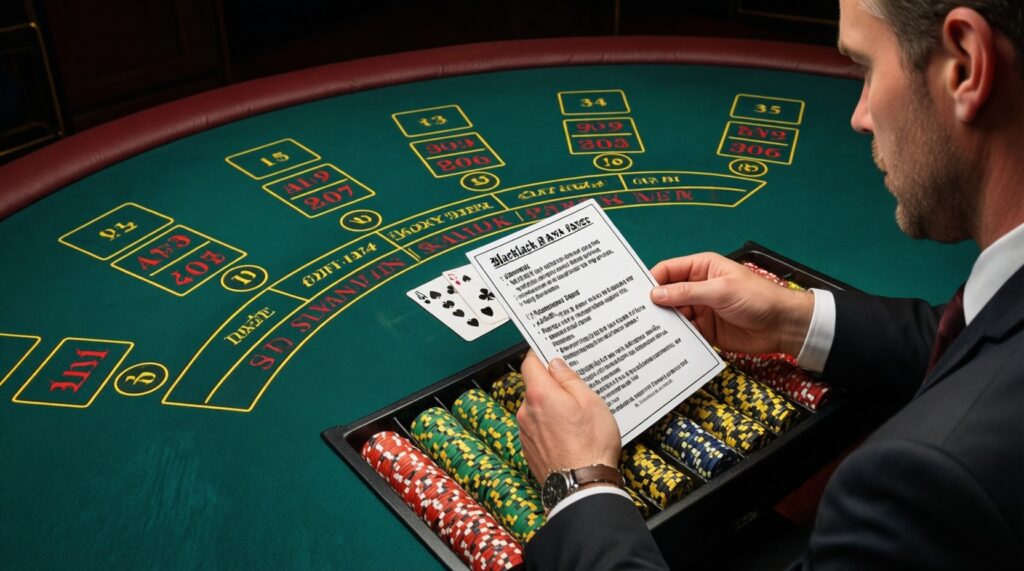
แบล็คแจ็ค 6:5 คืออะไร? It's a payout rule where a natural blackjack returns less than the classic 3:2. This single line on the felt (or in the game info panel) is often the biggest rule-driven penalty you can select by accident.
- Best fit: Players using basic strategy consistently and wanting the cleanest baseline conditions should focus on โต๊ะแบล็คแจ็ค 3:2.
- When not to play: If the game pays 6:5, the disadvantage typically overwhelms small "good" rules elsewhere (like DAS). Treat it as a hard stop unless you are playing purely for entertainment value.
- Online note: In คาสิโนออนไลน์ แบล็คแจ็ค 3:2 listings, verify the payout inside the rules/info panel, not only in the lobby title.
| Rule / Condition | Player impact (direction) | Selection guidance |
|---|---|---|
| Blackjack pays 3:2 | Lower house edge | Prefer; make it your first filter |
| Blackjack pays 6:5 | Higher house edge | Avoid; don't "compensate" with other minor rule perks |
| Dealer stands on soft 17 (S17) | Lower house edge | Prefer, especially if you play long sessions |
| Dealer hits soft 17 (H17) | Higher house edge | Avoid when an S17 table is available |
| Double after split (DAS) | Lower house edge | Prefer; improves key split situations |
| Late surrender | Lower house edge | Prefer if clearly offered and you'll use it correctly |
| Continuous shuffling / reshuffle every hand | Higher house edge (skill removal) | Avoid if you care about penetration and tracking |
Deck Count and Penetration: How Many Decks Really Matter
Players often ask แบล็คแจ็ค กี่เด็ค ดีที่สุด. Fewer decks are generally better for the player, but only if penetration is decent; a low-deck game that shuffles extremely early can be worse than a higher-deck game dealt deep.
What you need before you sit down
- Access to the full rules sheet: at a live table, ask the dealer or floor; online, open the rules/info panel.
- A quick penetration read: live shoe games-watch where the cut card appears; online-look for stated reshuffle triggers or "auto shuffle" notes.
- A stable staking plan: table minimum/maximum and your own stop-loss/stop-win to avoid chasing variance.
- Basic strategy reference (memorized or studied beforehand): don't rely on "feel," especially under time pressure.
Dealer and Play Rules: S17, DAS, Resplits, Surrender - What to Prioritize
- Variance is real: even with strong rules, short sessions swing; don't escalate bets to "fix" a downswing.
- Rule-reading errors cost more than small skill edges: confirm payouts and soft-17 behavior before buying in.
- Online speed increases mistakes: faster rounds mean more decisions per hour and more chances to misclick or deviate.
- Heat and policy differences: advantage-style behavior (tracking, aggressive spread) can lead to restrictions; stay within house terms.
-
Confirm the blackjack payout first.
Check the felt sign or rules panel for 3:2 vs 6:5; this is where many "low edge" tables fail. If you see 6:5, treat it as a non-starter for a กติกาแบล็คแจ็ค house edge ต่ำ approach.
-
Lock in soft-17 behavior.
Prefer dealer stands on soft 17 (S17). If the dealer hits soft 17 (H17), assume the table is less favorable and require other strong positives (like 3:2 and good penetration) before you consider it.
-
Check double rules, especially DAS.
Look for "double after split allowed." DAS strengthens several high-frequency situations created by splitting.
- If doubling is restricted to specific totals only, expect reduced flexibility.
- If doubling after split is not allowed, you lose value in common split lines.
-
Review resplit limits and special-case bans.
Resplitting improves outcomes on repeatable high-value splits. Watch for "no resplit aces" or "one card only to split aces," which are common restrictions.
-
Use surrender only if it's clearly offered and you're trained on it.
Late surrender can help in specific bad spots, but only when applied correctly. If surrender is available yet you're unsure, it may be safer to stick to a no-surrender basic strategy rather than improvise.
-
Evaluate decks and penetration together.
Don't choose solely by deck count. A deeper deal in a shoe can beat a "better-sounding" low-deck game that reshuffles early or uses continuous shuffling.
Table Constraints: Limits, Minimums, and How They Shape Risk
- The posted minimum bet fits your bankroll without forcing you to "overbet" to feel engaged.
- The table maximum allows you to follow your plan without sudden cap issues (especially if you raise bets after wins).
- Pacing is comfortable: you can make correct decisions without being rushed by the dealer or auto-timer.
- Rules are visible and unambiguous: payout, soft 17, double rules, splits, surrender, and shuffle policy.
- No continuous shuffling or frequent auto-reshuffles that erase penetration benefits.
- Side bets are optional and not pushed as "required" for bonuses.
- For online tables, latency and UI reduce misclick risk (clear hit/stand/double/split prompts).
- House policy doesn't penalize basic-strategy play (no forced side-bet participation, no unclear bonus wagering traps).
Counting and Strategy Adjustments for Intermediate Players
- Overvaluing deck count while ignoring penetration: "fewer decks" is not automatically "better" if the shuffle comes early.
- Assuming all 3:2 games are equal: a 3:2 table can still be undermined by H17, no DAS, tight resplits, or harsh shuffle rules.
- Bet-spreading without a reason: increasing stakes impulsively magnifies variance and bankroll risk more than it improves outcomes.
- Misapplying surrender: using it as an "escape button" instead of a trained decision leaks value.
- Playing side bets "because the main game is tight": side bets usually increase volatility and disadvantage.
- Ignoring speed effects online: more hands per hour means faster bankroll swings; set session limits before you start.
- Not adapting to rule differences: basic strategy is slightly rule-dependent; confirm whether your memorized chart matches S17/H17 and double/split rules.
Side Bets, Continuous Shuffling, and Hidden Rule Traps
If your primary goal is a กติกาแบล็คแจ็ค house edge ต่ำ, treat the options below as situational rather than default.
- Skip side bets entirely: appropriate when you want steadier variance and fewer "casino tax" add-ons.
- Choose a slower live table over a fast online timer: appropriate when decision quality matters more than hands per hour.
- Pick a transparent ruleset even if stakes are higher: appropriate when the cheaper table uses 6:5, continuous shuffling, or unclear restrictions.
- Use demo/free mode to rule-check an online table: appropriate before committing money, especially for any คาสิโนออนไลน์ แบล็คแจ็ค 3:2 claim in the lobby.
Practical Concerns Answered for Table Selection
How do I verify a "3:2" table online without guessing?

Open the rules/info panel and confirm the blackjack payout line explicitly says โต๊ะแบล็คแจ็ค 3:2. Don't rely on table names or thumbnails.
แบล็คแจ็ค 6:5 คืออะไร in plain terms?

It means a natural blackjack pays less than the traditional payout, reducing your return on one of your best outcomes. If you're optimizing rules, avoid 6:5.
แบล็คแจ็ค กี่เด็ค ดีที่สุด for an intermediate player?
Prefer fewer decks, but only when the game is dealt deep enough before shuffling. If penetration is poor or continuous shuffling is used, deck count becomes far less meaningful.
If the table is 3:2 but the dealer hits soft 17, should I still play?
Only if you can't find a comparable S17 game and the rest of the rules are player-friendly. Make sure you're comfortable with the added disadvantage and variance.
What's the fastest way to spot a "low edge" ruleset at a live table?
Scan for 3:2 payout signage first, then ask about soft 17 and double-after-split. Those checks filter most bad tables quickly.
Are side bets ever compatible with a กติกาแบล็คแจ็ค house edge ต่ำ goal?
Usually no-side bets are designed to be higher edge and higher variance. If you take them, treat it as entertainment spend, separate from your main-game bankroll.
Do continuous shuffling machines matter if I'm not counting?
Yes: they remove penetration-related benefits and can worsen the overall value proposition. If you care about table quality, prefer standard shuffles with clear shoe play.