

Choose flat betting when you want stable decision-making, clear bankroll control, and your edge comes from picking good prices rather than chasing streaks. Use progressive systems only when you accept higher drawdowns and have strict stop rules. For most intermediate bettors in Thailand, a simple fixed-% staking plan is the safest default, with carefully bounded progressions for specific short-run goals.
Core criteria for choosing bet-sizing
- Edge source: price/line value (needs consistency) vs. entertainment/streak targeting (tolerates variance).
- Bankroll depth: number of "units" you can realistically lose without changing behavior.
- Market type: high-liquidity pre-match vs. higher-variance live/props (impacts drawdown).
- Execution discipline: ability to follow stop rules after losses and after wins.
- Risk tolerance: preference for lower volatility vs. willingness to accept tail-risk.
- Stake constraints: minimum bet, maximum bet, and account limits (common across Thai-facing books).
- Record-keeping maturity: whether you track closing line value, ROI, and max drawdown.
Understanding flat betting: mechanics, math and edge preservation
A flat betting strategy means each bet is the same stake (fixed unit) or the same fraction of bankroll. Its main job is to preserve your edge by preventing your stake sizing from amplifying random variance.
- Unit definition: decide whether 1 unit is a fixed THB amount (easier) or a bankroll % (more robust).
- Edge sensitivity: if your edge is small and noisy, flat sizing reduces the chance you "bet biggest when wrong."
- Bet frequency fit: higher volume (e.g., daily football) favors flat sizing because outcomes regress.
- Liquidity/limits: flat stakes are easier to keep under max-bet thresholds and less likely to trigger stake-size scrutiny.
- Operational simplicity: fewer rules = fewer mistakes, especially when betting live or across multiple books.
- Variance control: avoids geometric stake growth that can force you to quit mid-sequence.
- Stop-rule clarity: daily/weekly loss limits are straightforward when stakes are stable.
- Psychological stability: reduces tilt after losses and overconfidence after wins.
Quick worked sizing: Bankroll 20,000 THB. If you flat-bet 1% per wager, stake = 200 THB. If you prefer a fixed unit, set 1 unit = 200 THB and keep it unchanged for a set review period (e.g., every 50 bets), then recalibrate.
Progressive systems unpacked: Oscar's Grind, Martingale, Kelly and hybrids
A progressive betting system changes stake based on past results (usually increasing after losses or after wins). These systems can be structured, but they do not "create" edge; they mainly reshape volatility and the path of results.
| Variant | Who it fits | Pros | Cons | When to choose |
|---|---|---|---|---|
| Fixed-unit flat | Recreational bettor; anyone building discipline | Simple; low error rate; stable drawdowns | Not bankroll-adaptive unless you rescale | Default for most sports; when you want a clean baseline |
| Fixed-% flat | Bankroll-constrained investor; steady long-run approach | Automatically scales risk; reduces ruin risk versus aggressive progressions | Stake shrinks after losses (can feel slow to recover) | When bankroll fluctuates; when limits and long-term survival matter |
| Oscar's Grind | Recreational bettor who wants structure without explosive doubling | Caps profit per cycle; gentler than Martingale; can reduce "chasing" impulses | Still path-dependent; can stall in long losing patches | Short sessions with strict cycle caps and realistic stake ceilings |
| Martingale | Almost nobody as a long-run plan; only as a small, bounded experiment | High chance of small wins in short sequences | Tail-risk is severe; quickly hits max-bet / bankroll limits; a classic martingale betting system failure mode | Only if you hard-cap steps and accept the capped-loss outcome upfront |
| Kelly (full) | Sharp trader with measurable edge and accurate probabilities | Growth-optimal in theory; bankroll-adaptive | Overbetting from model error is punishing; volatile | When you have calibrated probabilities and can tolerate swings |
| Fractional Kelly (e.g., 1/2 or 1/4) | Sharp trader transitioning to scaling; cautious pros | Balances growth and drawdown; more forgiving to estimation error | Requires probability estimates; still more complex than flat | When you want "Kelly-like" discipline but smoother variance |
| Hybrid: flat base + small performance band | Intermediate bettor who tracks results and wants mild adaptivity | Controlled adjustments; avoids runaway sequences | Can drift into disguised chasing without rules | When you can enforce bands (e.g., 0.75u-1.25u) and review intervals |
Mini calculation (why doubling is dangerous): If you start at 200 THB and double after each loss (200, 400, 800, 1600...), the stake grows geometrically. Even with a step cap, a few losses can push you into account limits or exceed your planned daily loss cap, especially on Thai books with strict max stakes per market.
Bankroll dynamics: volatility, max drawdown and ruin probability
Bet sizing is risk engineering. Think in paths: how bad can it get before you stop executing correctly?
- If you cannot tolerate a multi-day losing run without changing your strategy, then use fixed-% flat (e.g., 0.5%-1.5%) and a hard daily loss limit.
- If your edge is model-based but still noisy (typical intermediate), then avoid full Kelly; use fractional Kelly or flat until your probability calibration is proven.
- If you're bankroll-limited and the minimum bet is "large" relative to bankroll, then reduce bet frequency (higher selectivity) rather than adding a loss-chasing progression.
- If you insist on a progression for entertainment, then predefine: maximum steps, maximum total session loss, and a mandatory cooldown after a capped-loss session.
- If you bet volatile markets (live totals, player props), then shrink stake size versus your normal pre-match size because variance and mispricing risk are higher.
Empirical matchups: when flat betting wins in the long run
Use this selection algorithm to pick the best bankroll management strategy for your situation without overfitting to recent results.
- Write down your last 100 bets (or start now) and compute average odds, hit rate, and largest peak-to-trough downswing.
- Set a maximum acceptable drawdown (in units) that you can endure without breaking rules.
- Check constraints: min bet, max bet, and whether doubling-style sequences would hit limits quickly.
- If you cannot estimate your edge reliably, choose flat (fixed-unit or fixed-%) and focus on price selection.
- If you can estimate probabilities and track closing line value, test fractional Kelly on paper for at least one full review cycle.
- If your goal is short-session entertainment, choose a bounded progression with explicit caps, not open-ended chasing.
- Lock in a sports betting staking plan with written stop rules before you place the next bet.
Applied use-cases for progressives: short streak plays and bankroll-limited scenarios
Progressions fail more from misuse than from math. These are the mistakes that typically make a progression worse than flat betting:
- Using Martingale logic on prices far from even odds (doubling assumes a specific payoff structure that often isn't present after fees/vig).
- Not capping the number of steps; an "uncapped" plan is not a plan.
- Ignoring max-bet limits and market liquidity; the sequence breaks exactly when you need it to continue.
- Changing markets mid-sequence (e.g., switching from football sides to live corners) and pretending it's the same risk.
- Increasing stakes after wins without a profit-lock rule (wins inflate confidence, then a reversal wipes multiple sessions).
- Running multiple progressions in parallel across different matches; correlation spikes total exposure.
- Using a progression to compensate for poor selection (no staking system fixes negative EV).
- Failing to track "worst-case session loss" before starting; the capped-loss outcome should be acceptable upfront.
- Confusing variance reduction with edge creation; a progression reshapes outcomes, it doesn't change expected value.
Operational playbook: concrete sizing templates, tracking table and stop rules
Best fit depends on persona: recreational bettors usually do best with fixed-unit flat plus strict stop rules; sharp traders tend to prefer fractional Kelly once their probabilities are calibrated; bankroll-constrained investors typically benefit from fixed-% flat and higher selectivity rather than any aggressive progression.
Persona templates: Recreational bettor (simplicity + control)
- Template A (fixed-unit flat): 1 unit = 1% of starting monthly bankroll; bet 1u per pick; rescale only after every 50 bets.
- Template B (bounded Oscar's Grind): Start 1u; after each win increase by +1u until +1u net profit for the cycle; after any loss reset to 1u; caps: max 3u stake, max 5 cycles/session.
Stop rules: stop for the day at -5u or after +5u; no exceptions. If you hit the stop, next day starts at 1u again.
Persona templates: Sharp trader (edge-driven scaling)
- Template A (1/4 Kelly): Stake = 0.25 × Kelly fraction × bankroll. If your model says 55% at decimal 2.00, Kelly fraction = (bp − q)/b with b=1, p=0.55, q=0.45 ⇒ 0.10; quarter-Kelly stake = 2.5% bankroll.
- Template B (hybrid band): Base stake 1% bankroll; allow 0.75%-1.50% only when (a) you beat closing line consistently and (b) the bet meets a minimum edge threshold you define.
Stop rules: if drawdown exceeds your pre-set max (e.g., 20u equivalent), pause and re-validate probabilities; no "win it back" sessions.
Persona templates: Bankroll-constrained investor (survival first)
- Template A (micro fixed-%): 0.5% bankroll per bet; if minimum bet forces you above 1%, reduce number of bets rather than upsizing.
- Template B (two-tier flat): 0.5% for standard plays; 0.25% for high-variance markets (live, props). No progressions.
Stop rules: weekly stop at -8% bankroll; after stopping, review selection criteria and reduce volume for the next cycle.
Tracking rows to keep (simple and audit-friendly)
| Field | What to record | Why it matters |
|---|---|---|
| Date / Market | League, bet type, pre-match vs live | Finds where variance or errors cluster |
| Odds + Stake | Decimal odds, units/THB | Enables true risk and return tracking |
| Closing odds (if available) | Best proxy for pricing skill | Separates luck from edge |
| Result + Notes | Win/loss, rationale, execution issues | Improves process, not just outcomes |
| Running drawdown | Peak-to-trough units | Tests if sizing matches tolerance |
Practitioner clarifications and concise answers
Is flat betting always better than a progression?
Flat sizing is usually more robust because it doesn't depend on streak structure. A progression can be acceptable only when it is bounded and you can tolerate the capped-loss scenario.
Does a progressive betting system increase expected value?

No. If your picks are negative EV, changing stake paths won't make them positive; it only changes volatility and the timing of wins/losses.
When is the martingale betting system ever reasonable?
Only as a strictly capped experiment with predefined maximum steps and a maximum session loss you're happy to take. Uncapped Martingale is incompatible with real bankrolls and real max-bet limits.
Should intermediates use full Kelly?
Usually not. Full Kelly is sensitive to probability errors; fractional Kelly or flat betting is safer until your estimates are demonstrably calibrated.
What is the simplest sports betting staking plan to start with?
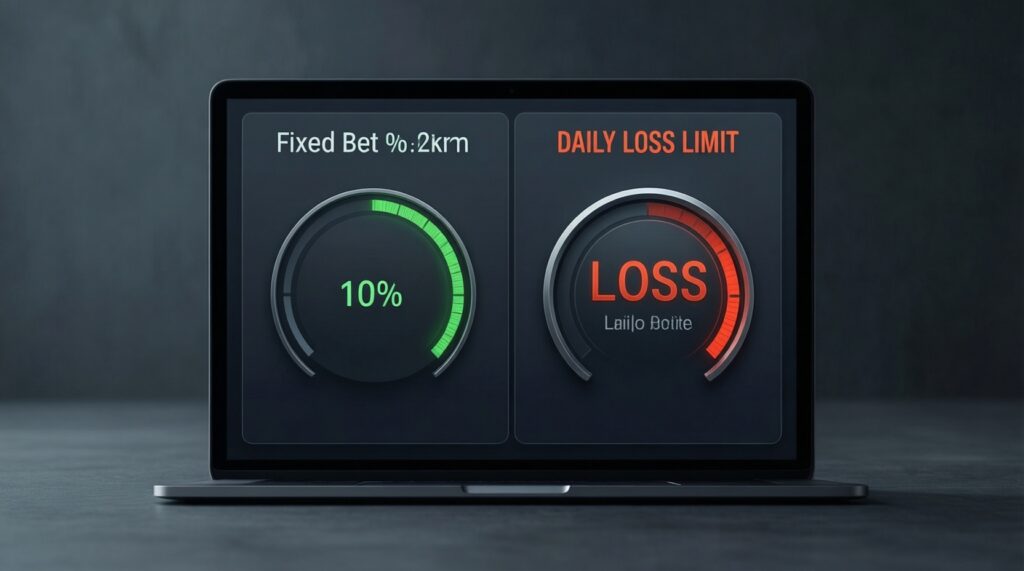
Fixed-% flat (e.g., 1% per bet) plus a daily loss limit. It scales automatically and is easy to audit.
How often should I rescale my unit size?
Use a fixed review interval (such as every 50 bets or monthly) rather than rescaling after every swing. Frequent rescaling can turn into disguised chasing.
How do I pick the best bankroll management strategy for my personality?
If you value stability and discipline, choose flat. If you have measured edge and strong tracking, consider fractional Kelly; if you want session structure for entertainment, choose only bounded progressions with strict stop rules.