

To spot and avoid roulette myths, treat every spin as independent, ignore "hot" or "due" numbers, and focus on what you can control: game rules, bankroll limits, and bet sizing. Most roulette myths come from pattern-seeking and misreading short streaks. Use a simple checklist, a short logging test, and strict stop-loss rules to prevent costly "chasing."
Quick Facts: What Actually Affects Roulette Outcomes
- Wheel type and rules (European vs American, and any special rules) affect house edge; "hot numbers roulette" does not.
- Each spin is (effectively) independent; prior results do not make a specific next outcome more likely.
- Bet selection changes volatility, not the built-in disadvantage; a "roulette strategy guide" should separate risk control from prediction.
- Short-term streaks happen naturally in random sequences and look meaningful even when they are not.
- Tracking results can reduce self-deception, but it cannot turn roulette into a positive-expectation game.
- For "online roulette tips," prioritize reputable providers, clear rules, and responsible limits over pattern-based systems.
How Roulette Mechanics Defeat the Notion of 'Hot Numbers'
Roulette outcomes don't "heat up" because the wheel has no memory and no goal to balance results.
Who this matters for: anyone tempted to follow "hot numbers roulette" boards, recent-hit highlights, or dealer chatter about streaks.
When not to use this approach: if you are trying to diagnose a physical wheel bias without proper data, time, and permission; casual "hot number" tracking is not bias detection.
Micro-experiment: write down the last 10 outcomes you saw and circle repeats. The repeats feel meaningful, but repeating is normal in small samples-your brain flags it as a "signal."
Practical takeaway: treat "hot numbers" displays as entertainment, not input for betting decisions.
Quantifying the Gambler's Fallacy: Probability, Independence, and Expected Value

The gambler's fallacy is believing a result is "due" after a run, even though independence means the next spin doesn't correct the past.
What you need (simple, safe, and practical):
- A note app or paper to log outcomes and your reason for each bet (one line per spin).
- Basic probability language: "independent," "sample size," "expected value."
- A fixed session bankroll and two preset limits: stop-loss and stop-win.
Minimal math that matters: for a bet with win probability p, average win W, and average loss L, expected value is EV = p·W − (1−p)·L. "Due" thinking doesn't change p; it only changes how aggressively you risk money.
Micro-experiment: flip a coin 20 times (or use a random generator). After 5 heads in a row, notice the urge to say "tails is due." Then flip once more-your urge doesn't influence the outcome. That urge is the same mechanism behind gambler's fallacy roulette decisions.
Practical takeaway: any rule that increases stake because something is "due" is a red-flag system, not an edge.
Pattern Chasing Explained: Why Perceived Runs Aren't Predictive
Pattern chasing happens when you convert normal randomness into a narrative (zigzags, clusters, "dealer rhythm") and then bet the story.
-
Define the claim in one sentence (e.g., "After three reds, black is next"). Write it before you bet, not after.
- If you can't write the rule clearly, you are reacting emotionally, not testing a hypothesis.
- Separate prediction from preference. "I feel black" is a preference; "my rule predicts black after X" is testable.
-
Run a small, pre-registered log. Commit to a fixed number of spins you will observe and record, without changing the rule midstream.
- Log: outcome, whether the pattern condition was met, what it predicted, and whether it hit.
- Count hits vs misses without storytelling. Compare the rule's hit rate to what you'd expect from the base rate of that event.
- Audit your bet sizing. Many losses come from scaling up during "strong-looking" patterns, not from the pattern itself.
- Stop if you catch rule-drifting. If you change the pattern definition after a miss, you are no longer testing-only justifying.
Fast-track mode: a 60-second anti-myth routine
- Name the myth: "hot streak," "due number," or "pattern."
- Say the independence reminder: "Last spins don't change the next spin's odds."
- Lock limits: stake size, stop-loss, and stop-win before betting.
- Log one line: outcome + why you bet (to catch story-making).
- Default to non-chasing play: no progressive increases triggered by runs.
Practical takeaway: if the "pattern" only looks good in hindsight, it's not a usable prediction rule.
Common Cognitive Biases at the Roulette Table and How to Counter Them
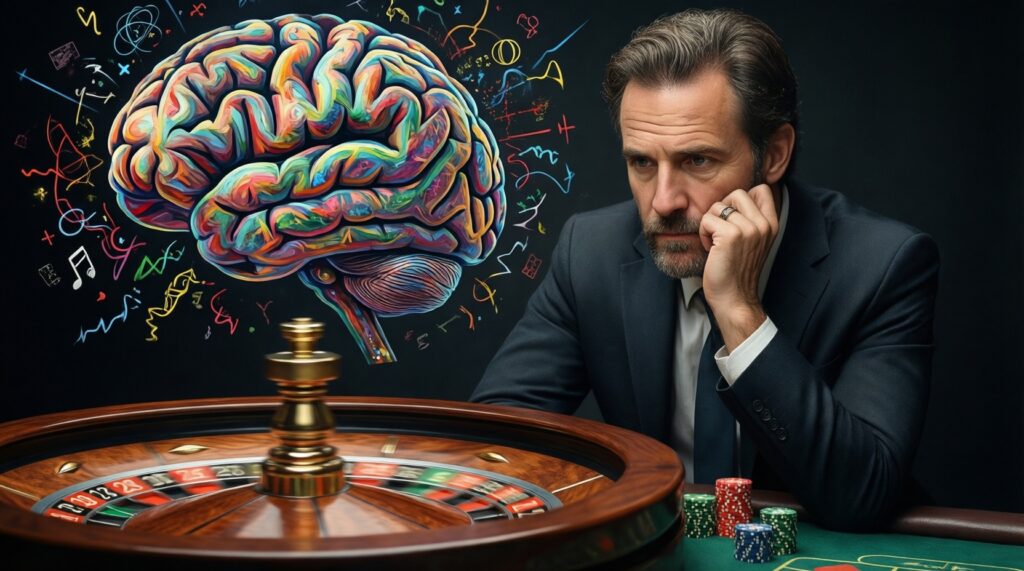
Most roulette myths persist because your brain is optimized for finding patterns quickly, not for judging randomness accurately.
- I can explain my bet in one testable sentence (not a vibe or story).
- I am not increasing stakes because something is "due" (gambler's fallacy roulette trigger).
- I am not treating "hot numbers roulette" displays as evidence.
- I can state my stop-loss and stop-win out loud right now.
- I have not changed my rule after a miss (no "moving the goalposts").
- I can accept a loss without "winning it back" this session (no loss-chasing).
- I am not selectively remembering hits and forgetting misses (confirmation bias check).
- I have checked the game variant and rules before playing (especially for online roulette tips).
Practical takeaway: if you fail any two checklist items, pause the session and reset limits before the next bet.
Practical Risk Controls: Betting Adjustments That Reduce Damage
You can't remove the house edge with myths, but you can reduce how quickly myths drain your bankroll by controlling exposure.
- Raising bet size after losses because "it must turn" (classic progression trap).
- Raising bet size after wins because you feel "in sync" (hot-hand thinking).
- Switching systems mid-session to "find what's working," which usually increases variance and tilt.
- Using martingale-style doubling without a hard table-limit and bankroll cap.
- Ignoring rule differences (European vs American; special rules) while focusing on patterns.
- Tracking only outcomes, not reasons for bets (you miss the myth trigger).
- Extending sessions after a stop-win because "today is my day."
- Playing faster after a loss (speed amplifies mistakes and reduces self-control).
Practical takeaway: the safest "roulette strategy guide" habit is pre-committing to limits and keeping bet size flat when emotions rise.
Empirical Checks: Simple Tests and Data to Verify or Debunk Claims
If you want to be rigorous, use small tests that reveal whether you're seeing signal or noise-without escalating risk.
- Outcome-reason journaling: record 30-50 spins with your bet reason; review which reasons correlate with losses (myth triggers).
- Rule vs baseline comparison: test one clear pattern rule and compare its hit rate to the base rate for that outcome; stop if you keep redefining the rule.
- Provider and rules audit (online): verify wheel type, rules, and published terms; use this as your primary "online roulette tips" checklist item rather than pattern tracking.
Practical takeaway: test behaviors (your decision rules) more than results; results are noisy, but your triggers are consistent.
Clarifications on Common Myth-Driven Concerns
If a number hit twice recently, is it more likely to hit again?
No-recent hits don't increase its probability on the next spin. Repeats feel rare, but they occur naturally in random sequences.
Is gambler's fallacy roulette thinking the same as using "balance" strategies?
Yes if "balance" means betting the opposite because outcomes are "due." That logic assumes the wheel corrects itself, which it doesn't.
Do "hot numbers" screens in casinos indicate real advantage?
They summarize recent history, not future odds. They can influence behavior, which is why they're effective marketing.
Can pattern chasing ever work if I track enough spins?

Tracking helps you spot your own biases, but "seeing patterns" doesn't create edge by itself. Without a verified physical bias or exploitable rule difference, patterns remain non-predictive.
Are there any safe roulette systems?
There are safer money-management rules (limits, flat or capped staking), not safer prediction systems. Any system claiming to forecast outcomes is a roulette myth unless independently verified.
What's the most practical thing to do mid-session when I feel a streak is meaningful?
Pause and restate your limits, then reduce speed and keep stake size flat. If you want to act, act on control variables-not on the streak story.