

Blackjack side bets are optional wagers placed alongside your main hand, usually with flashy blackjack side bets payouts and rare-hit jackpots. They feel attractive because small stakes can win big, but their expected value (EV) is typically worse than the main game. Treat them as entertainment unless you can verify blackjack side bets odds and a genuinely favorable paytable.
Bottom-line summary: side bets and expected value
- Tempting feature: high top-end payouts and frequent "almost hit" outcomes.
- Main tradeoff: convenience and excitement versus higher bankroll volatility and usually lower EV.
- What matters most: the exact paytable; small wording changes can flip the EV meaningfully.
- Best practice: evaluate the side bet as its own game; don't assume your main-hand skill transfers.
- Risk control: pre-cap side-bet spending per session, separate from your main stakes.
Common myths about side bets - what players get wrong
Myth 1: "If I play perfect basic strategy, the side bet improves too."
Basic strategy optimizes decisions on the main hand (hit/stand/double/split) given the rules. Most blackjack side bets resolve from initial cards (yours, dealer's, or both) and ignore your decisions-so your main-hand skill does not "fix" a poor side-bet EV.
Myth 2: "The best blackjack side bets are the ones with the biggest headline payout."
A huge top prize can coexist with a weak overall EV if the hit rate is tiny. The correct comparison is not payout size alone, but the weighted average across all outcomes: probability × payout (net of stake).
Myth 3: "Online side bets are more beatable because they're digital."
With online blackjack side bets, the key variables are still the same: rules, number of decks, card exposure, and the published paytable. Digital presentation can make them easier to place, not inherently better value.
Myth 4: "Side bets are just 'bonus variance' and don't affect my real results."
They directly change your session EV and variance because they are additional wagers. Even if your main-hand EV is stable, repeatedly adding negative-EV side bets drags the combined result downward while increasing swings.
Anatomy of typical blackjack side bets
Most side bets follow a common structure: you place a small extra stake before cards are dealt, then the bet resolves immediately (or after a small reveal) based on a specific pattern. Common designs include:
- Player-hand patterns: suited pairs, mixed pairs, three-card totals, or specific ranks.
- Dealer upcard triggers: bonus if dealer shows a certain rank/suit, sometimes combined with your cards.
- Community/3-card constructions: your two cards + dealer upcard form a poker-like hand or target total.
- Progressive/jackpot variants: a portion of stakes feeds a growing prize for a rare combination.
- Tiered payouts: several "hit" categories (small win, medium win, top win) with different frequencies.
- Rule dependencies: number of decks, whether dealer peeks, and how reshuffles happen can change probabilities.
How payout schedules determine house edge
The paytable is the engine of the side bet. Two tables can look similar but produce very different EV because each payout tier is tuned against the probability of hitting that tier.
Typical scenarios where paytables change the risk profile:
- Same name, different casino/operator: identically branded side bets may use different paytables; always check posted rules.
- Progressive vs. fixed: "progressive" can mean only the top tier grows while the base payouts are reduced.
- Deck-count sensitivity: a paytable designed for fewer decks may be offered on more decks without adjustment, worsening EV.
- "Push" vs. "lose" on near-misses: some side bets refund on a partial condition; others don't-this affects EV materially.
- Rounding and caps: capped max payout or "to 1" vs. "for 1" wording changes the net return.
Practical takeaway: when comparing blackjack side bets payouts, read them as a schedule of outcomes, not a marketing headline.
Calculating expected value: examples and formulae
For any side bet, treat it as a standalone wager with its own distribution. The expected value per 1 unit staked is:
EV = Σ (pi × netWini) + plose × (−1)
where netWini is the profit (not the total return) when outcome i hits, and probabilities sum to 1.
Two compact checklists: what to compute and what can mislead you
- Compute: all mutually exclusive hit categories; don't double-count overlapping conditions.
- Convert payout wording correctly: "x to 1" usually means profit = x; "x for 1" may include stake depending on house rules-confirm.
- Use the right sample space: probabilities depend on decks, removal, and which cards are visible (especially online implementations).
- Separate EV and volatility: a side bet can feel "fun" because it pays often, yet still have negative EV if small wins don't compensate for frequent losses.
- Misleading shortcut: judging by hit frequency alone (frequent small payouts can still be a bad deal).
- Misleading shortcut: comparing only the top jackpot line without weighting by probability.
- Misleading shortcut: assuming blackjack side bets odds are constant across tables-operators adjust paytables.
- Misleading shortcut: mixing side-bet results into your "blackjack EV" and concluding your strategy got worse or better.
Approaches compared by implementation convenience and risk
| Approach | How easy to implement | Primary risk | When it makes sense |
|---|---|---|---|
| Never play side bets | Very easy (default) | Opportunity cost if a rare promo is genuinely favorable | You want stable bankroll behavior and clean tracking of main-game results |
| Entertainment budget (fixed small cap) | Easy (set a cap before you start) | EV drag plus higher variance; chasing losses | You value excitement; you accept the cost as paid entertainment |
| Selective play based on posted paytable/promo | Moderate (requires reading rules and quick math) | Miscalculating payouts, misunderstanding terms, ignoring deck/rule differences | Promotions, rebates, or unusually generous schedules you can verify |
| Advantage-style targeting (only when conditions are favorable) | Hard (requires strong discipline and accurate estimation) | Operational mistakes; limited availability; bankroll swings | Only if you can objectively quantify when the EV turns positive |
How side bets interact with your main-hand EV
Even if you play the main hand well, side bets change the combined expectation because you are adding additional wagers with their own EV and variance.
- Combined EV is additive: EV(total) = EV(main wager) + EV(side wager). A negative side bet pulls the total down.
- Variance stacks faster than most players expect: a small side stake can dominate session swings if its payouts are spiky.
- "I'm up, so I'll press side bets" is a bankroll illusion: being ahead doesn't change the probabilities of the next deal.
- Main-hand adjustments rarely help: taking worse main-hand lines to "set up" a side bet usually harms the main EV without meaningfully improving the side-bet EV.
- Tracking gets messy: mixing results hides whether your base blackjack is winning/losing and encourages poor feedback loops.
Practical guidelines: when to play, when to avoid

Use a decision rule that you can execute quickly at the table or in online blackjack side bets, without emotions and without "hot streak" logic.
A simple decision workflow (with a simulation-style sanity check)
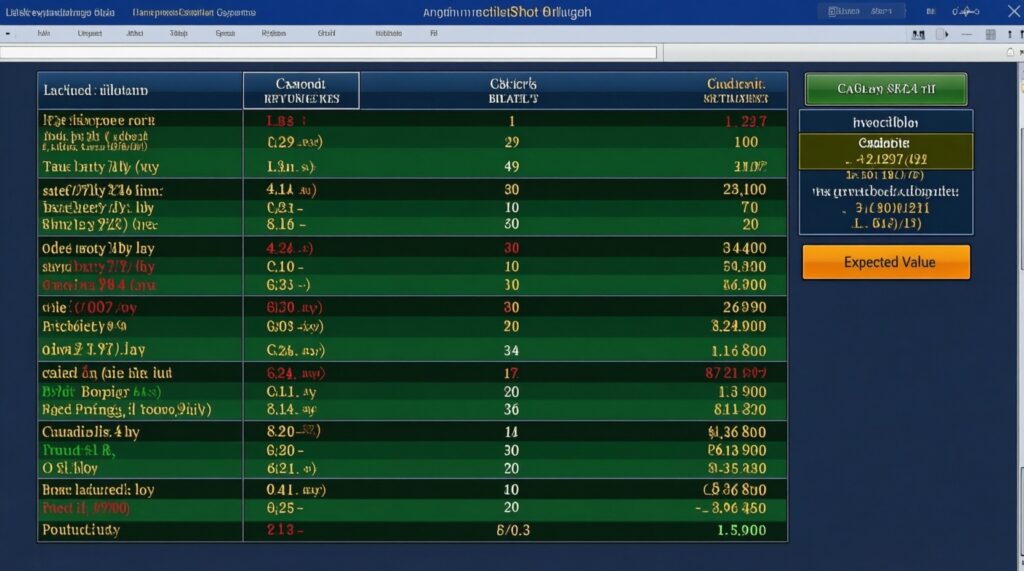
- Write down the paytable for the side bet you are considering (a photo/screenshot is enough).
- List outcomes and probabilities (even rough categories), then compute EV per unit using EV = Σ(p×netWin) − plose.
- Run a sanity check by simulation thinking: imagine (or spreadsheet-simulate) thousands of repeats; ask what the distribution looks like-many small losses with rare spikes means high volatility and long losing stretches are normal.
- Set a hard cap (for example, a fixed number of side-bet units per session) and stop when the cap is reached-win or lose.
- Re-check after any table change because paytables and rules can differ even within the same venue/operator.
Worked numeric example (end-to-end EV)
Suppose a side bet costs 1 unit and has only two outcomes:
- With probability p = 1/20, it pays 15 to 1 (netWin = +15).
- Otherwise (probability 19/20), you lose your stake (netWin = −1).
Then EV = (1/20 × 15) + (19/20 × −1) = 0.75 − 0.95 = −0.20 units per bet. It looks exciting because the payout is big, but over many bets you expect to lose 0.20 units each time you place it-this is why "best blackjack side bets" is about EV and rules, not marketing.
Concise answers to common player questions
Are blackjack side bets beatable with skill?

Most are not affected by your play decisions, so typical "skill" doesn't apply. Only specialized, condition-dependent approaches can change EV, and only if you can quantify those conditions accurately.
Do blackjack side bets change the house edge of the main game?
They don't change the intrinsic main-hand rules, but they change your overall expected value because you are placing extra wagers with their own EV.
Which blackjack side bets payouts should I look for?
Look for schedules where the frequent, low-tier wins are not underpaid relative to their probability. If the table is dominated by one ultra-rare jackpot line, expect high volatility and usually poor EV.
How do I compare blackjack side bets odds between two casinos or sites?
Compare the full paytable and the dealing conditions (decks, reshuffle policy, what cards are used). Same side-bet name does not guarantee the same probabilities or payouts.
Are online blackjack side bets different from live tables?
Mechanically they're similar, but speed of play can be higher online, which can amplify losses if the EV is negative. Always re-check the posted paytable and rules on the specific game instance.
Should I ever place a side bet when I'm already winning?
Your current session result doesn't change the next-hand probabilities. Decide based on EV and a pre-set entertainment budget, not on being up or down.