
To actually reduce the house edge in blackjack, you must play correct basic strategy on every hand: choose hit/stand/double/split based on your total, whether it's hard or soft, and the dealer's upcard. Use a reliable blackjack strategy card, apply surrender when available, and avoid side bets and "gut-feel" deviations.
Core Decisions That Actually Reduce the House Edge
- Use one consistent blackjack basic strategy chart that matches the table rules (H17/S17, DAS, surrender).
- Anchor every decision on the dealer's upcard; it drives most EV differences.
- Prioritize correct doubles and splits; these are the biggest "mistake multipliers" when missed.
- Track hard vs soft hands correctly; mislabeling Aces causes systematic errors.
- Take late surrender only in the few hands where it beats playing the hand out.
- Keep deviations separate from "best blackjack strategy" marketing; only deviate with a real count edge.
When to Hit, Stand, Double or Split: Practical Rules
This decision framework fits intermediate players who want consistent, low-error play in live casinos in Thailand and in online tables. It works best when you can see rules clearly and can follow a fixed chart without improvising.
- Use it when: you can identify dealer upcard, confirm whether dealer hits soft 17, and you're allowed to double after split (DAS) and/or surrender.
- Do not force it when: table rules are unknown, the game uses unusual payoffs/promos that change decisions, or you're playing variants that are not standard blackjack (different rules for 21 payouts, special draws, etc.).
Example: If you are unsure whether it's H17 or S17, don't "average" the chart-ask the dealer or check the info panel (especially important for online blackjack basic strategy).
Hard vs Soft Hands: How Strategy Changes
What you need to execute cleanly:
- A blackjack strategy card (digital or printed) that explicitly shows hard totals, soft totals, and pairs.
- Rule confirmation: H17 vs S17, DAS yes/no, surrender (late/early) yes/no.
- A simple way to avoid Ace confusion: treat "soft" as "Ace counted as 11 without busting."
- If you play online: stable UI zoom/visibility so you never misread the dealer upcard or your total.
Example: A♠+6♦ is soft 17 (can't bust by hitting once). A♠+6♦+K♥ becomes hard 17 (Ace must count as 1).
Interpreting the Dealer's Upcard: Decision Matrices
| Hand type | Your hand | Dealer 2-6 (weak) | Dealer 7-A (strong) |
|---|---|---|---|
| Hard totals | 8 or less | Hit | Hit |
| Hard totals | 9 | Double vs 3-6; otherwise Hit | Hit |
| Hard totals | 10 | Double vs 2-9; otherwise Hit | Hit vs 10/A |
| Hard totals | 11 | Double vs 2-10; vs A follow your chart/rules | Double vs 7-10; vs A follow your chart/rules |
| Hard totals | 12 | Stand vs 4-6; otherwise Hit | Hit |
| Hard totals | 13-16 | Stand vs 2-6 | Hit vs 7-A (or surrender spots if offered) |
| Hard totals | 17+ | Stand | Stand |
| Soft totals | A,2 to A,6 (soft 13-17) | Often Double vs 4-6 (varies by total); otherwise Hit | Hit |
| Soft totals | A,7 (soft 18) | Stand most; Double vs 3-6 in many charts | Hit vs 9-A; Stand vs 7-8 (per chart) |
| Soft totals | A,8 / A,9 (soft 19-20) | Stand (some charts double A,8 vs 6) | Stand |
| Pairs | A,A and 8,8 | Always Split | Always Split |
| Pairs | 10,10 | Stand | Stand |
| Pairs | 5,5 | Treat as hard 10 (Double vs 2-9) | Hit vs 10/A |
-
Confirm the rule set before the first hand.
Identify H17/S17, whether double after split is allowed, and whether late surrender exists. Your blackjack basic strategy chart must match these rules or it becomes unreliable.- In online lobbies, open "Game Rules/Help" first; don't guess.
- At live tables in Thailand, ask politely or read the placard.
-
Classify your hand correctly: hard, soft, or pair.
If you have an Ace, decide whether it can still be counted as 11 without busting; if yes, it's soft. If your first two cards are the same rank, consider the pair strategy first. -
Start from the dealer's upcard band: 2-6 vs 7-A.
Use the matrix logic: 2-6 is the dealer's "bust pressure" zone; 7-A is the dealer's "finish strong" zone. This single split prevents many instinctive mistakes that raise blackjack odds and house edge against you. -
Apply action priority: Split > Double > Stand > Hit (only when the chart says so).
Pairs and doubles change the stake when you have an edge; missing them is costlier than a borderline hit/stand error.- Always re-check: did I miss a split (A,A or 8,8)?
- Then ask: is this a chart double?
-
Lock your decision with a fixed reference, not table talk.
Use a blackjack strategy card you trust, not "dealer advice" or other players' preferences. This is the most practical way to maintain the best blackjack strategy under time pressure.
Fast mode: 30-second operating loop
- Check the dealer upcard: 2-6 or 7-A.
- Tag your hand: pair vs soft vs hard.
- Look for splits (A,A / 8,8 first), then doubles, then stand/hit.
- If surrender is offered, check only the known surrender hands; otherwise ignore it.
- Repeat exactly-no "momentum" bets, no gut-feel deviations.
Late and Early Surrender: When Folding Improves EV
- I confirmed whether surrender is early (before dealer checks) or late (after dealer checks for blackjack).
- I only considered surrender on the specific hands my chart marks as surrender; I didn't invent new ones mid-session.
- I did not surrender by mistake when the dealer showed an Ace/10 and I actually had a strong double/split.
- If surrender is unavailable, I immediately switched back to the normal chart (no "pseudo-surrender" lines).
- I verified the UI prompt (online) or hand signal (live) so surrender wasn't misregistered as hit/stand.
- I remembered: surrender is a rule-dependent tool, not a default safety move.
- I avoided using surrender as tilt control; I took a break instead.
Adjusting Bet Size and Play with True Count Insights
Common mistakes when people mix counting ideas into online blackjack basic strategy or live play:
- Raising bets without a verified true count (or without knowing penetration/shoe size).
- Making "count-based deviations" from memory that don't match the exact rule set you're playing.
- Changing bets mid-hand or after seeing other players' cards (not allowed in standard play; also signals confusion).
- Using side bets as a "count outlet" instead of sticking to the main bet where strategy applies.
- Letting a short losing streak trigger a bigger spread; that's not an edge process.
- Ignoring table limits; an edge plan that can't be executed within min/max is just theory.
- Counting at high speed but misplaying basic strategy fundamentals (the edge leaks faster than the count helps).
Avoidable Errors That Inflate the House Edge
Alternatives that are often more appropriate than trying to outsmart the game in real time:
- Use a single correct chart and master it first. If you can't play the blackjack basic strategy chart flawlessly, don't add count deviations yet.
- Switch to lower-speed formats for accuracy. If a live table is too fast, use slower online tables to practice correct decisions without pressure.
- Choose better rules instead of "hero plays." If you can pick tables, prioritize rule sets that your blackjack strategy card supports cleanly (e.g., surrender available, favorable dealer rules) rather than improvising.
- Skip side bets entirely. If your goal is to control blackjack odds and house edge, side bets are the wrong lever; focus on main-hand decisions.
Quick Clarifications on Ambiguous Plays
Is there one "best blackjack strategy" for every table?
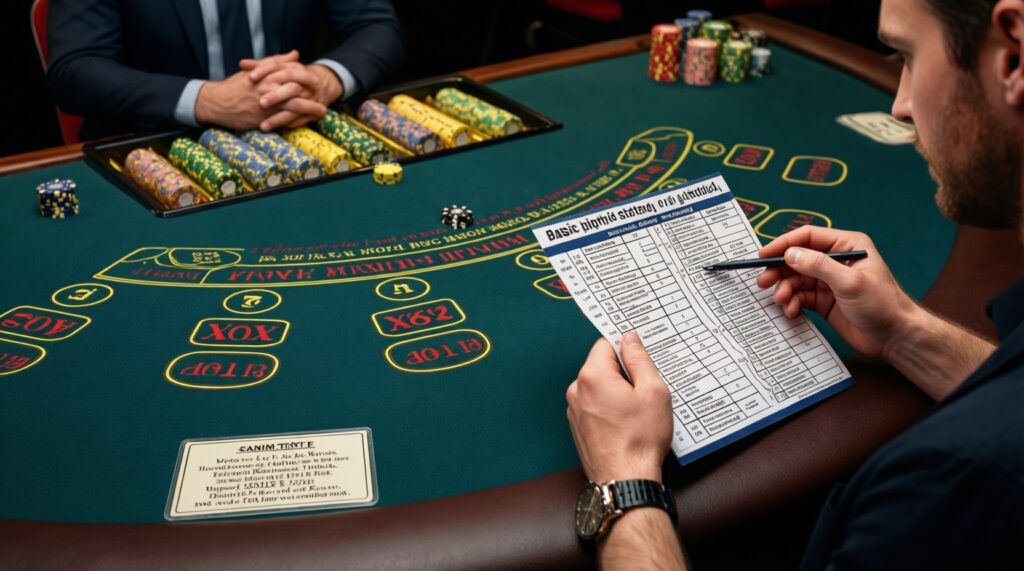
No. Basic strategy depends on rules (H17/S17, DAS, surrender). Use the chart that matches the rules you are playing.
Can I rely on a generic blackjack strategy card if rules are unclear?
Only as a stopgap. If rules are unclear, confirm them first; a mismatched card creates consistent errors.
How do I handle soft hands quickly without overthinking?
Ask one question: can the Ace still count as 11 without busting? If yes, it's soft; if not, treat it as a hard total.
Does online blackjack basic strategy change compared with live blackjack?
The decisions are the same for the same rules. The difference is execution: online you must avoid misclicks and ensure the rules panel matches your blackjack basic strategy chart.
Where do blackjack odds and house edge get worse the fastest for intermediates?
Missing doubles and misplaying pairs (especially 8,8 and A,A) are common high-impact leaks. Side bets also typically worsen results versus focusing on the main hand.
Should I ever split 10s?

In basic strategy, no-stand. Splitting 10s is a niche deviation and should not be used without a verified advantage framework.