

A progressive jackpot is a prize pool that increases with each wager until someone triggers the jackpot event, after which it resets and starts growing again. To judge whether it is worth playing, you estimate expected value (EV), approximate hit frequency, and size your bankroll for extreme volatility. If any input is unknown, treat the chase as entertainment, not an investment.
Core concepts and metrics for progressive jackpots
- If the jackpot grows from a contribution rate, then its value to you depends on your bet size and eligibility rules (minimum bet, max lines, side-bet).
- If you can estimate the trigger probability, then you can translate it into "hit frequency" and compare it to your session length.
- If you can model EV, then you can identify the "must-hit-by" or "overfunded" zone where chasing can be rational.
- If volatility is extreme, then bankroll and stop-loss rules dominate short-term outcomes more than small EV edges.
- If you lack reliable inputs (RTP, contribution, odds), then your best move is conservative stake sizing and short sessions.
What a progressive jackpot is and how it grows
In progressive jackpot slots, a portion of wagers is diverted into a shared (network) or local (single-machine) jackpot meter. The meter grows until a specific jackpot condition occurs (for example, a rare symbol combination, feature trigger, or mystery/random award), then the meter resets to a seed amount and starts accumulating again.
Boundaries that matter for analysis:
- Eligibility: If you are not betting the required stake (or required bet configuration), then your effective jackpot EV is zero, even if you see the meter rising.
- Type of trigger: If the jackpot is "mystery/random," then the trigger is independent of reel outcomes; if it is "symbol/feature-based," then the trigger ties to the game's math model.
- Pooling: If it is a network progressive, then the meter grows faster but is also "competed for" by many players; your individual odds are determined by your own action rate, not by how busy the network feels.
If you are comparing best progressive jackpots online, then treat the meter size as only one input; the required stake, contribution share, and trigger mechanics decide whether the big number is meaningful for your bankroll.
Expected value: formulas, assumptions, and edge cases
EV for the jackpot component is the probability you trigger it on a given wager (or spin) times the jackpot amount you would receive, adjusted for any conditions. For intermediate analysis, keep the jackpot EV separate from the base-game EV.
Compact EV box (per spin)

Let:
p = jackpot trigger probability per spin (given your bet qualifies)
J = current jackpot amount you would be paid
c = your cost per spin (stake)

Jackpot_EV_per_spin = p × J
Jackpot_EV_per_baht = (p × J) / c
If you want a practical workflow, then do this in order:
- If you can obtain p (from a published spec, audited disclosure, or large empirical sample), then use it; otherwise treat p as unknown and avoid "precision math."
- If the jackpot has a must-hit-by cap, then include it explicitly; if it is uncapped, then focus on current J and realistic time-to-hit rather than "infinite growth."
- If the jackpot is shared (network), then your p is still per spin for you; do not dilute p by the number of players unless the trigger is defined per network event rather than per spin.
- If the game requires a side bet or minimum stake, then set c to the qualifying cost; otherwise you will overstate EV per baht.
- If payout is tiered (mini/minor/major/grand), then compute EV as a sum: EV = Σ(pi × Ji).
Edge cases to watch:
- If the jackpot can be won only on max bet, then "partial betting" produces a misleadingly low cost basis because you are not actually eligible.
- If the trigger is a mystery award with a range (must-hit-by), then EV can spike near the cap; if you are far from the cap, then EV may be dominated by the base game.
- If the operator applies non-cashable bonuses or wagering restrictions, then your realized value of J can be lower than the headline meter.
Hit frequency: probability models and empirical estimation
"Hit frequency" translates the progressive jackpot odds into something operational: how many spins (or baht of handle) you expect between jackpot hits for a single player at a fixed stake and spin rate. If you know p per spin, then the expected spins-to-hit is 1/p.
Mini-scenarios where analysts apply these models:
- Mystery progressive on a timer-like RNG: If the rule is "randomly award after each qualifying spin," then a geometric model fits (each spin is a new trial with probability p).
- Symbol/feature-triggered jackpot: If the jackpot triggers through a rare feature, then p depends on the reel/feature math; use the disclosed trigger rate if available, not guesses from short sessions.
- Must-hit-by progressives: If the jackpot must drop before a cap, then hazard increases as the meter approaches the cap; a constant-p model becomes wrong near the top.
- Network progressives: If you are estimating from "time between network hits," then you must normalize by total qualifying spins across the network; otherwise you confuse crowd activity with odds.
- Multi-tier progressives: If tiers have different trigger rules, then each tier has its own p and its own hit frequency; do not average them into a single number unless you also average payouts.
| Scenario | What you can usually observe | What you need to estimate | If you cannot estimate reliably, then... |
|---|---|---|---|
| Single-tier mystery progressive | Current meter J, eligibility (min bet), recent "someone won" notices | p per qualifying spin (or spins-per-hit) | Assume p is unknown and size stakes for high variance; treat the chase as entertainment |
| Must-hit-by progressive | Current J and the cap (must-hit-by), seed amount | How hazard changes as J approaches the cap | Only consider chasing when close to cap; otherwise avoid overinterpreting the meter |
| Multi-tier (mini/minor/major/grand) | Four meters, qualifying rules, side bet requirements | pi for each tier and whether pi changes with stake | Focus on tiers with known/trackable triggers; ignore tiers you cannot model |
Bankroll requirements: volatility, ruin probability, and stake sizing
Progressives add a "lottery-like" tail outcome: most sessions end without a jackpot, and a tiny fraction include a very large win. If you are not prepared for long losing stretches, then even a mathematically favorable chase can fail in practice due to bankroll ruin.
If you need operational bankroll rules, then use these constraints:
- If you are chasing a jackpot with unknown p, then cap any single session loss to an amount you can repeat many times without stress.
- If your eligibility requires a higher stake, then assume your variance increases materially; lower-volatility play at non-qualifying stakes is a different product (and has zero jackpot EV).
- If you must increase stake to qualify, then scale session length down, not up; otherwise your risk-of-ruin accelerates.
- If you cannot tolerate frequent zero-jackpot sessions, then do not target progressives; choose non-progressive games with steadier payout distributions.
Stake sizing recommendations in "if..., then..." form:
- If your goal is learning the game's behavior, then use the minimum qualifying stake and track outcomes; avoid "martingale" escalations.
- If the progressive jackpot strategy relies on chasing near a cap, then predefine a hard stop (time or loss) and exit when the window passes.
- If you experience a large win, then separate bankroll (future play) from profits (withdrawal) immediately; otherwise you are effectively compounding variance.
Actionable rule-of-thumb: If you cannot explain (in one sentence) why the current meter level makes the jackpot EV meaningfully better than usual, then do not increase stake "because it feels due."
Bridging theory and practice: simulation, tracking, and data needs
Most real mistakes come from mixing correct formulas with incorrect inputs. If you want your model to match reality, then prioritize data quality over algebra.
- If you estimate p from a small sample, then your error bars are huge; do not treat short-term "dry spells" as proof the jackpot is imminent.
- If you compare different casinos or aggregators, then confirm stake/eligibility is identical; otherwise "best progressive jackpots online" comparisons are distorted by hidden requirements.
- If you use simulation, then simulate the actual trigger (mystery vs feature-based vs must-hit-by); a generic geometric model can be wrong near caps.
- If you track results, then record: qualifying stake, spins, time window, meter level at start/end, and any jackpot hits; without these fields you cannot back out plausible odds.
- If someone claims to know how to win progressive jackpot reliably, then check whether they are confusing "bankroll endurance" with "increased probability." Your per-spin probability does not rise because you are confident.
Decision framework: when a progressive jackpot is worth chasing
If you need a repeatable go/no-go, then decide using a small checklist driven by eligibility, EV, and bankroll tolerance.
- If you are not eligible at your planned stake, then do not chase (stop).
- If you cannot approximate p or a must-hit-by hazard curve, then treat the jackpot as a bonus and optimize for entertainment (stop chasing).
- If you can estimate p and J, then compute jackpot EV per spin and compare it to your cost per spin.
- If the resulting edge is small or uncertain, then only play within a strict session-loss cap; if the edge is clearly favorable and you can tolerate long droughts, then consider a limited chase window.
Mini-pseudocode for a chase decision

if not eligible(stake, bet_config):
    decision = "Do not chase"
elif p_unknown and no_must_hit_by_info:
    decision = "Play only for entertainment; fixed small stake"
else:
    jackpot_ev = p * J
    if jackpot_ev is "meaningful" relative to stake_cost and bankroll_tolerates_droughts:
        decision = "Chase with time/loss limits"
    else:
        decision = "Do not chase; choose lower-variance play"
If your goal is to select between two progressive jackpot slots, then prefer the one where you can (a) confirm eligibility, (b) approximate progressive jackpot odds, and (c) sustain the required stake without forcing reckless bankroll jumps.
Practical questions players and analysts ask
Are progressive jackpots always worse EV than non-progressive slots?
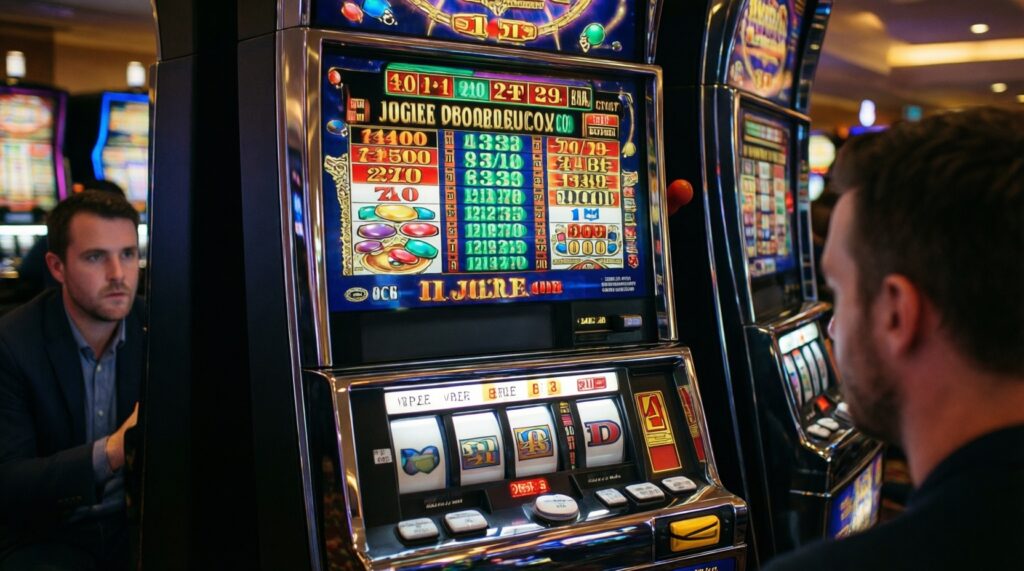
No. If the current meter is unusually high (especially near a must-hit-by cap), then the jackpot component can improve total EV; otherwise it is often just extra variance.
Does playing during "busy hours" improve my chances on a network progressive?
Your per-spin chance depends on your own qualifying spins. If the network is busy, jackpots may be hit more often overall, but your progressive jackpot odds per spin do not automatically increase.
Is it ever rational to raise my bet just because the jackpot is big?
Yes only if raising your bet is required for eligibility or increases your share/qualification, and you have reason to believe EV improved (for example, near a must-hit-by cap). If neither is true, then raising the bet only increases variance and cost.
What's the cleanest way to estimate hit frequency without inside data?
If you can log qualifying spins and track observed hits over a long period, then you can estimate an empirical hit rate. If you cannot collect enough observations, then treat the rate as unknown and avoid firm conclusions.
How should I compare the best progressive jackpots online across sites?
If the rules differ (min bet, side bet, caps, payout terms), then the meters are not comparable. Compare only after normalizing for eligibility cost and understanding what event actually triggers each tier.
What is a sensible progressive jackpot strategy for bankroll safety?
If you choose to chase, then set a fixed session-loss cap and a fixed time window, and never escalate stakes to "recover." If you cannot keep those constraints, then avoid chasing progressives.
Is there a skill-based way for how to win progressive jackpot?
Not in the sense of forcing a win. If you can identify favorable conditions (eligibility, near-cap must-hit-by, known odds), then you can choose better spots to play, but the trigger remains probabilistic.