
The Fibonacci betting system is a progression that increases roulette stakes after losses following the Fibonacci sequence and steps back after a win. It can help structure bet sizing on even-money bets (red/black, odd/even), but it cannot overcome the house edge and can trigger rapid stake growth under long losing streaks.
Practical Summary for Immediate Application
- Use the Fibonacci sequence only as a staking framework on even-money bets; it does not change roulette odds.
- Define a base unit (U) you can lose comfortably; keep early steps small to avoid hitting table limits.
- Run the progression on one even-money market per session; do not switch targets mid-sequence.
- Set a hard stop-loss (e.g., 20-30U) and a session win cap (e.g., 5-10U) to prevent escalation and overplay.
- Check the table's minimum/maximum and rules (European vs. American; any special zero rules) before starting.
- If you want lower escalation, consider flat staking or capped progressions instead of roulette betting systems Fibonacci fans often copy blindly.
How the Fibonacci Sequence Maps to Roulette Stakes
In this fibonacci betting system, your stake follows 1, 1, 2, 3, 5, 8, 13... units (each number is the sum of the previous two). Most players apply it to even-money roulette bets because payouts are simple and the sequence is easy to track.
- After a loss, move one step forward. Your next bet becomes the next Fibonacci number in units.
- After a win, move two steps back. This is the "recovery" mechanic that aims to regain prior losses more gently than Martingale.
- Stop at step 1 when you can't move back further. You never go below 1U.
Who it fits: intermediate players who want a repeatable staking routine, can track steps accurately, and accept that a fibonacci betting system roulette session is still negative expectation over time.
When not to use it: if you are tempted to chase losses, if table limits are tight, if you can't commit to a stop-loss, or if you play American roulette where the extra zero worsens results.
Step-by-Step Setup: From Bankroll to Betting Units
You need a bankroll plan, a unit size, and a way to track the sequence. The goal is to prevent "accidental overbetting," which is the most common failure mode in any fibonacci betting strategy roulette approach.
- Choose your game variant first. Prefer European (single-zero) when available; avoid switching variants mid-session because limits and rules change risk.
- Pick a base unit (U). Set U so that reaching 8U or 13U is still within your comfort zone and the table maximum.
- Set session boundaries before betting. Define (a) stop-loss in units, (b) time limit, and (c) win cap.
- Prepare a simple tracker. Use a notes app or paper with the Fibonacci steps listed and a marker for your current step.
- Choose one even-money target. Red/Black, Odd/Even, or High/Low; do not rotate targets in response to outcomes.
Concrete example (units): If U = 20 THB, your early stakes are 20, 20, 40, 60, 100, 160, 260 THB. If that escalation already feels stressful, your U is too large.
Using Fibonacci in Live vs. Online Roulette: Table Rules and Limits
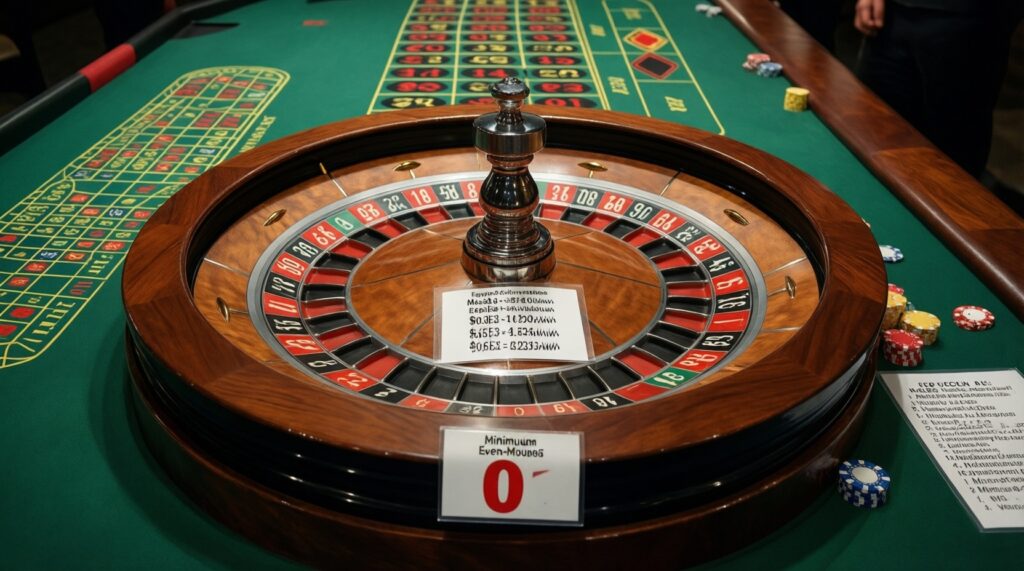
- Confirm table minimum and maximum (including any max payout limits online).
- Confirm roulette type (European vs. American) and any special rules on even-money bets (e.g., half back on zero, if offered).
- Pre-write your unit ladder: 1U, 1U, 2U, 3U, 5U, 8U, 13U, 21U.
- Set an "abort step" (a maximum step you will not exceed), such as stopping at 13U.
-
Verify limits before the first spin.
In live roulette, table signage sets min/max; online roulette shows limits in the UI. Your progression must fit under the max even at your planned highest step.- If max bet is 2,000 THB and U = 200 THB, then 13U already equals 2,600 THB (not allowed).
- Adjust by lowering U or capping the step (e.g., stop at 8U).
-
Start at 1U on one even-money bet.
Place 1U on Red (or your chosen target). Record the step number, not just the amount, so you can move back correctly after a win. -
On a loss, advance one Fibonacci step.
If you lose at 1U, your next stake is still 1U (second "1"). After that, it becomes 2U, then 3U, then 5U, and so on. -
On a win, move back two steps.
Example: if you are at 5U and you win, go back to 2U (two steps back: 5U → 3U → 2U). If a two-step move would go below step 1, return to 1U. -
Handle zero outcomes consistently.
Treat zero according to the table's rule for even-money bets: it is commonly a loss in many formats. Whatever the rule, apply it the same way every time so your tracker stays accurate. -
End the sequence by rule, not emotion.
Stop when you hit your win cap, stop-loss, time limit, or your pre-set maximum step. This matters more than picking the "best roulette betting system" because discipline dominates outcomes.
Risk Control: Bankroll Management, Table Limits and Stop-Loss Criteria

- My unit size (U) keeps 8U and 13U under both the table maximum and my comfort threshold.
- I set a hard stop-loss in units (example: stop at -25U for the session) and will not reload.
- I set a win cap (example: stop at +7U) to avoid giving back profits during variance spikes.
- I set a maximum step I will not exceed (example: do not bet beyond 13U; end session if reached).
- I track steps explicitly and apply the "win = back two, loss = forward one" rule without exceptions.
- I do not switch between Red/Black and Odd/Even mid-session to "follow patterns".
- I confirm game variant and zero handling (loss vs. special rule) before starting.
- I limit session duration (example: 30-60 minutes) to reduce fatigue-based mistakes.
- I avoid side bets and high-variance bets while running the progression.
Performance Boundaries: House Edge, Variance and Expected Outcomes
The fibonacci betting system roulette approach changes the path of your bankroll (volatility and drawdowns), not the underlying probabilities. The house edge applies to every unit you wager, so increasing stakes under pressure increases exposure.
- Believing progression "beats" the wheel. The sequence can't change the probability of winning an even-money bet.
- Using it on high-payout bets. Applying Fibonacci to straight-up numbers or volatile side bets makes drawdowns harsher and tracking harder.
- Ignoring table maximums. A normal losing streak can force stakes beyond the max, locking in losses before recovery steps occur.
- Raising U mid-session. Increasing your unit after losses breaks the risk model and usually accelerates tilt.
- Chasing with extra spins after stop-loss. The fastest way to blow up a bankroll is "one more sequence" thinking.
- Miscounting the two-step retreat. One tracking error can turn a mild progression into accidental overbetting.
- Switching targets to match streaks. This adds randomness without improving expected value and makes the tracker unreliable.
- Calling it the best roulette betting system. No staking plan removes the casino advantage; evaluate systems by risk control, not promises.
Empirical Tests: Simulations, Case Studies and Interpreting Results
If your goal is controlled entertainment rather than "beating roulette," consider alternatives that reduce escalation risk. These options are often more practical than roulette betting systems fibonacci progressions when limits are tight.
- Flat staking (constant 1U). Best when you want the cleanest control of variance and the simplest discipline rule: same bet every spin.
- Capped Fibonacci (stop at 8U or 13U, then reset). Useful when you like Fibonacci structure but refuse runaway stakes; treat the cap as a hard end-of-session trigger.
- Stop-win/stop-loss only (no progression). Choose a target like +5U / -20U and quit; this prevents long sessions where mistakes compound.
- Time-boxed sessions with a fixed spin budget. Example: 50 spins maximum, then stop regardless of result; helps prevent fatigue and impulsive step changes.
Practitioner Clarifications
Is the Fibonacci betting system safe for beginners?
It's safer than aggressive doubling systems, but it still escalates stakes during losing streaks. If you can't follow a stop-loss and a maximum step, don't use it.
What bet types fit a fibonacci betting system roulette session best?
Even-money bets (Red/Black, Odd/Even, High/Low) are the most practical because tracking is simple. Avoid applying it to high-variance bets where swings are larger.
How do I pick the unit size (U) in a fibonacci betting strategy roulette plan?
Set U so that your planned cap step (often 8U or 13U) is both affordable and below the table maximum. If 13U would make you anxious, your U is too big.
What should I do if I hit the table maximum?

Stop the session; you've reached a structural limit where the method can't be executed correctly. Lower U next time or choose a table with higher limits.
Does switching between online and live tables affect roulette betting systems Fibonacci outcomes?
Yes, because limits, pace, and zero rules can differ, which changes how often you collide with caps and how often tracking errors happen. Keep conditions stable during a session.
Can this be the best roulette betting system if I'm disciplined?
Discipline improves risk control, not expected value. If you measure "best" as minimal escalation and simplest execution, flat staking often wins.
When should I reset the sequence back to 1U?
Reset when you end a session, when you hit your maximum step, or when you reach your stop-loss/win cap. Avoid mid-sequence resets just to feel better; that hides risk rather than managing it.