
Table limits usually break betting progressions because your next required stake eventually exceeds the minimum/maximum allowed, or your bankroll cannot keep up before you reach that cap. In practice, the failure shows up as forced flat-betting, partial doubling, or switching bets mid-sequence-changing the system's math and turning "recovery" rounds into unrecoverable losses.
Critical Symptoms That Signal a Progression Is About to Fail
- Your next planned bet is rejected or capped by roulette table limits (max bet reached).
- You start "splitting" the progression across multiple outside bets to fit under casino table limits roulette.
- After a loss streak, a win does not restore you to your target profit (the classic progression "catch-up" fails).
- You quietly change the system mid-run (skip a step, bet less than planned, or reset early) to avoid the max.
- The number of required steps to recover grows faster than your comfort/bankroll, even on even-money bets.
- You keep hitting the table max earlier than expected when you add side bets, tips, or increase base units.
How Table Limits Manifest as Progressive System Failures
- "Next bet" is higher than the posted maximum, so the dealer (or online UI) forces a smaller amount.
- You can place the bet, but only by changing the bet type (e.g., moving from an outside bet to an inside bet with different limits/payout).
- You reach the max in fewer losses than your spreadsheet predicted because the table uses a different limit per bet position.
- Multiple concurrent progressions collide: you can't raise all required bets while staying under the max.
- Minimums block resets: after a partial recovery you cannot drop back to your intended base unit because the minimum is higher.
Mathematical Mechanics: Why Common Progressions Outgrow Limits
- Read the placard/UI: confirm min and max for the exact bet you use (outside vs inside can differ under roulette table limits).
- Write your base unit (U) and compute your next 8-12 steps for that system; don't assume you'll stop earlier.
- Compute the max workable step: the last step where planned stake ≤ table max.
- Compute the loss budget: sum of all stakes up to that last workable step (bankroll needed to survive to it).
- If you use even-money bets, remember the win returns ~1× stake; if you are capped, the "win" may not cover prior losses.
- If you raise U during play, recompute immediately; doubling U halves the number of losses you can absorb before hitting casino table limits roulette.
- If you spread bets (e.g., two even-money bets), treat it as one combined stake for max-limit pressure (your total exposure grows faster).
- If you chase with a "plus" progression (e.g., add 1 unit each loss), check how quickly cumulative losses exceed what one win can offset.
- If you switch to inside bets to "fit under max," verify the limit and variance; the recovery path changes.
- Reality check: if a system's recovery assumes unlimited stakes, it's incompatible with real roulette table limits.
Common Progression Schemes and Their Specific Limit Vulnerabilities
These are typical failure modes seen when players combine betting systems for roulette with strict table caps. The fastest checks are listed first (read-only: observe limits, calculate steps, don't change anything at the table until confirmed).
| Symptom | Possible causes | How to verify (read-only first) | How to fix (lowest disruption first) |
|---|---|---|---|
| Martingale hits the max after a short losing run | Base unit too high for the max; table max is per-bet-position; you added side exposure | List planned stakes (U, 2U, 4U...); find first step > max; confirm exact max for your bet area | Lower U; choose a table with higher max; cap the progression early and accept partial recovery; avoid stacking extra bets |
| A win at the cap does not recover prior losses | You were forced to under-bet due to max; you split bets changing net exposure; you reset too early | Compare "required next stake" vs "allowed stake"; compute net after the win using actual bet amounts | Switch to a progression that targets partial recovery; reduce target profit per cycle; predefine a stop-loss when capped |
| You can't drop back to the intended base unit after recovery | Minimum is higher than your unit; unit definition inconsistent (chips vs totals) | Check table minimum; confirm whether your U is below the minimum | Redefine U to match the minimum; avoid systems requiring micro-resets; move to a lower-min table |
| Negative progression (e.g., D'Alembert) becomes "endless" | Add-1 schemes don't guarantee recovery under variance; max reached before catching up | Calculate cumulative loss after N steps; compare to a single-step win size; note where max blocks further increases | Limit steps per cycle; use smaller profit goals; treat it as flat-bet with guardrails, not a guaranteed recovery method |
| Fibonacci or similar sequence suddenly jumps beyond max | Sequence grows faster than expected after clustered losses; starting point too high | Write the sequence values in units and multiply by U; locate the first value over max | Start lower; cap the sequence length; reset rules that trigger earlier; pick a higher-max table |
| You "solve" max limits by switching bet types, but results deteriorate | Different limits and payout profiles; changed hit-rate/variance; rules for inside bets differ | Confirm limits for the new bet type; verify payout; track actual hit rate during the session | Keep bet type consistent within a cycle; only switch if the whole system is recalculated for the new payout/variance |
| System looks fine on paper, fails live due to compounding exposure | Running multiple progressions; adding "insurance" bets; chasing across columns/dozens simultaneously | Total your exposure per spin (all bets); compare to max constraints and bankroll drawdown speed | Run one progression at a time; remove side bets; simplify to one even-money line if you must test a system |
Concrete progression-to-limit comparison (quick planning)
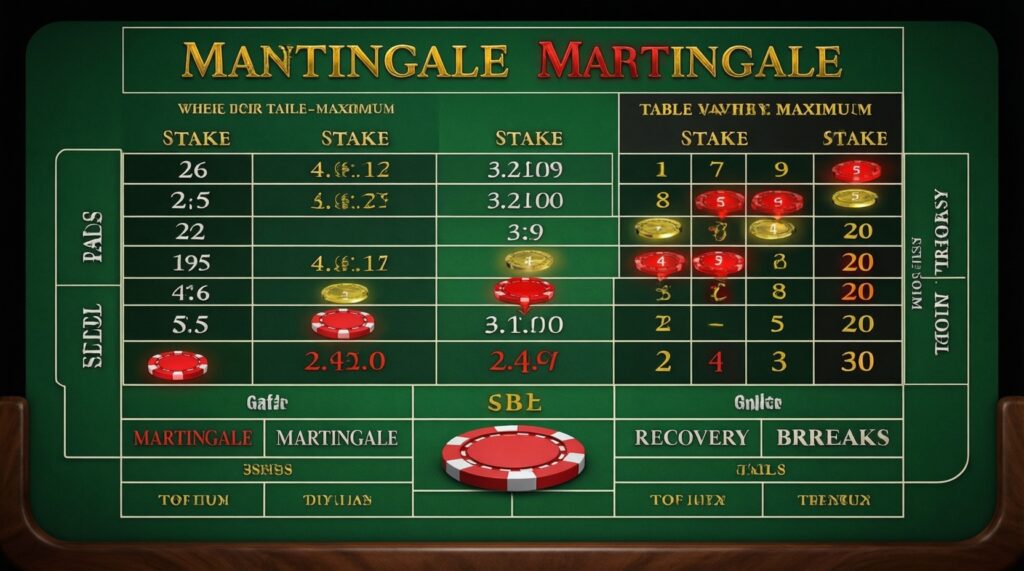
| Progression step | Stake (Martingale, in units) | Works if table max is at least | What fails when max is lower |
|---|---|---|---|
| 1 | 1U | ≥ 1U | Can't start or must change unit |
| 2 | 2U | ≥ 2U | Early cap forces partial doubling |
| 3 | 4U | ≥ 4U | Recovery cycle breaks after 2 losses |
| 4 | 8U | ≥ 8U | Win no longer recovers accumulated losses |
| 5 | 16U | ≥ 16U | Forced deviation: bet-splitting or reset under pressure |
Diagnosing Breaks at the Table: Observable Indicators and Metrics
- Read-only: confirm the exact limit for your bet spot. On many layouts, different outside bets or special bets can have different maxima even within the same table.
- Write your actual base unit (U) you are using right now. Use the chip value and the number of chips you place, not what you "intended."
- Calculate the next 6-10 steps before you play. If any step exceeds the posted max, the progression is already incompatible.
- Compute "max survivable losses" under limits. Count how many consecutive losses you can take before the next required step exceeds the max.
- Track total exposure per spin. If you place multiple bets, add them; limits may apply per bet, but your bankroll risk is the total.
- Simulate the cap event. Decide in advance what you will do at the first step that would exceed the max: stop, reset, or switch to a capped recovery plan.
- Check whether a capped win can still net positive. Use the actual allowed stake at the cap step and compute net result after a win; if still negative, your system can't "complete."
- Only then adjust (smallest change first). Reduce U or shorten the sequence length before changing bet type or adding complexity.
Practical Mitigations: Adjusting Stakes, Sequence, and Risk Profile
- Lower the unit first. Most "broken" progressions are simply oversized for the existing roulette table limits.
- Pre-cap the system. Convert "must recover fully" into "recover partially, then reset" so the cap is an intentional endpoint, not a surprise.
- Use one cycle = one risk budget. Define a maximum number of steps or a stop-loss amount; if reached, stop the cycle.
- Choose limits to match the system, not the other way around. If you insist on a martingale system roulette approach, you need enough headroom between min and max; otherwise it is structurally fragile.
- Stop mixing systems. Combining multiple betting systems for roulette usually increases exposure faster than it increases recovery capacity.
- Escalate to casino support only for rule clarity. Ask (or check terms) about per-bet maximums, special bet limits, and whether online tables enforce different caps per selection; do not request rule exceptions.
Aftermath Analysis: Interpreting Loss Streaks, Recovery Attempts, and Exit Triggers
- Log the exact point of failure. Note the step number, required stake, allowed stake, and table max.
- Separate variance from limit failure. A normal losing streak is not a "system bug"; a forced under-bet due to max is a structural break.
- Recalculate with your real behavior. Include any side bets, bet-splitting, and early resets; these changes often explain why the "best roulette betting strategy" on paper didn't match results.
- Check whether your target profit per cycle is realistic under caps. If the cap prevents full recovery, your cycle profit target must shrink or you must accept incomplete cycles.
- Define an exit trigger tied to limits. Example: stop the session when the next planned step would exceed the max, rather than improvising.
- Audit table selection. If your approach depends on wide min-to-max range, pick tables accordingly; "good vibe" tables with tight casino table limits roulette are incompatible.
- Reduce complexity before your next session. One bet type, one system, one unit size-then add constraints only if results remain stable.
- Treat capped recovery as a different game plan. Once capped, you are no longer running the original progression; plan a separate capped-mode rule set or stop.
Troubleshooting Scenarios and Quick Clarifications for Common Issues
Why did my progression fail even though I never hit the posted max?
You may have hit a lower max for that specific bet position, or your total exposure (multiple bets) exceeded what your bankroll could support before the max mattered. Verify per-bet limits and recalc using total stake per spin.
Are roulette table limits the same for outside and inside bets?
Not always. Many tables have different maxima depending on the bet type or placement, so confirm the exact limit for the bet you are using before you rely on any progression.
Can I "fix" Martingale by splitting the bet across red and black or multiple even-money bets?
Splitting changes the net payout dynamics and usually increases total exposure without guaranteeing recovery. It may help fit under a per-bet cap, but it does not remove the underlying limit constraint.
What is the safest immediate action when the next step exceeds the table max?

Stop the cycle and reset only after you accept the current loss. Any forced under-bet turns the original progression math invalid, so continuing usually increases variance without restoring the intended recovery.
How do I choose a base unit that won't collide with casino table limits roulette?
Pick U so that several planned steps remain below the max, not just the first few. If the system requires a step that would exceed the max, lower U or shorten the sequence.
Is there a single best roulette betting strategy that works under any limits?
No. Any strategy that assumes unlimited scaling will eventually break under real-world caps; the practical "best" approach is one whose risk and step size are explicitly designed around the table's min/max.
Do betting systems for roulette become safer if I stop after a small win?

Stopping early reduces time-in-risk and can prevent reaching cap steps, but it doesn't change the fact that an adverse streak can still force a limit collision. You still need a defined stop-loss and cap rule.