
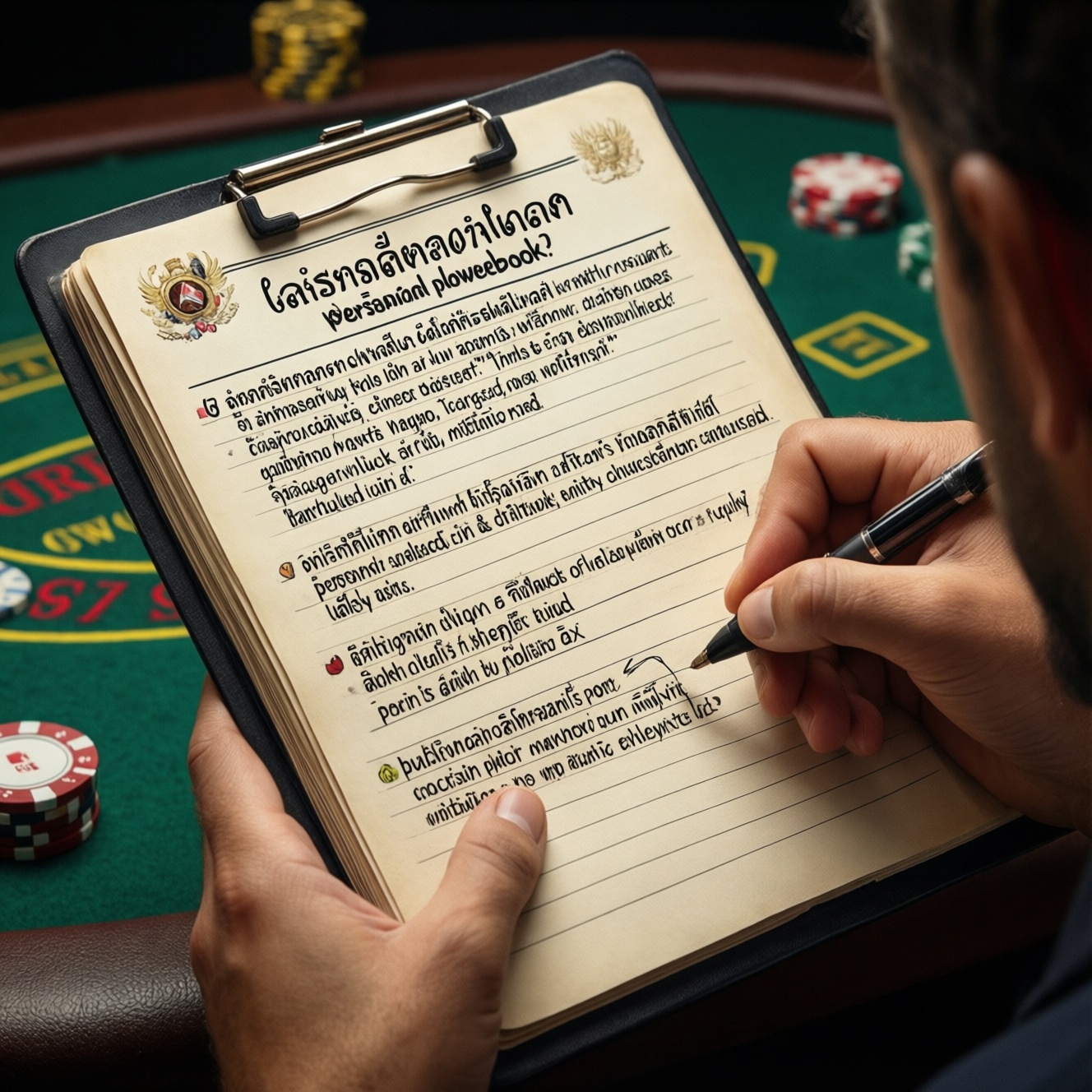
A personal casino playbook is a written set of rules you follow every session: clear goals, a consistent method for choosing games, strict casino bankroll management limits, and a short post-session review. Build it once, then reuse it to reduce impulsive bets, standardize your casino betting strategy, and make your online casino strategy guide actionable in Thailand.
Core components of your casino playbook
- Define two goal layers: session targets (time, spend, stop rules) and long-term goals (skill-building, entertainment budget).
- Choose games systematically using three filters: rules/edge awareness, volatility tolerance, and time-to-resolution.
- Use fixed bankroll rules: session bankroll, base unit size, stop-loss, stop-win, and "tilt stop."
- Run a pre-session checklist and a stake schedule you can follow without negotiation.
- Apply in-session decision rules to prevent ad‑hoc deviations and chase behavior.
- Log results and notes after every session; adjust only on a schedule, not emotionally.
Define measurable session and long-term goals
This fits intermediate players who already know the basics of their preferred games and want consistent execution. Skip it if you're playing while stressed, sleep-deprived, or using gambling to solve money problems; in those cases, the safest move is not to play.
| Goal type | What to measure | One-line template (copy/paste) |
|---|---|---|
| Session (today) | Time cap, session bankroll cap, stop-loss, stop-win, max stake, break rule | "Today: play for __ minutes, max loss __ units, stop-win __ units, max bet __ unit, break every __ minutes." |
| Long-term (4-12 weeks) | Number of sessions, learning objectives, budget ceiling, review cadence | "By __ date: __ sessions, learn __, entertainment budget __ units, review every __ sessions." |
| Skill goal (process) | Rules accuracy, decision consistency, tilt incidents | "Process: follow stake schedule 100%, record decisions, 0 chase bets, 1 review note per session." |
Systematic game selection: edges, volatility, and time
What you need: access to the game rules (house rules matter), a simple tracker (Notes/Sheets), and enough time to complete a full session without rushing. If you're looking for the best casino games to play, define "best" as "I can execute my rules reliably," not "highest hype."
| Filter | What to check | Safe default rule |
|---|---|---|
| Rules clarity | Can you explain payouts/decisions without guessing? | If you can't describe the key decisions in one minute, don't play it today. |
| Volatility tolerance | How swingy results feel relative to your session bankroll | Prefer lower-volatility formats when you're learning or tired. |
| Time-to-resolution | How fast you can complete a planed number of rounds | Avoid ultra-fast formats if you struggle with impulsive clicks. |
| Execution fit | Can you keep stakes consistent and log outcomes? | Pick the game where you can follow your stake schedule without "just this once." |
Bankroll rules: sizing, limits, and risk thresholds

- Confirm your chosen game(s) and the minimum bet.
- Choose a currency/unit you'll use consistently (THB or "units").
- Decide your maximum session duration.
- Open a note or sheet for logging before you start.
- Commit to a hard stop rule for tilt (anger, chasing, numb autopilot).
-
Separate your entertainment bankroll from life money
Only use funds you can afford to lose without affecting bills, debt payments, or obligations. Treat this as non-negotiable; it's the base of safer play and meaningful casino gambling tips.
-
Set a session bankroll (the maximum you can lose today)
Define a fixed cap for the session and don't reload once it's gone. A practical threshold is: if losing it would change your mood for the rest of the day, it's too high.
- Template: "Session bankroll = __ units; no top-ups."
-
Choose a base betting unit and a hard max stake
Pick a base unit small enough that normal swings won't force you into panic decisions. Set a hard maximum bet (e.g., 2-5 units) and never exceed it, regardless of streaks.
- Template: "Base unit = __; max bet = __ (never exceed)."
-
Define stop-loss, stop-win, and a time stop
Stop-loss protects you from digging a hole; stop-win protects you from giving back a good run; time stop prevents fatigue mistakes. Keep them written and visible.
- Template: "Stop-loss = __ units OR __ minutes (first hit ends session)."
- Template: "Stop-win = __ units (bank it and stop)."
-
Add a tilt stop and a reset protocol
Decide in advance what "tilt" looks like for you and what happens immediately when it appears. This is the part most casino betting strategy write-ups ignore, but it drives real outcomes.
- Tilt triggers: raising stakes to "get even," skipping breaks, hiding losses, blaming the dealer/RNG.
- Reset protocol: stand up/log out, 10 minutes off-screen, then either end session or resume at base unit only.
| Rule | Write it as a sentence | Where to keep it |
|---|---|---|
| Session bankroll | "I will not lose more than __ units today." | Top of your notes app / first line of your sheet |
| Max bet | "My maximum stake is __ units, no exceptions." | On-screen sticky note / phone lock screen text |
| Stop conditions | "If __ happens, I stop immediately." | Next to the game window (visible while playing) |
Pre-session plan: checklists, stake schedule, and stop conditions
- I know exactly which game(s) I'll play and why they fit my rules today.
- I have a fixed session bankroll and I will not add funds mid-session.
- My base unit and max bet are written down and visible.
- My stop-loss, stop-win, and time stop are set and non-negotiable.
- I have a break schedule (e.g., every 20-30 minutes) and a tilt stop rule.
- I am not playing to recover losses from another day.
- I've removed distractions that lead to impulsive clicks (notifications, alcohol, multitasking).
- I have a simple logging method ready (wins/losses, time, notes).
| Stake schedule type | When to use it | Simple rule |
|---|---|---|
| Flat staking | Default for most players; best for control | Always bet 1 base unit; no progression. |
| Step-up within a cap | When you can follow rules strictly and want structure | Increase by +1 unit only after a pre-defined checkpoint; never exceed max bet. |
| Step-down after losses | When you notice tilt after losing streaks | After each loss, return to base unit for the next bet. |
One-line session card: "Game: __. Bankroll: __ units. Base: __. Max: __. Stops: -__ / +__ / __ min. Breaks: every __ min. Tilt stop: __."
In-session decision rules: bet sizing, deviations, and tilt control
- Chasing losses: raising stakes to "get even" violates your casino bankroll management rules; the correct action is to return to base unit or stop.
- Hidden top-ups: adding funds mid-session turns one controlled session into multiple uncontrolled ones; treat any top-up as an immediate stop.
- Progressions without limits: any system that can exceed your max bet is not a plan; it's a delayed blow-up.
- Changing games out of frustration: switching because you're down usually increases mistakes; switch only if it was pre-planned and logged.
- Speed creep online: faster clicking increases errors; in an online casino strategy guide, your best edge is often "slow down."
- Ignoring breaks: skipping a planned break is an early tilt indicator; take the break immediately.
- Outcome-driven thinking: "I'm due" and "hot table" narratives lead to random deviations; follow your written decision rules only.
- Not logging: if you stop tracking, you stop learning; missing logs often precede overspending.
Post-session review: data log, lessons, and iterative adjustments
Keep reviews short and mechanical. Your goal is to improve repeatable decisions, not to justify outcomes.
| Log field | What to write | One-line template |
|---|---|---|
| Context | Game, date/time, location/site, mood (1-5) | "Date __, game __, mood __/5, energy __/5." |
| Plan adherence | Did you break any rules? Which ones? | "Broke rules: none / __. Trigger: __." |
| Stops | Which stop ended the session? | "Ended by: stop-loss / stop-win / time stop / tilt stop." |
| Next change | Exactly one small adjustment for next time | "Next session: I will __." |
Alternatives to full reviews (use when appropriate)
- Two-minute debrief: use when you're tired; record only stops hit, any rule breaks, and one fix for next time.
- Weekly batch review: use when you play many short sessions; review patterns once per week to avoid overreacting.
- Rule-audit only: use after a messy session; ignore results and document only where your process failed and how you'll prevent it.
- Cooling-off pause: use when tilt repeats; take a fixed break from play and rewrite stop conditions before returning.
Practical clarifications and common pitfalls
How is a playbook different from a "system"?
A playbook controls your behavior (limits, pace, decisions, review). A "system" usually promises outcomes; your playbook should make no promises and instead enforce safer execution.
What are the best casino games to play for disciplined sessions?
The best casino games to play are the ones where you understand the rules, can keep stakes consistent, and can stop on schedule. If a game pushes you to bet faster or bigger, it's a bad fit for your playbook.
Can I use the same casino betting strategy online and in physical venues?
Yes, if the strategy is really bankroll-and-rules based. Adjust only for speed (online is faster), distractions, and how easily you can take breaks.
Do I need complex tracking for casino bankroll management?

No. Track only what you will actually maintain: session bankroll, start/end time, rule breaks, and one lesson. Consistency beats detail.
What's the biggest mistake in an online casino strategy guide?
Skipping stop conditions and tilt rules. Without them, any guide becomes permission to improvise under pressure.
Are casino gambling tips like "quit while ahead" enough?
Not by themselves. You need a specific stop-win number, a time stop, and a rule that prevents giving profits back through bigger stakes.
When should I change my rules?
Change only after a scheduled review (e.g., after a set number of sessions) or after a clear safety issue. Never change rules mid-session.