

To decide whether to chase a progressive jackpot, estimate its expected value (EV) from your stake, the jackpot contribution rate, the reset value, and the hit probability, then compare that EV to the non-jackpot game return and your risk limits. Most players misread progressive jackpot payout odds; hit frequency is usually extremely low, so bankroll and stop rules matter.
What to expect from progressive jackpots: core takeaways
- Progressive jackpot slots trade rare, high-impact wins for higher volatility; bankroll stress is the main practical cost.
- Chasing can be mathematically justified only when the incremental jackpot EV (above reset) is large enough relative to the bet and hit probability.
- "Highest progressive jackpots online" is not automatically "best value"; the right question is EV per unit bet, not jackpot size.
- Hit frequency and jackpot magnitude are linked by design; a bigger prize typically implies a lower per-spin hit probability.
- "How to win progressive jackpot" is mostly about choosing when not to chase: caps, eligibility rules, max-bet requirements, and contribution rates dominate outcomes.
- Risk-aware play needs hard limits (time, loss, and session variance tolerance) more than "hot/cold" beliefs.
How progressive jackpots are funded and paid out
A progressive is funded by a small slice of bets (your bet and everyone else's) routed into a shared pool, then paid to a single winning event defined by the game rules. Many progressive jackpot slots require a qualifying bet size (sometimes max bet) to be eligible for the top tier, which changes your cost base and your EV.
Who this fits: players who can treat the stake as entertainment spend, tolerate long droughts, and can follow strict stop rules.
When not to do it (risk-aware):
- If you must "get it back" in the same session or you are sensitive to long losing streaks.
- If eligibility requires bet sizes that break your bankroll plan.
- If the jackpot is capped, recently reset, or the terms allow the operator/network to adjust contribution/eligibility.
- If you are selecting purely by "best progressive jackpot casinos" marketing claims rather than rules transparency (qualifying bet, cap, reset, contribution).
Estimating expected value: formulas, inputs, and assumptions
You cannot compute EV precisely without the game's jackpot hit probability and the base-game return, but you can still build a usable estimate with transparent assumptions and sensitivity checks.
Inputs you need (or must reasonably assume)
- Bet per spin (b): your stake per spin in THB or credits.
- Jackpot amount now (J): current displayed progressive.
- Reset value (R): amount after a win (often shown in rules).
- Incremental jackpot above reset (ΔJ): ΔJ = J − R.
- Hit probability per spin (p): the chance the progressive triggers on one spin at your bet level (often not published; treat as an assumption).
- Contribution rate (c): fraction of wager going to the jackpot pool (sometimes disclosed; otherwise you can't rely on it).
- Base-game expected return excluding the progressive (EVbase): the underlying game performance without the progressive component (rarely disclosed in a way you can isolate).
Core EV model (practical, intermediate level)

- Expected jackpot value per spin (simplified): EVjackpot ≈ p × J.
- Incremental value of chasing above reset: EVincrement ≈ p × (J − R) = p × ΔJ.
- Break-even condition versus "playing after reset": chasing makes sense only if p × ΔJ is meaningfully larger than the extra cost you incur (often higher bet size to qualify) and the opportunity cost of playing a different, steadier game.
Assumptions to state explicitly (so you don't fool yourself)
- The jackpot hit probability p is constant per spin at your qualifying bet (no "must-hit-by" mechanics unless stated).
- Your play does not influence RNG outcomes; "near misses" and streaks do not change p.
- The displayed J is accurate, and the rules about caps, reseed/reset, and eligibility are enforced as written.
- Network-wide progressives can change while you play (others contribute and can win). Your EV is time-dependent, not just spin-dependent.
Hit frequency versus jackpot magnitude: reading the signals
Risks and real-world constraints to keep in view:
- Eligibility rules (max bet, side-bet, or specific coin value) can change the effective cost per qualifying spin.
- Jackpot caps, "must-hit-by" bands, or reseed logic can break a simple p × J model.
- Network progressives can be won by someone else at any time; your "target" can vanish instantly.
- Published progressive jackpot payout odds are often not published at all; if p is unknown, treat your result as a scenario estimate, not truth.
-
Confirm the qualifying conditions for the top jackpot.
Read the paytable/rules and verify the bet size and any side-bet requirement; if you're not eligible, your EV for the top prize is effectively zero.- Check whether "max bet" is required for the top tier only or for all progressive tiers.
- Confirm whether autoplay/quick-spin changes eligibility (some terms restrict promos, not jackpot eligibility).
-
Separate "reset value" from "current value."
Write down J and R, then compute ΔJ = J − R; ΔJ is the part that can justify chasing compared with playing immediately after a win/reset. -
Pick a conservative range for hit probability p.
If p is unknown, do not invent a single number; choose a low/high range (for example plow and phigh) and see how sensitive EV is.- If the game is a network "jackpot wheel" triggered randomly, p is often extremely small; your range should reflect that uncertainty.
- If it's an in-game rare symbol combo, p may still be small, but you can at least infer "rarity" from how often the bonus feature appears.
-
Compute incremental jackpot EV per spin and per 100 spins.
Use EVincrement ≈ p × ΔJ; multiply by 100 to get an intuitive session-scale number. This helps compare games that advertise "highest progressive jackpots online" but have very different p. -
Compare the incremental EV to your incremental cost to qualify.
If you must raise your bet from bbase to bqual, the extra cost per spin is (bqual − bbase). Chasing is only rational if the incremental EV is competitive with that extra spend and your variance tolerance. -
Sanity-check with time-to-hit intuition, not hope.
The average spins-to-hit is roughly 1/p (but your actual result can be far from average). If 1/p is far beyond what you can realistically afford, the "plan" is not risk-aware even if EV looks attractive on paper.
Volatility, bankroll planning, and risk limits
- Set a fixed session budget you can lose completely without changing your finances or mood; treat it as spend, not investment.
- Use a hard stop-loss (money) and a hard stop-time; whichever comes first ends the session.
- Cap qualifying bet size so that a long dry spell will not force you to deviate (no "one last spin" escalation).
- Decide in advance whether any win is a cash-out trigger (e.g., if you double your session bankroll, lock a portion).
- Prefer progressives with clear, readable rules (eligibility, reset, cap, tiers); avoid ambiguity.
- Track spins and spend; if you won't track, assume your perceived results will be biased and lower your chase intensity.
- Never rely on "due" logic; streaks happen naturally in low-p events.
- If you are comparing "best progressive jackpot casinos," include withdrawal friction and wagering requirements (bonuses can distort risk).
Decision rules: when chasing a progressive makes mathematical sense
- Ignoring eligibility costs. If top-tier eligibility forces a much higher bet, you must compare EV against that higher burn rate, not your preferred stake.
- Confusing jackpot size with value. "Highest progressive jackpots online" can coincide with a tiny p; EV depends on p × J, not J alone.
- Using a single guessed p. If you can't justify p, run a range; if the decision flips within a plausible range, don't chase.
- Mixing up base RTP with jackpot EV. A high advertised return may include the progressive under assumptions you can't replicate; isolate the incremental value of ΔJ where possible.
- Overweighting recent near-misses. Near-misses are typically visual design; they do not increase the progressive jackpot payout odds on the next spin.
- Failing to account for "someone else can win." On network progressives, your target J can reset while you're mid-session; chasing based on a screenshot is not a plan.
- Not defining a quit condition. If your strategy doesn't include an exit rule, variance will eventually force poor decisions.
- Assuming you can "how to win progressive jackpot" by timing. Unless the rules explicitly state a must-hit-by band or visible trigger mechanics, timing does not change p.
Worked examples and a comparative table of scenarios
These examples use transparent assumptions to show the mechanics. Replace numbers with your game's real rules where available.
Example A: incremental EV from a growing jackpot
- Assume current jackpot and reset. J = 2,000,000 THB, R = 200,000 THB, so ΔJ = 1,800,000 THB.
- Assume a hit probability range. p is unknown, so test p = 1 in 5,000,000 and p = 1 in 10,000,000 per qualifying spin.
- Compute incremental EV per spin. EVincrement = p × ΔJ:
- At 1/5,000,000: EV ≈ 1,800,000 / 5,000,000 = 0.36 THB per spin.
- At 1/10,000,000: EV ≈ 0.18 THB per spin.
- Interpretation. If qualifying spins cost, for example, 20 THB each, an extra 0.18-0.36 THB/spin is small relative to variance; chasing may still be entertainment-only unless the base game is strong and your bankroll is robust.
Example B: max-bet eligibility changes the decision
- Assume you like 10 THB/spin, but max-bet is 50 THB/spin. Incremental cost to qualify is +40 THB/spin.
- Use the same incremental EV band as above. EVincrement ≈ 0.18-0.36 THB/spin.
- Decision implication. Paying +40 THB/spin to gain +0.18-0.36 THB/spin in incremental EV is typically not justified for a risk-aware player unless other factors (better base return, additional tiers you value, promo constraints) materially change the picture.
Comparative table: scenarios to evaluate quickly
| Scenario | Assumed p (per spin) | ΔJ (J−R) | EV_increment per spin (p×ΔJ) | Hit frequency signal | Variance profile (practical) |
|---|---|---|---|---|---|
| Small progressive, frequent-ish feature | 1 / 1,000,000 | 200,000 THB | 0.20 THB | Less rare than network mega-jackpots | High, but sometimes survivable with modest bankroll |
| Large network progressive (headline amount) | 1 / 10,000,000 | 1,800,000 THB | 0.18 THB | Extremely rare trigger | Extremely high; long droughts dominate outcomes |
| Same large progressive, but with slightly better assumed p | 1 / 5,000,000 | 1,800,000 THB | 0.36 THB | Still very rare; don't expect "feelable" progress | Extremely high; risk limits still required |
| Chasing requires max bet (extra cost to qualify) | Use your p range | Use your ΔJ | Compare to added bet cost | Eligibility constraint is the main signal | Variance amplified by higher stake per spin |
Alternatives that often fit risk-aware play better
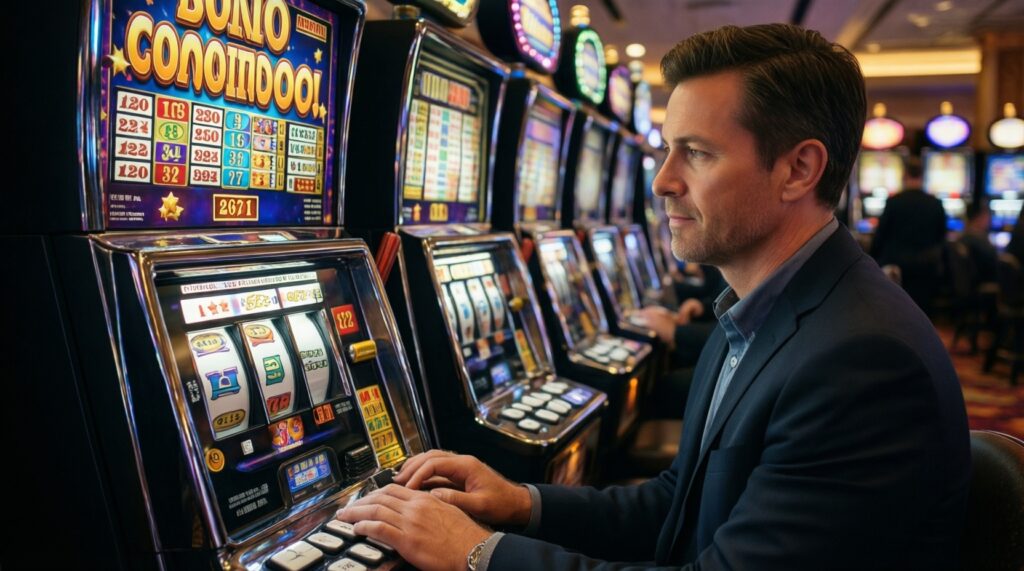
- Play the same title at your normal stake without qualifying for the top tier if the base experience is what you enjoy; treat the top jackpot as irrelevant EV.
- Choose lower-tier progressives where eligibility is easier and hit frequency is higher, then evaluate EV_increment for that tier.
- Set "progressive windows" (short, budgeted attempts) rather than open-ended chasing; this controls downside even when EV is uncertain.
Quick clarifications for risk-aware players
Are progressive jackpot slots ever +EV for players?
They can be under specific conditions, but you need credible inputs (especially hit probability and eligibility cost). Without those, treat any EV claim as a scenario estimate, not a fact.
Do "best progressive jackpot casinos" change my odds of hitting?
They shouldn't change RNG probabilities for the same game, but they can change your real-world outcomes via eligibility rules, transparency, limits, and withdrawal friction. Choose operators with clear terms and predictable payments.
What do progressive jackpot payout odds usually mean?
When published, they typically refer to the chance of triggering the jackpot event per qualifying spin, not the chance of winning any prize. If odds aren't published, assume uncertainty and avoid aggressive chasing.
Does a bigger jackpot mean it's easier to win?
No. "Highest progressive jackpots online" are often paired with extremely low hit frequency, so the prize is larger precisely because it's rarer.
Is there a practical way to estimate "how to win progressive jackpot" chances?
Use a probability range and compute EV_increment = p × (J − R). If the decision changes wildly across plausible p values, the safe choice is not to chase.
If the jackpot just reset, should I stop playing?
Reset reduces ΔJ, which reduces the incremental EV of chasing the progressive specifically. You can still play for entertainment, but don't rationalize it as "value chasing" right after a reset.