

Casino bankroll management means pre-defining how much you can afford to lose, splitting it into sessions and units, and enforcing stop-loss/stop-win rules so short-term swings in roulette, blackjack, or slots cannot derail you. This guide turns การจัดการเงินทุน คาสิโนออนไลน์ into a simple routine: set a budget, size bets, apply game-specific limits, and track results.
Core Principles of Casino Bankroll Control
- Separate bankroll (total budget) from session bankroll (today's amount) and from units (base bet).
- Choose a unit size first; every rule (stop-loss, stake changes, "tree" betting) must be expressed in units.
- Match variance to the game: roulette and slots require tighter exposure control than advantage-style blackjack play.
- Use hard stop-outs: "When X units lost, I stop," not "I'll stop when I feel it."
- Never increase stakes to "get even"; recovery is a schedule decision, not an emotional one.
Setting Your Overall Budget: Goals, Timeframe, and Risk Appetite
This approach fits intermediate players who want repeatable discipline across multiple games and can commit to recording sessions. Avoid it if you cannot keep bankroll money separate from living expenses, or if you plan to chase losses with credit, borrowed funds, or "must-win" goals.
| Decision | Practical options | Pick one rule (example) |
|---|---|---|
| Bankroll timeframe | Trip / week / month | "This bankroll lasts 30 days; no reloads." |
| Risk appetite | Low / medium / high swings tolerance | "Max loss per session = 10 units." |
| Goal type | Entertainment, skill practice, controlled profit attempt | "Stop-win = +6 units, then cash out." |
Decision point: If you cannot state a fixed bankroll and timeframe in one sentence, do not start playing that day.
Session Planning and Stake Allocation: From Unit Size to Betting Trees
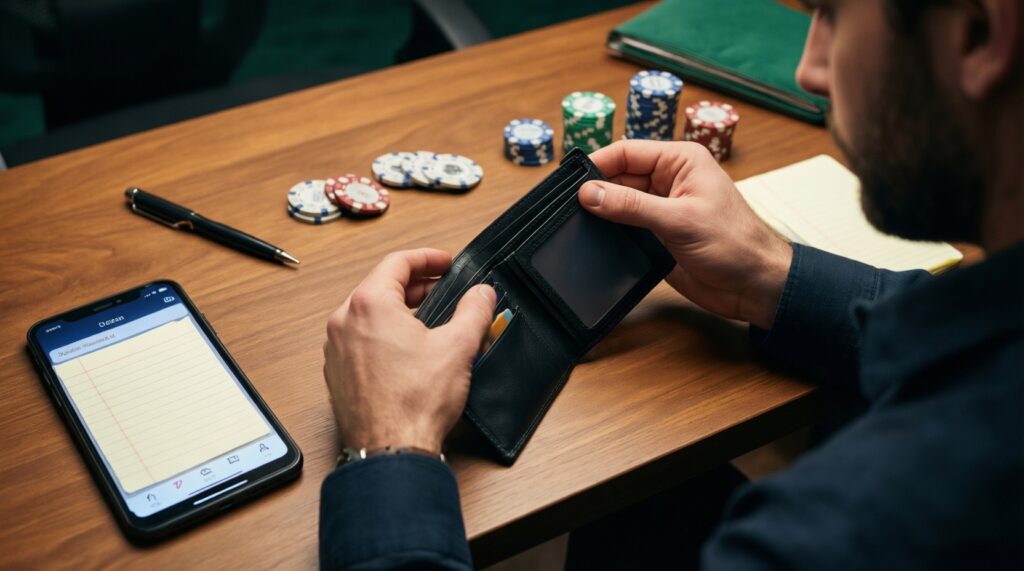
What you need before you play: a separate wallet/account for the bankroll, a simple notes app or spreadsheet, and a fixed unit size that remains stable for the full session. This is where "ตั้งงบและหยุดขาดทุน คาสิโนออนไลน์" becomes operational: budget → session amount → unit → permitted bet patterns.
- A written session plan (start time, end time, game order)
- A unit definition (e.g., 1 unit = 50 THB or 100 THB)
- Stop-loss and stop-win expressed in units
- A simple stake map ("betting tree") you will not exceed
| Item | Safe default | Example |
|---|---|---|
| Session bankroll | Only what you bring to the table/app | 2,000 THB allocated for today |
| Unit size | Small enough for 50-100 bets without reloading | 1 unit = 50 THB |
| Betting tree cap | Max stake in units (hard ceiling) | Never exceed 4 units on any single outcome |
Decision point: If your planned unit does not allow at least a meaningful number of bets within the session bankroll, reduce the unit or do not play.
Game-Specific Variance: Adapting Bankroll Rules for Roulette, Blackjack, and Slots
- Confirm your bankroll, unit, stop-loss, stop-win, and max stake cap are written.
- Choose the game order (e.g., blackjack first, slots last) and lock it.
- Decide in advance whether you will change tables/games after a stop event (usually: stop the session).
- Disable or avoid features that increase speed (auto-spin, rapid re-bet) unless your tracking keeps up.
-
Set a universal "exposure cap" per bet.
Keep any single bet at or below a fixed number of units so one outcome cannot blow up the session. For many players, a cap like 2-4 units per outcome is safer than open-ended progressions.- Rule: "Max bet size = 4 units, no exceptions."
-
Apply a roulette staking rule (สูตรบริหารเงินทุน รูเล็ต) that avoids long progressions.
For roulette, prioritize flat betting or short, capped progressions because losing streaks can extend unpredictably. If you use any progression, it must end at the cap even if you are "one step away" from recovery.- Example: Flat bet 1 unit on an outside bet; after 2 losses, you may go to 2 units once, then back to 1 unit.
- Hard stop: stop-loss triggers the end of the session, not a switch to a "system."
-
Use blackjack bankroll discipline (บริหารเงินทุน แบล็คแจ็ค) with table-fit checks.
Blackjack swings are smaller than many slot sessions when you keep stakes stable, but bad table conditions still hurt (rules, limits, side bets). Keep the main wager consistent; treat side bets as separate higher-risk bets with their own tiny cap or avoid them.- Example: Main bet 1 unit each hand; no side bets, or side bets capped at 0.5-1 unit with a separate mini-stop.
- Rule: If you feel compelled to double your base bet to "fix" results, end the session.
-
Use a slots split-stakes plan (สูตรแบ่งไม้สล็อต) instead of chasing bonus features.
Slots are high-variance; protect the session by splitting play into small "blocks" and never increasing stake just because you are "due." Decide the number of spins per block and the maximum stake step-ups allowed.- Example split: 10 blocks of 30 spins at 1 unit; optionally 2 blocks at 2 units if you are above +3 units overall.
- Rule: No buying bonuses or increasing denomination unless it was pre-approved in the plan.
-
Execute the same stop-loss/stop-win mechanics across all games.
The game can change; the boundaries should not. Once you hit a stop, cash out and stop the session rather than switching games to "continue responsibly."- Example: Stop-loss = −10 units; stop-win = +6 units; max session length = 90 minutes.
| Game | Primary risk | Bankroll control that works | Concrete rule |
|---|---|---|---|
| Roulette | Streaks + temptation to martingale | Flat/short capped progressions | Max stake 4 units; no progression beyond 2 steps |
| Blackjack | Overbetting + side bet leakage | Stable base bet + side bet cap/avoid | Base bet fixed at 1 unit for session |
| Slots | High variance + rapid betting | Spin blocks + stake steps only when ahead | Only increase stake when ≥ +3 units overall |
Decision point: If you cannot describe your next 10 minutes of play (stake, pace, cap, stop rule), pause and rewrite the plan before continuing.
Loss Limits, Profit Targets, and When to Walk Away
- I set a stop-loss in units and will end the session immediately when it hits.
- I set a stop-win in units and will cash out when it hits (no "one more bet").
- I set a max stake cap per bet and did not exceed it even during losing streaks.
- I kept the unit size fixed for the entire session.
- I did not reload the session bankroll from outside funds.
- I did not change games as a way to avoid stopping (switching is allowed only if pre-planned and within limits).
- I tracked results at least by session end (units up/down, time, notes).
- I ended the session if I felt tilt, urgency, or "must recover today" thinking.
| Trigger | What it means | Action |
|---|---|---|
| −X units (stop-loss) | Risk limit reached | Cash out, end session |
| +Y units (stop-win) | Target reached | Cash out, end session |
| Max time | Fatigue risk | End session regardless of result |
Decision point: If any single trigger fires, you stop-no negotiation.
Tracking, Metrics, and a Simple Table-Based Monitoring System
Common bankroll-management failures are usually tracking failures. If you cannot see what happened, you will rewrite history and loosen rules in the next session. Treat tracking as part of the wager.
- Changing unit size mid-session ("just this once").
- Using profit to justify larger bets without a pre-set rule.
- Not separating base bets from high-volatility side bets/bonus buys.
- Ignoring time: longer sessions increase fatigue and impulsive decisions.
- Measuring in currency only, not units (harder to compare across games).
- Switching games after losses to avoid the stop-loss.
- Tracking wins but not losses (or "forgetting" small top-ups).
| Session log field | What to write | Example |
|---|---|---|
| Date/time | Start-end | 2026-06-20, 19:30-20:45 |
| Game | Main game played | Roulette (outside bets) |
| Unit size | Fixed base stake | 1 unit = 50 THB |
| Stop-loss / stop-win | Units | −10 / +6 |
| Result | Units up/down | −7 units |
| Notes | Any rule breaks or tilt signs | Felt urge to double after 4 losses; stopped early |
Decision point: If you do not fill the log the same day, reduce your next session bankroll until tracking is consistent.
Adjusting Strategy After Swings: Recovery, Downsizing, and Stop-Out Rules
Adjustments should be rule-based and scheduled. "Recovery" is allowed only as a controlled next session plan, never during the same session after a stop-loss.
| Alternative | When it fits | Rule to keep it safe |
|---|---|---|
| Downsize the unit | After 2-3 losing sessions or reduced confidence | Cut unit by one step (e.g., 100 → 50 THB) for the next 3 sessions |
| Shorten sessions | When tilt or fatigue is the main issue | Reduce max time by 25-50% until tracking stabilizes |
| Stop-out period (cooldown) | After hitting stop-loss twice in a short span | Take a fixed break (e.g., skip the next planned session) |
| Game focus rotation | If one game repeatedly breaks your rules (often slots) | Limit that game to a small, capped block or remove it for a week |
Decision point: If you hit your stop-loss, the only "adjustment" allowed today is ending the session; all other changes wait for the next scheduled session plan.
Practical Concerns and Quick Clarifications
How do I choose a unit size if table limits are high?
If the minimum bet is too large to allow a reasonable number of bets within your session bankroll, skip that table/game or increase bankroll only if it is truly disposable. Do not compress the plan by raising the unit.
Can I use martingale as a bankroll method for roulette?

Not safely without a strict cap, because the required stakes can escalate quickly. If you insist on a system, treat it as a short, capped progression and stop at the cap.
Should blackjack side bets be included in my unit?

Yes-either include them in the same unit accounting or cap them separately at a very small fraction of the main bet. Otherwise you will underestimate risk and violate your stop-loss invisibly.
What is a practical "สูตรแบ่งไม้สล็อต" for intermediate players?
Split play into blocks (fixed number of spins) with a fixed stake, and allow stake increases only when you are already ahead overall. Never increase stake to chase a bonus or a near-miss.
Is it okay to switch from slots to roulette after losses?
Only if it was pre-planned and you are still within the same stop-loss/stop-win limits. Switching games to avoid stopping is a form of chasing.
What if I hit my stop-win early-do I keep playing with "house money"?
No; treat stop-win as an end-of-session rule and cash out. If you want more playtime, plan a separate session on another day.
How do I enforce "ตั้งงบและหยุดขาดทุน คาสิโนออนไลน์" online?
Pre-commit by moving only the session bankroll into the gambling wallet and keeping the rest inaccessible. If you can top up instantly, your stop-loss becomes a suggestion instead of a rule.