

Blackjack outcomes are mainly driven by the blackjack house edge, which is built from payout terms, dealer rules, and what actions you're allowed to take (double, split, surrender). For intermediate players, the "basics that matter" are choosing the best blackjack rules, applying the right blackjack strategy for that ruleset, and executing cleanly whether you play live or play blackjack online.
Core concepts that actually shift your edge
- House edge is not one number; it's the result of payouts + rules + your decision quality (basic strategy execution).
- Rule changes are not cosmetic: S17 vs H17, surrender availability, and double/split limits change optimal actions.
- Your biggest "skill edge" without counting is avoiding rule traps (poor payouts, restrictive doubles, no DAS).
- A blackjack basic strategy chart is only correct for a specific ruleset; the wrong chart silently leaks EV.
- Variance dominates short sessions; bankroll rules and bet sizing determine whether you can realize long-run EV.
- If you add counting, the value comes from bet sizing and a few deviations-not from memorizing hundreds of plays.
How house edge is constructed: payouts, rules and expected value
The blackjack house edge is the casino's built-in advantage assuming you play optimally for the exact rules in front of you. It comes from asymmetric constraints: the dealer follows forced rules, but you act first and bust first, and payouts/rules can be tuned to favor the house.
Think of each hand as an expected-value (EV) decision tree: after seeing your cards and the dealer upcard, every legal action (hit/stand/double/split/surrender) has a different EV. Your goal is not "win more hands," but choose the action with the highest EV under that ruleset.
Two boundaries matter in practice. First, payout terms (especially blackjack payout) set the baseline edge before decisions. Second, rule permissions (what you're allowed to double/split/surrender) determine how much EV you can "claim back" with correct play.
Rule variations that force a strategy change: S17 vs H17, doubling, splits and surrender
- S17 vs H17 (dealer stands or hits soft 17): When the dealer hits soft 17 (H17), the dealer completes more strong totals. This shifts several borderline player decisions (notably some doubles and soft-hand plays) compared to S17.
- Blackjack payout (e.g., 3:2 vs 6:5): Payout changes don't just "hurt a bit"; they reduce the value of your strongest result (a natural), raising house edge regardless of how perfect your decisions are.
- Double rules (any two vs 9-11 only, after split allowed or not): Restrictive doubling removes high-EV opportunities. If DAS is not allowed (no double after split), some splits become less attractive.
- Split rules (resplitting limits, re-splitting aces, hit split aces allowed or not): Aces are special because the follow-up hand is constrained. If you can't resplit aces or can't take additional cards, the EV of splitting aces changes and your overall edge worsens.
- Surrender (late surrender available or not): Late surrender gives you a controlled loss option on certain bad matchups. If surrender is available, optimal play includes using it in specific high-negative-EV spots.
- Number of decks: More decks typically reduce the player's chances of naturals and change distribution details. Basic strategy remains similar, but "borderline" actions and counting value depend on deck count.
Quantifying impacts: a comparison table of common rule sets and their edge effects
Use this as a field guide for choosing best blackjack rules when comparing tables in Thailand-facing platforms (live studios, crypto casinos, international operators) or when you play blackjack online. The exact magnitude depends on the full ruleset; the table below focuses on reliable direction and practical severity.
| Rule / condition | Player impact on house edge | What you do in practice |
|---|---|---|
| Blackjack pays 3:2 | Strongly better for player (lower edge) | Prefer these tables; treat 6:5 as a "hard avoid" unless you're practicing only. |
| Blackjack pays 6:5 | Strongly worse for player (higher edge) | Don't "fix it" with tactics-no strategy adjustment restores the lost payout value. |
| Dealer stands on soft 17 (S17) | Better for player | Use the S17 version of your blackjack basic strategy chart. |
| Dealer hits soft 17 (H17) | Worse for player | Switch to H17 strategy: expect a few more hits/doubles to change on soft totals. |
| Double on any two cards allowed | Better for player | Take more high-EV doubles (especially on 9-11, and some soft hands depending on rules). |
| Double restricted (e.g., 9-11 only) | Worse for player | Remove the blocked doubles from your decision tree; don't replace them with "aggressive hits." |
| Double after split allowed (DAS) | Better for player | Splits become more profitable; ensure your chart is marked DAS. |
| No double after split (no DAS) | Worse for player | Tighten some splits (ruleset-specific); avoid defaulting to "always split" slogans. |
| Late surrender available | Better for player | Use surrender in the specific worst matchups (especially hard totals vs strong dealer upcards). |
| No surrender | Worse for player | Replace those would-be surrenders with the best of hit/stand per the correct chart. |
Where these rule differences show up in real play

- Live online blackjack lobbies: Different studios label tables similarly while hiding key rules in an info panel; always open it before sitting.
- "Speed" and "Unlimited" variants: Convenience formats often pair with worse payouts or restricted doubles; treat the format as a risk flag until verified.
- Side-bet heavy tables: Base game rules can be weaker; your main EV leak may be the base rules, not the side bets.
- Promotional tables: A bonus can be offset by worse rules; compare rule quality first, then evaluate promo value.
- New player practice rooms: Common place to see 6:5 payouts; fine for mechanics practice, not for serious EV-focused play.
Fast practical tips you can apply today
- Two-second rule scan: Check blackjack payout, S17/H17, double restrictions, DAS, and surrender before your first bet.
- One-chart discipline: Save two charts only: "S17 multi-deck (DAS)" and "H17 multi-deck (DAS)". Don't mix rules in your head.
- EV hygiene: If you miss the correct play, default to "don't invent"-return to chart logic next hand rather than chasing.
- Table selection beats heroics: If payout is 6:5 or doubles are heavily restricted, leave. No clever blackjack strategy compensates efficiently.
- Online execution: Turn on game history/roadmap only if it helps your discipline; never use it to predict cards.
Action rules: concise basic strategy for most common rule combinations
Below is a compact, rules-agnostic core that matches most multi-deck games you'll meet when you play blackjack online. For precision, still use the correct blackjack basic strategy chart for S17 vs H17 and for surrender/DAS settings.
Core decision blocks (works as a memory scaffold)
- Hard totals: Stand on 17+. Hit 11 or less. For 12-16, your decision is driven by the dealer upcard: you generally stand against weaker dealer cards and hit against stronger ones.
- Soft totals: Soft hands are "double-friendly." Many soft 13-18 hands improve most by doubling against weaker dealer upcards when allowed; otherwise hit until you reach a strong standing total.
- Pairs: Always split aces and 8s in standard rulesets. Treat 10s as a made hand (usually do not split). The rest depends heavily on DAS/no-DAS and dealer upcard.
- Surrender (if offered): Use it as a loss-control tool on a small set of worst matchups rather than as a general escape hatch.
Limits and failure modes to watch
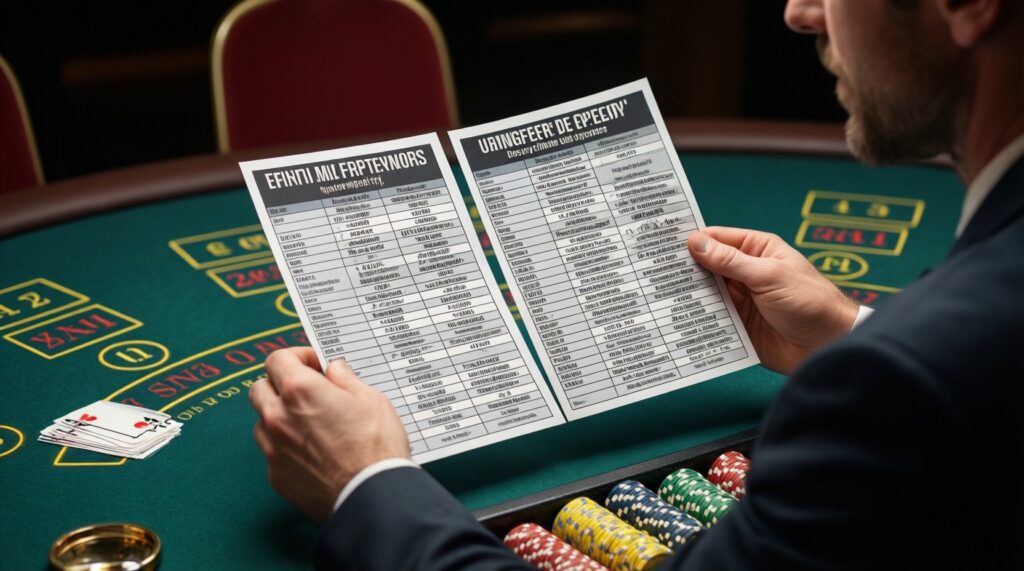
- Wrong-chart leak: Using an S17 chart in an H17 game (or ignoring no-DAS) is a silent EV drain that looks like "bad luck."
- Rule-blocked actions: If doubling is restricted, remove those doubles rather than substituting emotional aggression (like forced hits).
- Mechanical errors: Misreading A as 1 (soft vs hard) and mishandling pair logic are the most common intermediate mistakes.
- Outcome bias: Correct play can lose; evaluate by decision quality, not by whether the dealer turned a miracle card.
Money management and bet sizing: minimizing ruin and maximising long-term growth
- Myth: Martingale fixes variance. It converts normal variance into bankroll blow-up risk and can collide with table limits quickly.
- Mistake: sizing by emotion. "Pressing when you feel hot" and "recovering when down" disconnects bet size from any real edge.
- Mistake: ignoring session stop rules. Without predefined stop-loss/stop-win behavior, decision quality typically degrades as fatigue and tilt increase.
- Mistake: treating comps/bonuses as free EV. A weak-rules table can cost more than the value of points or small rebates.
- Practical baseline: Keep stakes small enough that you can follow the chart perfectly; discipline is part of your EV.
Bringing strategy to the table: simple counting principles and practical deviations
Card counting is not required for strong fundamentals, but it clarifies why table selection and bet sizing matter. A simple approach is to track whether the remaining shoe is richer in tens/aces (better for player) or richer in small cards (better for dealer).
A minimal counting workflow (concept-to-practice)
- Choose a simple system: Assign small cards a positive tag, tens/aces a negative tag, and middle cards neutral.
- Maintain a running count: Update the count as cards are revealed (including dealer cards after resolution).
- Convert to a true count: Divide by an estimate of decks remaining to normalize across shoe depth.
- Bet ramp idea: Bet your minimum at neutral/negative counts; increase only when the true count is meaningfully positive.
- Deviations (keep it small): Learn a short list of the highest-impact departures from basic strategy for positive counts, rather than chasing completeness.
Mini-case you can rehearse before a session
You join a multi-deck table with decent rules and notice several low cards fall early. Your running count rises and the shoe is still deep. You (1) keep playing basic strategy precisely, (2) only scale your bet when your normalized count is clearly positive, and (3) apply only your memorized top deviations-no improvisation.
Precise clarifications intermediate players request
Is house edge the same as my expected loss per hand?
Not exactly. House edge is the long-run advantage built into the game assuming optimal play; your actual results fluctuate widely short-term. Your personal EV depends on rules plus how closely you follow correct decisions.
Does basic strategy guarantee profit if I play long enough?
No. Basic strategy minimizes losses and variance relative to random play, but it does not overcome a negative-EV ruleset. Profit requires an additional edge (counting, promotions with strict conditions, or mistakes by others that you can exploit in permitted formats).
What are the best blackjack rules I should prioritize first?
Start with blackjack payout (avoid 6:5), then S17 over H17, then permissive doubling (including DAS), then surrender availability. If you can't check rules quickly, choose another table.
Do I need a different blackjack basic strategy chart for every table?
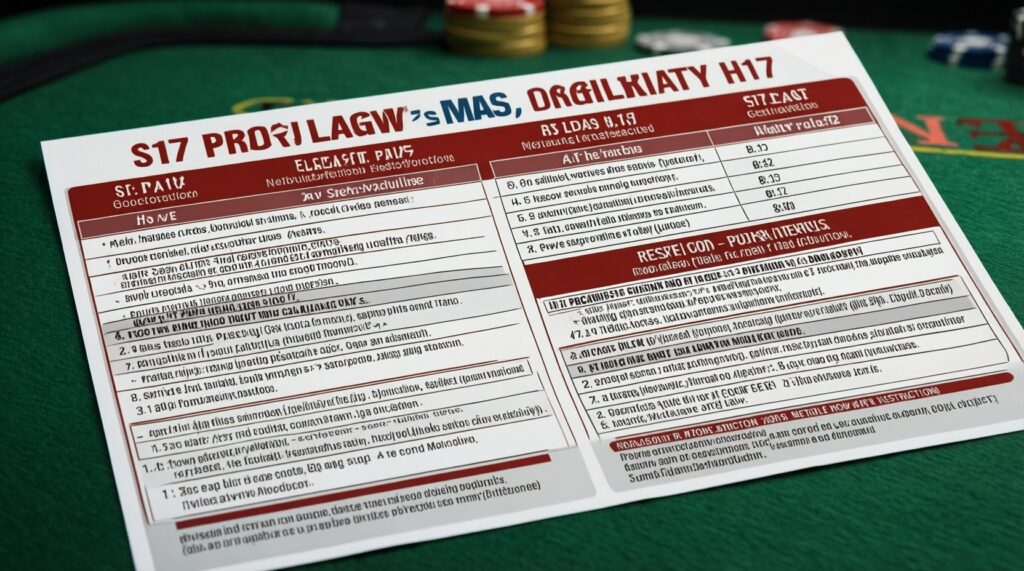
You mainly need the correct chart for S17 vs H17 and for key permissions (DAS/no-DAS, surrender, double restrictions). Many other differences are secondary for non-counters.
When I play blackjack online, does the RNG change the strategy?
No. If the game faithfully deals from the same rules and deck model, optimal decisions are the same. What changes online is your ability to verify rules quickly and maintain disciplined pace.
Is card counting realistic for intermediate players?
Yes, but only if you can keep perfect basic strategy first and then add counting as a separate, repeatable process. The biggest practical gains come from bet sizing and a small set of deviations, not from complicated math.