

Blackjack basic strategy is a fixed decision system (hit/stand/double/split) that minimizes the house edge for the exact rules you're playing. It does not "beat" the game by itself; it prevents avoidable mistakes and stabilizes results. Your real edge comes only from rule selection, disciplined bankroll control, and-if used-advantage play like counting.
Essential Strategy Snapshot
- Use a rule-matched blackjack strategy chart; a "generic" chart can be wrong for your table.
- Basic strategy reduces loss rate; it does not guarantee profit or short-term wins.
- Separate decisions (strategy) from wagers (bet sizing); mixing them creates costly volatility.
- Know the three hand types: hard totals, soft totals, pairs; each has different default actions.
- Prioritize safety: avoid side bets, avoid chasing, and cap session exposure before you start.
- For online blackjack strategy, verify rule set (decks, dealer hit/stand soft 17, double/split limits) before trusting any chart.
Common Strategy Myths Debunked
Myth 1: "The best blackjack strategy to win is a secret pattern." There is no pattern that changes the math of independent hands. What exists is blackjack basic strategy: a published, table-dependent set of choices that minimizes expected loss given you cannot see the next card.
Myth 2: "Basic strategy means you'll win if you memorize it." Even perfect play still faces variance; short runs can look terrible. Basic strategy mainly prevents big, frequent leaks (wrong doubles/splits, bad stands) that quietly compound over time.
Myth 3: "You can feel when the deck is hot." Without a verifiable method (like counting) and sufficient sample size, "hot/cold" is noise. Safe play means relying on decisions you can justify on every hand, not on mood or streaks.
Myth 4: "One chart fits all tables." A blackjack strategy chart is only correct for the rules it was calculated for. Deck number, dealer behavior on soft 17, and double/split rules shift correct actions in specific spots.
Basic Strategy: When to Hit, Stand, Split and Double
Basic strategy is a decision tree that compares the risk of improving your hand versus the risk of busting, while also accounting for the dealer's upcard. To learn blackjack basic strategy efficiently, treat it as three mini-systems: hard totals, soft totals, and pairs.
- Start with the dealer upcard. Low dealer cards (2-6) tend to create dealer bust risk; higher dealer cards (7-A) pressure you to improve.
- Hard totals (no Ace counted as 11): hit to build when you're behind; stand when your bust risk outweighs improvement chances.
- Soft totals (Ace counted as 11): you can be more aggressive because you often cannot bust on one hit.
- Doubling: double when one extra card has high upside and your current total is strong enough versus the dealer's upcard.
- Splitting pairs: split when turning one weak/awkward hand into two better starting hands increases long-run value.
- Insurance: treat it as a separate bet; basic strategy players typically avoid it unless they have additional information.
Quick reference table for common decisions (typical rules)
| Player hand | Dealer upcard | Recommended action | Why it's the "safe" default |
|---|---|---|---|
| Hard 16 (not 8,8) | 7-A | Hit | Standing loses too often; hitting is ugly but reduces expected loss. |
| Hard 16 (not 8,8) | 2-6 | Stand | Let the dealer bust; your hit-bust risk is high. |
| Hard 12 | 2-3 | Hit | Dealer is less likely to bust; you often need improvement. |
| Hard 12 | 4-6 | Stand | Dealer bust chance rises; standing protects bankroll volatility. |
| Hard 11 | 2-10 | Double (otherwise hit) | High chance to reach a strong total with one card. |
| Soft 18 (A,7) | 9-A | Hit (sometimes stand vs 9 depending on rules) | You can improve without immediate bust risk. |
| Pair 8,8 | Most upcards | Split | 16 is a long-run trap; two 8-starts are usually better than one 16. |
| Pair A,A | Any | Split | Creates two premium starting hands; don't waste the Ace as a "1". |
| Pair 10,10 | Any | Stand | 20 is already strong; splitting increases variance and reduces expected value. |
Hard Totals vs Soft Hands: Clear Decision Rules
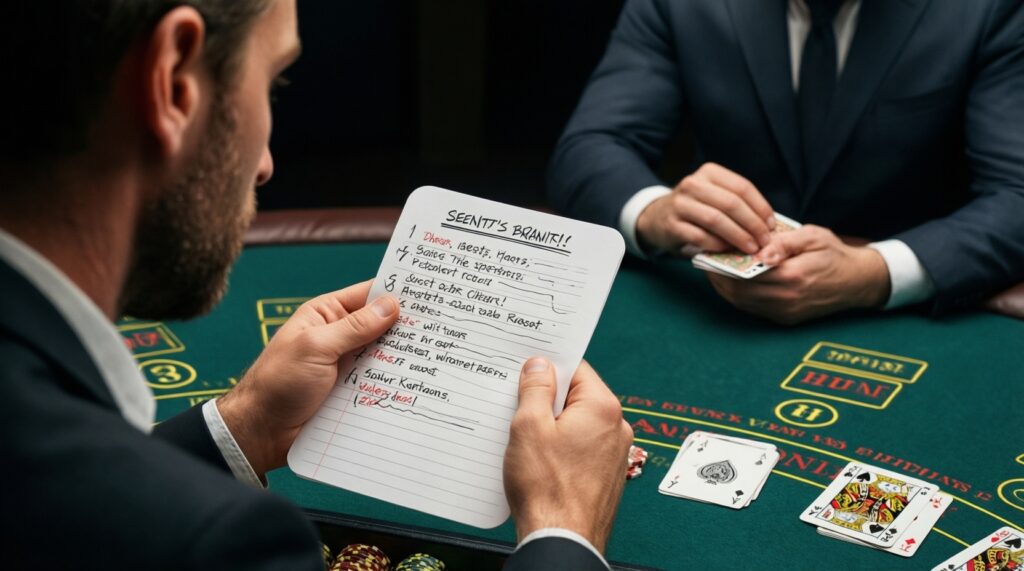
Use these scenarios to avoid the most common "almost right" mistakes. They're written as practical defaults; always defer to the chart that matches your rules.
- Hard 13-16 vs dealer 2-6: stand and let the dealer break more often than you do.
- Hard 13-16 vs dealer 7-A: hit because standing bleeds too much long-run value.
- Soft 13-17 (A,2 through A,6): usually hit; double when allowed and the dealer shows a vulnerable card (commonly 4-6).
- Soft 18 (A,7): stand against weaker dealer upcards; become more aggressive (hit or double depending on rules) against stronger upcards.
- Hard 9-11: consider doubling based on dealer upcard; if doubling isn't allowed, hit rather than "playing scared."
Where the Real Player Edge Comes From: Strategy vs Counting
Basic strategy is defensive: it narrows mistakes and keeps your decisions consistent. "Edge" (positive expected value) is a separate question and depends on whether you can shift the game conditions in your favor.
What basic strategy reliably does for you

- Reduces the house edge versus random or intuition-based play.
- Standardizes decisions so you can review errors and improve.
- Makes bankroll swings more predictable than impulsive deviations.
- Provides a baseline for any further skill (counting, game selection, promotions).
What basic strategy cannot do (limitations you should accept)
- It cannot overcome unfavorable rules by "trying harder."
- It cannot guarantee profit in a session; variance dominates short-term outcomes.
- It does not tell you how much to bet; that's bankroll/variance management.
- It does not create an advantage without additional information; card counting is a separate discipline with heat/limits.
Bet Sizing, Variance and Bankroll Rules for Sustainable Play

Most intermediate players lose money not because they never saw a blackjack strategy chart, but because they bet reactively. Safe steps focus on controlling exposure when the cards do what they always do: swing.
- Do not "press to recover." Chasing converts normal variance into bankroll-ending variance.
- Set a loss cap and a time cap before you sit down. Stopping rules are safer than "I'll stop when I feel good."
- Keep bet changes slow and rule-based. If you're not counting, large bet ramps are usually just emotion in disguise.
- Avoid side bets as a default. They typically add volatility and distract from correct main-hand decisions.
- Use a consistent base unit. Choose a unit you can comfortably lose multiple times without breaking your plan.
Table Rules and Dealer/Deck Variations That Shift Expected Value
Before you trust any "online blackjack strategy" guide or printable chart, confirm the exact rule set. Small rule differences create specific decision differences (especially in doubling and soft-hand play) and can change how "safe" a table is for your bankroll.
Mini-case: selecting a chart and playing safely (rule-check workflow)
- Read the table rules: number of decks, dealer hits/stands on soft 17, double rules (any two or restricted), split limits, surrender availability.
- Pick the matching blackjack strategy chart: do not reuse a chart from a different ruleset "because it's close."
- Lock your session rules: base bet, max bet (if any), stop-loss, stop-time.
- Play decisions first, results second: track whether choices matched the chart, not whether you won that hand.
if rules_changed:
  update_strategy_chart()
  reset_session_limits()
for each_hand:
  action = chart_lookup(player_hand, dealer_upcard)
  execute(action)
Practical Clarifications and Quick Answers
Is blackjack basic strategy the same as card counting?
No. Basic strategy is the correct play given no extra information; counting attempts to estimate when the remaining cards favor the player and then adjusts bets and sometimes plays.
Do I need a blackjack strategy chart at the table?
If allowed, yes-especially while you learn blackjack basic strategy. If not, memorize in chunks (hard totals, soft totals, pairs) and practice until decisions are automatic.
What is the best blackjack strategy to win if I'm not counting?
Use the correct basic strategy for the table rules, avoid side bets, and keep conservative, consistent bet sizing. This won't guarantee wins, but it prevents common high-cost errors.
Does online blackjack strategy change compared to live blackjack?
The decision logic is the same, but rule sets and game speed differ. Online, double-check decks and soft-17 rules and be stricter with time/loss limits because volume increases variance exposure.
Why do charts sometimes disagree on hands like soft 18?
Because optimal actions depend on rules (especially dealer hit/stand soft 17 and doubling rules). Always use a chart built for your exact game conditions.
Should I ever deviate from basic strategy because I'm "due"?
No. Being "due" is not actionable information and usually increases expected loss. Deviations should be rule-based and information-based, not emotion-based.
Is insurance ever a good idea?
For basic-strategy-only players, it's typically avoided because it's a separate wager that usually doesn't pay off often enough. Treat it as independent from playing your hand correctly.