

Bankroll management for casino play means predefining a bankroll, choosing a fixed "unit" bet size, and enforcing loss and win-stop rules so a bad streak cannot escalate into uncontrolled spending. A practical casino bankroll management strategy uses small, repeatable bets, clear stop loss limits casino gambling thresholds, and disciplined session scheduling as part of responsible gambling bankroll management.
Core Principles of Casino Bankroll Management
- Separate your gambling bankroll from living money; never "borrow" from essentials.
- Use a fixed unit size and a consistent bet sizing strategy casino players can repeat under stress.
- Set layered limits (session, daily, monthly) and treat them as non-negotiable.
- Define stop-loss and take-profit rules before you start; follow them even when "close."
- Match unit size to game volatility and table limits; don't force stakes that don't fit.
- Track results and rule-compliance, not just wins and losses.
Calculating Your Optimal Unit Size
Your unit is the "default bet" used for most wagers in a session. It fits most bankroll management casino setups because it reduces emotional overbetting and makes limits easy to calculate.
Who this suits: intermediate players who want repeatable control across slots, roulette, baccarat, and blackjack.
When not to do it: if you can't tolerate short-term variance without chasing, if table minimums force you above your planned unit, or if you're using money you cannot afford to lose.
Quick method
- Decide your bankroll amount for the period (session/day/month).
- Choose a unit as a small percentage of that bankroll (kept consistent).
- Ensure the unit is compatible with table minimums and your typical number of bets.
Unit-sizing examples (by bankroll and bet percentage)
| Bankroll (THB) | 0.5% unit (THB) | 1% unit (THB) | 2% unit (THB) |
|---|---|---|---|
| 2,000 | 10 | 20 | 40 |
| 5,000 | 25 | 50 | 100 |
| 10,000 | 50 | 100 | 200 |
| 20,000 | 100 | 200 | 400 |
Worked numerical example (simple, usable)
You set a session bankroll of 6,000 THB. You choose a 1% unit = 60 THB. You decide a session stop-loss of 25 units (1,500 THB) and a take-profit of 15 units (900 THB). Most bets stay at 1 unit; occasional higher-volatility spins might be capped at 2 units (120 THB) if limits still fit.
Setting Session, Daily and Monthly Loss Limits
To implement stop loss limits casino gambling rules safely, you need a written plan and a way to enforce it in real time-before you get tired, tilted, or rushed.
What you'll need
- Bankroll definition: a fixed amount for the period (session/day/month).
- Unit size: your default bet in THB (from the unit-sizing step).
- Limit sheet: a note on your phone or a small card with thresholds (units and THB).
- Time boundary: a session duration or end-time you will not extend.
- Cash discipline: bring only the session bankroll (or segregate e-wallet funds) to reduce "top-ups."
Session limits template (copy and fill)
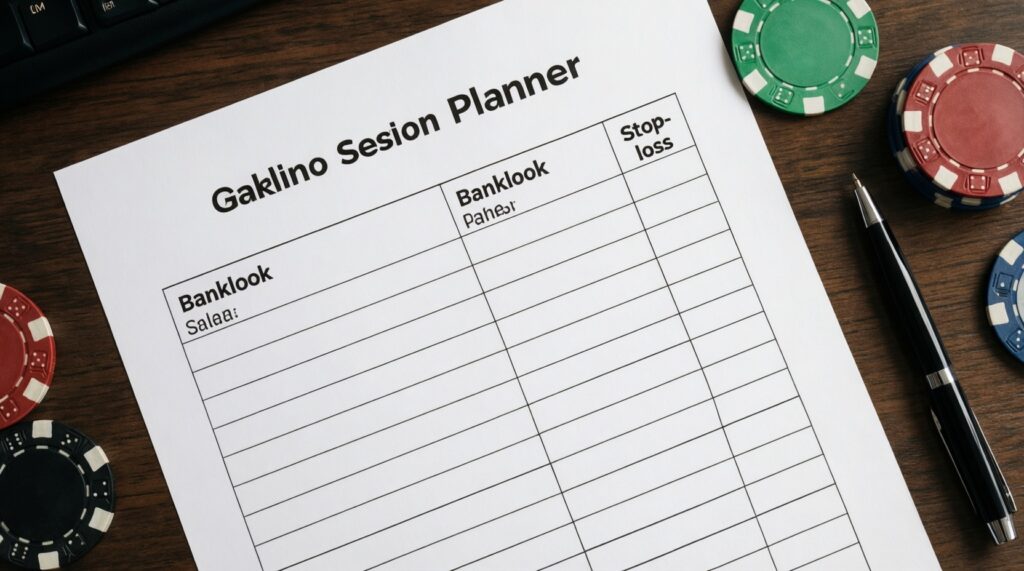
- Session bankroll: ____ THB
- Unit size: ____ THB (____% of session bankroll)
- Stop-loss: ____ units = ____ THB
- Take-profit: ____ units = ____ THB
- Hard stop time: ____ (no extensions)
- Rebuy/top-up rule: Not allowed / Allowed once (choose one)
Crafting Stop-Loss and Take-Profit Rules for Casino Play

- Write your bankroll, unit, stop-loss, take-profit, and time limit in one place.
- Decide your maximum bet in units for the session (cap your "upsizing").
- Pre-commit to leaving the table/app when any stop is hit.
- Choose one short reset routine for breaks (water, walk, timer) to reduce impulse bets.
-
Define a single session bankroll (separate money)
Pick one amount you can afford to lose without affecting essentials. This is the base for responsible gambling bankroll management because it prevents "repair spending" after losses.
-
Lock your unit and maximum bet cap
Choose a unit you can repeat calmly, then set a hard cap (for example, 2-3 units) for any higher-risk moments. This is the core of a bet sizing strategy casino players can follow under pressure.
- Do: keep most bets at 1 unit.
- Don't: raise stakes to "win it back."
- Threshold: if you feel urgency, drop to 1 unit or pause.
-
Set the stop-loss in units (then convert to THB)
Choose a loss limit you will not cross in the session. Express it in units first (easier to follow), then write the THB equivalent.
- Do: stop immediately when the stop-loss is hit.
- Don't: "take one more shot" after the limit.
- Threshold: if you hit 50% of stop-loss quickly, take a timed break before continuing.
-
Set a take-profit that ends the session cleanly
A take-profit turns good variance into a finished result instead of a longer, riskier session. Keep it realistic relative to your unit and game speed.
- Do: cash out or stop play once you reach it.
- Don't: increase stakes because you are "playing with house money."
- Threshold: after take-profit, no "victory lap" bets.
-
Enforce a time stop to prevent fatigue betting
Pick an end time and set an alarm. Time stops reduce mistakes and keep your casino bankroll management strategy consistent across days.
-
Define what happens after a stop (cooldown rule)
Write one rule for what you do next: leave, log results, and wait a minimum time before any new session. This prevents instant re-entry chasing.
- Do: log the stop trigger and your mood (calm/tilted/tired).
- Don't: switch games to justify continuing.
Sizing and Adjusting Bankroll by Game Type and Volatility
- My unit fits the minimum bet and doesn't force me into larger stakes to participate.
- My maximum bet cap (in units) is lower for higher-volatility games (for example, many slots).
- I can survive typical downswings without hitting the stop-loss in a few minutes.
- I'm not using side bets or bonus buys that effectively multiply my unit risk.
- I know how many bets my session typically contains (roughly) and my unit isn't too large for that volume.
- If I change games, I re-check that the unit still makes sense for that game's variance and bet rhythm.
- I'm not increasing unit size mid-session; adjustments happen only between sessions.
- If table limits conflict with my unit plan, I change table/game-not my rules.
Managing Progression Systems and Preventing Ruin
- Using Martingale-style doubling without a strict cap; table limits and streaks can break the plan fast.
- Raising unit size after losses ("chasing") instead of following the predefined bet sizing strategy casino rules.
- Mixing bankrolls: treating monthly money as a backup for a blown session limit.
- Ignoring game volatility: sizing roulette or slots the same way you size low-variance decisions.
- Counting "near wins" as signals to increase stakes.
- Resetting limits after a win ("I'm up, so I can risk more") and giving it back.
- Letting bonuses, comps, or jackpots justify breaking stop-loss or time stops.
- Not planning for fatigue: playing longer than intended and making larger, sloppier bets.
Tracking Results: Metrics, Logs and a Review Table
If detailed tracking feels heavy, use one of these lighter alternatives-each still supports bankroll management casino discipline.
- Session-only logging: record date, game, unit, stop-loss/take-profit, and whether you followed rules (best when you want simplicity).
- Weekly review: log sessions normally but review once per week (best when you tilt easily and want fewer emotional "post-mortems").
- Threshold alerts: only record when you hit 50% of stop-loss or any rule break (best when time is limited).
- Game-separated notes: separate pages for each game type to spot volatility issues (best when you rotate games often).
Compact review table (copy into notes)
| Session date | Game | Unit (THB) | Stop-loss (units/THB) | Take-profit (units/THB) | Result (THB) | Rules followed? (Y/N) | Main issue to fix next time |
|---|---|---|---|---|---|---|---|
| ____ | ____ | ____ | ____ / ____ | ____ / ____ | ____ | ____ | ____ |
| ____ | ____ | ____ | ____ / ____ | ____ / ____ | ____ | ____ | ____ |
Practical Concerns and Concise Clarifications
Is bankroll management casino play useful if the house has an edge?
Yes: it doesn't change the edge, but it controls risk, protects time and money, and makes outcomes less dependent on emotional decisions.
How do I pick a unit if the table minimum is high?
If the minimum forces your unit above your plan, choose a different table or game. Don't "fix" it by increasing bankroll or removing limits.
Should I change unit size after a win streak?
Not within the same session. If you resize, do it between sessions based on a larger, clearly defined bankroll and the same casino bankroll management strategy rules.
What's the difference between a stop-loss and a daily limit?
A stop-loss ends one session; a daily limit prevents multiple sessions from stacking losses. Use both to make stop loss limits casino gambling rules harder to bypass.
Do progression systems replace a bet sizing strategy casino plan?
No. Progressions increase variance and can collide with table limits; only use them with strict caps and within your unit-based limits.
How do I keep responsible gambling bankroll management when playing online?
Pre-segregate funds, disable easy top-ups where possible, and keep your limit sheet visible. If you break a limit, stop for the planned cooldown period.
What if I hit take-profit early-can I keep playing "small"?
Keeping "small" often fails in practice because stakes creep up. Treat take-profit as a hard stop to protect the win and reinforce discipline.