

Basic strategy in blackjack is the lowest-risk decision system for hitting, standing, doubling, splitting, and (when offered) surrendering based on your hand and the dealer upcard. The fastest way to protect expected value (EV) is to follow a reliable blackjack basic strategy chart, avoid common deviations, and verify any "feel-based" exceptions with a blackjack strategy calculator.
Essential Strategic Summary for Expected Value
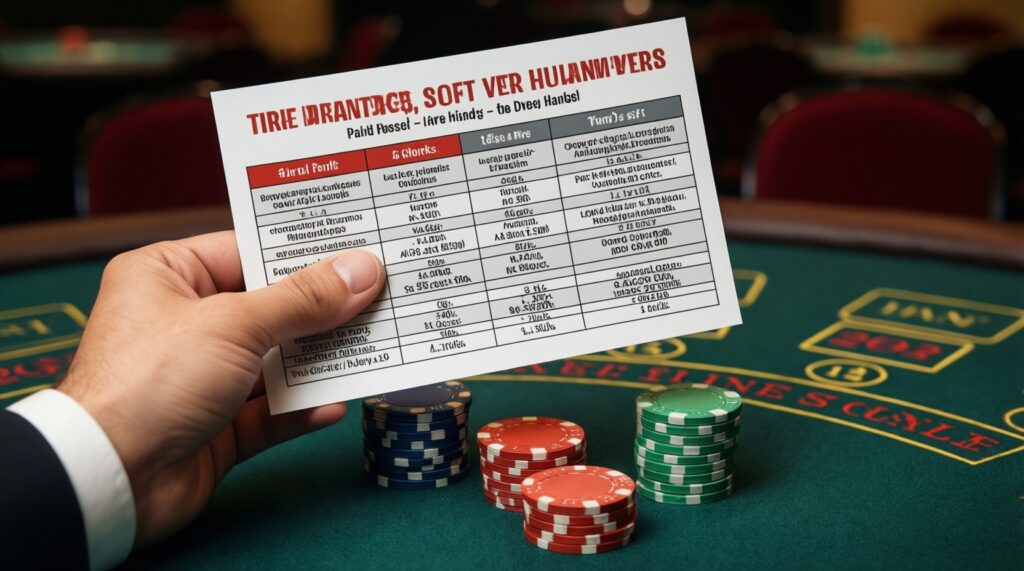
- Use a rule-matched blackjack basic strategy chart (decks, dealer hits/stands soft 17, double rules, surrender) and treat it as your default.
- Most EV leakage comes from bad doubles, wrong splits, and standing too often in dealer-advantage upcards.
- Only consider blackjack basic strategy deviations when you can name the exact trigger (usually the dealer upcard and whether the hand is hard/soft/pair) and you can reproduce it consistently.
- Variance management matters: some correct plays swing more in the short run; commit to EV-first decisions rather than "session protection."
- The "best blackjack strategy to win" in a real casino setting is boring: correct basic strategy, controlled bet sizing, and zero tilt-driven exceptions.
When to Hit, Stand, Split and Double: Decision Matrix
This decision matrix fits intermediate players who already know hand types (hard/soft/pairs) and want fewer unforced errors under live-table pace. It works best when the table rules are stable and you can keep the dealer upcard in view.
Do not rely on it when you cannot confirm house rules (especially soft-17, surrender availability, and doubling restrictions), when side bets are distracting your decisions, or when you're trying to "play to not lose" after a downswing (that mindset drives the most expensive mistakes).
- Hard totals: stand when your total is already strong against the dealer's likely bust pattern; hit when the dealer is favored to make a strong total.
- Soft totals: treat the Ace as "room to improve"; soft hands are often doubles against weak upcards because you can't bust with one card.
- Pairs: splitting is about creating two hands with higher combined EV, not about "getting away" from a bad total.
- Doubling: double when one additional card has a high chance to produce a final total that beats the dealer's most common outcomes for that upcard.
Common Mistakes That Cost Expectation
What you need to reduce blackjack basic strategy mistakes in real play:
- A single, correct reference: one blackjack basic strategy chart that matches the rules you are playing (don't mix phone images from different rule sets).
- Rule confirmation habit: know (or ask) whether the dealer hits soft 17, whether late surrender is offered, and what doubles are allowed.
- A validation tool: a blackjack strategy calculator (or reputable trainer) to check any "exception" you think you've learned.
- Practice format: short drills on specific families of hands (hard 12-16 vs dealer 2-A; soft 13-18 vs dealer 2-A; pairs vs dealer 2-A).
- Self-audit method: after a session, write down 3 hands you felt unsure about and resolve them offline (don't solve at the table).
How Dealer Upcards Change Optimal Play
Risk and limitations (read before the steps):
- House rules shift optimal actions; if rules are unknown, treat any "advanced" play as unverified and default to your best-matched chart.
- Do not chase losses with bigger doubles/splits; that increases variance without improving EV.
- Avoid "dealer tells" and pattern betting; it's noise that encourages inconsistent decisions.
- If you cannot execute a deviation consistently, it's not a strategy-stick to baseline decisions.
-
Classify your hand correctly (hard, soft, pair).
Decide whether an Ace is counted as 11 without busting (soft) and whether you have a pair (same rank).- If you misclassify a soft hand as hard, you'll miss profitable doubles and over-hit into bad outcomes.
- If you misclassify a pair, you'll stand/hit when splitting would create higher combined EV.
-
Read the dealer upcard as "pressure level."
Weak upcards (commonly 2-6) favor strategies that let the dealer break; strong upcards (commonly 7-A) force you to improve your total more aggressively. -
Start from baseline: hard totals vs the upcard.
Practical example: with a marginal hard total (e.g., hard 16), your decision swings heavily by whether the dealer shows a weak or strong upcard-standing into a strong upcard is usually a long-term leak. -
Then handle soft totals: look for double windows.
Practical example: soft 18 is not "always stand"; it can be a stand, hit, or double depending on the upcard and the table's double rules. -
Resolve pairs last: split only for a reason.
Practical example: splitting is strongest when it turns a compromised total into two hands that frequently start near strong ranges (or can be doubled effectively), and weakest when it creates two fragile hands against strong upcards. -
If you think you know a deviation, verify it once-then standardize.
Use a blackjack strategy calculator to confirm the move under your exact rules, then write it as a single-line trigger (hand type + dealer upcard + allowed options) so you don't improvise mid-shoe.
Soft Hands, Late Surrender and When to Deviate
Use this checklist to confirm you're deviating safely (or to confirm you should not deviate):
- I can state the house rules that affect the hand (soft-17, surrender, double-after-split, re-split rules).
- I know whether my hand is hard/soft/pair without recalculating twice.
- I can explain the deviation as "this upcard changes the dealer's bust/finish distribution," not "it feels due."
- I apply the same action every time the same situation appears (no mood-based switching).
- If surrender is available, I treat it as an EV tool (damage control), not as an emotional "escape button."
- I do not add extra deviations when I'm tired, tilted, or drinking; I revert to chart-only decisions.
- I re-check any new deviation offline with a blackjack strategy calculator before adopting it permanently.
Quantifying EV Loss: Tables, Examples and Thresholds
Exact EV loss depends on rules, number of decks, and available options, so giving fixed percentages without a rule-matched simulation would be misleading. Instead, use the table below to categorize typical mistake impact and then quantify it with a blackjack strategy calculator under your table conditions.
| Mistake pattern (what you do) | Typical scenario (example) | Why it leaks EV | How to quantify accurately (no guesswork) | Impact band (qualitative) |
|---|---|---|---|---|
| Stand "to avoid busting" too often | Hard marginal totals vs strong dealer upcard | You accept a low win-rate final total and skip necessary improvement draws. | Plug the exact hand + upcard + rules into a calculator; compare Stand vs Hit EV. | High |
| Double in the wrong spots | Doubling hands that don't gain enough from one card | You amplify variance when your expected improvement is weak. | Check EV difference between Double and Hit; confirm doubling restrictions. | High |
| Miss a correct double with a soft hand | Soft totals that have strong "one-card" improvement vs weak upcards | You leave value on the table by betting too little when advantage is highest. | Compute EV for Double vs Hit; ensure double is allowed on that hand type. | Medium-High |
| Split (or refuse to split) for emotional reasons | Pairs that create two weak hands against strong upcards (or the opposite) | Splitting can either create two better starts or multiply bad situations. | Compare EV of Split vs No Split under your re-split and DAS rules. | Medium-High |
| Ignore late surrender when it exists | Clearly disadvantaged matchups where surrender is offered | Surrender caps downside in negative-EV spots; skipping it overpays losses. | Calculate EV for Surrender vs optimal play; verify it's late (post-peek) surrender. | Medium |
| Use the wrong chart for the rules | Applying an H17 chart at an S17 table (or vice versa) | Many borderline decisions flip; systematic mismatch compounds across sessions. | Select the correct rule set in the tool; regenerate/print a matching chart. | High (systematic) |
Common EV-leak patterns to watch for (and how to set thresholds for yourself):
- "I always stand on X." Any always-rule on a borderline total is a red flag; borderline hands are typically upcard-dependent.
- "I never double unless I'm sure." That mindset usually deletes correct doubles; define "sure" as "confirmed by my chart," not feelings.
- "I split to change my luck." Splits must be rule-based; luck-based splits create inconsistent bet amplification.
- "I learned a few pro deviations." If you can't reproduce them exactly, they become random actions with negative drift.
- "I play faster under pressure." Speed increases classification errors (hard/soft/pair). When rushed, slow down and default to the chart.
- "My chart is on my phone somewhere." If it's not instantly accessible and rule-matched, you'll fill gaps with memory-and memory is noisy.
- "I change plays after losing a few hands." That's variance reacting; EV does not improve because your short-term results are bad.
Risk-Aware Shortcuts: Practical Rules Under Pressure
When table pace or fatigue makes full-detail recall unreliable, use one of these controlled alternatives rather than inventing plays:
- Chart-first fallback. If you are unsure, default to the action shown on your rule-matched blackjack basic strategy chart, even if the table is commenting-consistency protects EV.
- One-decision freeze. If you catch yourself hesitating, stop at "classify hand + read upcard," then commit to the charted action; do not layer in extra logic mid-hand.
- Deviation quarantine. Allow yourself only pre-verified blackjack basic strategy deviations (written as triggers). If you can't recite the trigger, you're not allowed to deviate.
- Post-session verification loop. Mark uncertain hands and later run them through a blackjack strategy calculator; you improve without risking live EV.
Clarifications on Edge Cases and Misconceptions
Is basic strategy the same as card counting?
No. Basic strategy is the default EV-maximizing play without using deck composition information; counting changes bets (and sometimes plays) based on the count.
Does a "blackjack basic strategy chart" work for every casino in Thailand?
Only if it matches the exact rules you are playing. If rules differ (soft-17, surrender, double limits), the correct action can change on borderline hands.
Are blackjack basic strategy deviations worth learning if I'm not counting?

Only a small, rule-dependent set may help, and only if you can apply them consistently. Unstable or half-remembered deviations typically perform worse than clean baseline play.
Why do I lose more when I "play safe" and stand?

"Safe" often means accepting a low-probability win total against strong dealer upcards. Hitting can feel riskier but can improve EV because standing locks in a weak finish.
What's the biggest source of blackjack basic strategy mistakes at live tables?
Misclassifying hands (soft vs hard, or forgetting pair logic) and using a chart that doesn't match the rules. Both create repeated, systematic EV loss.
Is there really a "best blackjack strategy to win" without any advanced techniques?
The best practical approach is correct basic strategy with disciplined bankroll control and zero emotional deviations. It won't guarantee short-run wins, but it minimizes the house edge you face.
Can I trust any blackjack strategy calculator I find online?
Only if it lets you set the table rules and clearly states what it's optimizing (EV). If rules can't be configured, treat results as potentially mismatched to your game.