

The Fibonacci betting system is a loss-recovery staking plan that increases your wager on a predefined sequence (1, 1, 2, 3, 5, 8...) until a win, then steps back. In roulette, it's most often applied to even‑money bets (red/black, odd/even, high/low). It can smooth small swings, but it cannot overcome the game's built-in house edge.
Fibonacci System Overview

- Uses Fibonacci numbers as betting units; you move forward after a loss and step back after a win.
- Most practical for roulette strategy for even money bets where outcomes are frequent and tracking is simple.
- Primary constraint is table limits and your bankroll depth during losing streaks.
- Works as a staking method, not an advantage play; long-run expectation remains negative.
- Best used with predefined stop-loss, session time limits, and clear exit rules.
- Tracking discipline matters more than "predicting" spins.
How the Fibonacci Sequence Maps to Betting Units
In a fibonacci betting system roulette approach, the sequence defines your stake in units. Example: if 1 unit = 20 THB, then a "5" step means 100 THB. After each loss you advance one step; after a win you usually move back two steps (or back one step in a more conservative variant).
Who it fits: intermediate players who can track steps accurately, accept that sessions can go sideways, and play within strict table limits.
When you should not use it:
- If table maximums are low relative to your unit size (you will hit the cap quickly during a bad run).
- If you're tempted to "chase" beyond your written sequence or ignore stop-loss rules.
- If you want a guaranteed profit system (no best roulette betting systems exist that remove the house edge via staking alone).
- If your bankroll can't comfortably cover multiple consecutive sequence steps.
Step-by-Step Implementation on Even‑Money Roulette Bets
This fibonacci roulette strategy is typically used on roulette fibonacci system even money bets: red/black, odd/even, or high/low. Choose one market and stay with it for the session.
What you need before you start
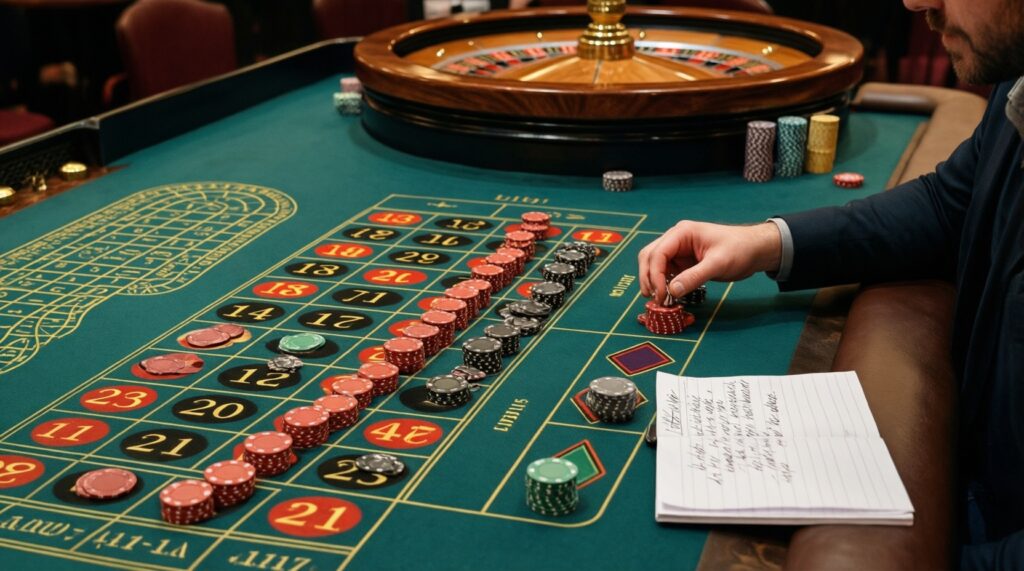
- A fixed unit size you can repeat without resizing mid-session (e.g., 10 THB, 20 THB, 50 THB).
- A written sequence line you will follow (at minimum: 1, 1, 2, 3, 5, 8, 13... expressed in units).
- Table limits (minimum and maximum bet) for the roulette table you're using.
- A tracking method: paper, notes app, or a simple tally-no complex tools required.
- Session rules: stop-loss, time cap, and a profit target (optional) set before the first spin.
Bankroll Management and Staking Examples (table included)
- Define your unit and your maximum allowed step. Pick 1 unit and decide the deepest Fibonacci step you will reach before stopping. This "max step" is your safety rail against runaway losses and table-limit problems.
- Safety guideline: if your max step stake is close to the table maximum, reduce unit size or choose a different table.
- Choose one even‑money bet and lock it in. Select red/black (or odd/even, high/low) and do not switch based on recent results. Switching increases tracking errors and often turns into emotional chasing.
- Start at Step 1 (1 unit). Place 1 unit on your chosen even‑money bet. Record the outcome as Win or Loss and keep your step index visible.
- After a loss, move forward exactly one Fibonacci step. If you lose at 1 unit, stake 1 unit again; if you lose again, stake 2 units; then 3, 5, 8, and so on. Do not "skip" numbers and do not add side bets.
- After a win, step back two positions (standard rule). If you win on 8 units, move back two steps (to 3 units next). If stepping back would go below the start, return to Step 1 (1 unit).
- Conservative option (lower swing, slower recovery): step back one position instead of two.
- Stop when you hit your pre-set exit rule. End the session if any of the following happens: you reach max step, hit your stop-loss, hit your time limit, or you've completed your planned number of cycles without errors.
Two practical unit-size scenarios you can copy
| Scenario | Goal | Unit size | Max step used | Largest single bet | When to prefer it |
|---|---|---|---|---|---|
| Short session / tighter risk | Limit drawdowns, fewer step climbs | Small (relative to bankroll) | Up to 8 units | 8 units | If table limits are low or you want a strict cap on exposure |
| Longer session / more runway | Allow more recovery attempts | Smaller (so steps stay affordable) | Up to 13 or 21 units | 13 or 21 units | If you can comfortably fund deeper sequences and still respect stop-loss rules |
Fast-track mode
- Pick one even‑money bet (e.g., red) and set 1 unit.
- Stake Fibonacci units: 1, 1, 2, 3, 5, 8... moving forward after each loss.
- After each win, move back two steps (never below Step 1).
- Stop immediately at your max step or stop-loss; do not resize the unit mid-session.
Mathematical Expectation: House Edge, Variance and Risk of Ruin
- Confirm you understand this is staking only: the game remains negative expectation because roulette payouts are slightly less than true odds.
- Verify your chosen even‑money bet includes the losing "zero" outcome(s) on your wheel type (European vs American), which increases variance.
- Check your plan against table maximum: your max Fibonacci step must remain below the table cap.
- Check your bankroll covers multiple consecutive losses up to your max step without borrowing or topping up.
- Track error rate: if you miscount steps even once per session, results can become random and risk rises sharply.
- Review recovery logic: Fibonacci recovery is partial and slower than Martingale; accept that one win does not always erase prior losses.
- Measure session volatility: if large swings make you break rules, reduce unit size or shorten the allowed max step.
Practical Adjustments: Limits, Session Targets and Exit Rules
- Setting the unit too large: choose a unit that keeps your highest planned step comfortably under the table maximum.
- No max-step rule: always define the deepest step you will play; otherwise the sequence can escalate beyond your constraints.
- Changing bets mid-run: avoid switching between red/black and odd/even to "follow patterns"; it breaks the method's bookkeeping.
- Adding side bets: splits attention and increases total exposure; keep one even‑money bet per run.
- Removing stop-loss after early wins: pre-commit to a stop-loss and keep it even when ahead.
- Chasing after hitting max step: if you reach max step, stop the session; do not "restart bigger" to recover.
- Ignoring pace and fatigue: cap session length (or number of spins) to reduce tracking mistakes.
- Profit targets that force risk: if you use a target, keep it modest and never increase step depth to "get there."
Common Pitfalls, Misconceptions and Defensive Measures
If your goal is controlled exposure rather than aggressive recovery, consider these alternatives to Fibonacci (all remain negative expectation, but may be easier to execute safely):
- Flat betting on even‑money outcomes: simplest control-same stake each spin; best when you want minimal complexity and fewer tracking errors.
- Fixed-step d'Alembert: increase by 1 unit after a loss, decrease by 1 after a win; typically smoother than Fibonacci and easier for many players to track.
- Small bounded Paroli (positive progression): increase only after wins for a limited number of steps; useful if you want to cap loss escalation entirely.
- Stop-loss + time-boxed play with any system: the most effective "defensive" layer is disciplined exits, regardless of staking style.
Practical Questions Players Ask About Using Fibonacci
Is the Fibonacci system a guaranteed profit method in roulette?

No. It's a staking plan, not an edge, so it can't turn roulette into a guaranteed win over time.
Which even‑money bet is best for roulette Fibonacci play?
Pick one of red/black, odd/even, or high/low and stick to it. None has a built-in advantage; consistency mainly reduces tracking errors.
Do I step back one or two numbers after a win?
The common rule is two steps back, which attempts faster recovery. Stepping back one is more conservative and may suit players who prefer smaller swings.
What happens if I hit the table maximum before finishing the sequence?
Your plan breaks, because you can't place the required next stake. The fix is to lower unit size, cap the max step earlier, or choose a table with higher limits.
Can I switch to another bet after a losing streak?
Avoid it. Switching bets mid-sequence usually becomes pattern-chasing and makes the progression harder to track correctly.
Is Fibonacci better than Martingale for even‑money roulette?
It usually grows slower than Martingale, which can help with table limits, but it also recovers losses less directly. Both remain negative expectation and depend heavily on bankroll and discipline.
What's the simplest way to use Fibonacci safely in a session?
Use a small unit, cap the max step, and stop immediately at that cap or your stop-loss. Treat it as structured entertainment, not income.