

Plan your blackjack bankroll by defining one betting unit, choosing a conservative bet sizing model (flat units or fractional Kelly), and setting session limits so variance cannot force you out. Use a simple risk-of-ruin approach to test whether your current bankroll and unit size are compatible, then track results to refine decisions safely.
Bankroll Summary and Essential Metrics
- Bankroll: money reserved only for blackjack; never mix with living expenses.
- Unit size: your base bet; all limits and targets are multiples of this unit.
- Bet sizing model: flat units for stability, fractional Kelly for controlled growth, full Kelly only if you accept big swings.
- Risk of ruin: the chance you go broke (or hit a stop-out bankroll) before your edge can show up.
- Session rules: time cap + loss cap + win cap to prevent "tilt math" and overbetting.
- Review cadence: adjust unit size only after a meaningful sample, not after one hot/cold night.
Understanding Expected Value, Variance, and Edge in Blackjack
Blackjack outcomes swing heavily in the short run because hands are high-variance and clustered. Even with correct basic strategy (and especially with any advantage play), your expected value is realized slowly, while variance can create long losing stretches. This is why blackjack bankroll management focuses on survival first, growth second.
Who this approach fits: intermediate players who can follow a fixed unit, avoid chasing losses, and keep records.
When you should not do this: if you are using borrowed money, cannot tolerate drawdowns, or you tend to double your bet after losses. In that case, reduce stakes or do not play.
- Checklist: Define your bankroll boundary (what is "in" vs "out").
- Checklist: Commit to one ruleset per table (no improvising mid-session).
- Checklist: Accept that short-term results are not proof of skill.
Practical Bet Sizing: Kelly, Fractional Kelly, and Flat Units
Your blackjack bet sizing strategy should match your goals and your tolerance for swings. If you are not estimating advantage precisely, default to flat units (same base bet) or very small ramps. If you do estimate advantage, consider fractional Kelly rather than full Kelly to reduce volatility.
What you need before choosing sizing:
- A fixed bankroll amount (separate wallet/account).
- A chosen base unit (e.g., 100 THB, 200 THB) that you can emotionally treat as "routine."
- A simple tracking method (notes app, spreadsheet, or photo of session log).
- If you plan to model risk: access to a blackjack bankroll calculator or a spreadsheet template; if you prefer tools, search for a blackjack risk of ruin calculator and verify inputs match your assumptions.
| Bankroll tier (units) | Suggested base bet (units) | Session stop-loss (units) | Session stop-win (units) |
|---|---|---|---|
| < 50 units | 1 unit (flat only) | 3-5 units | 2-4 units |
| 50-150 units | 1 unit (flat or mild ramp) | 5-8 units | 3-6 units |
| > 150 units | 1 unit (fractional Kelly possible) | 8-12 units | 5-10 units |
How to read the table: the "tier" is your bankroll measured in base-bet units. If your bankroll is 20,000 THB and your unit is 200 THB, you have 100 units.
- Checklist: Pick flat units unless you can explain your edge and your risk tolerance in one sentence.
- Checklist: If you change unit size, change it between sessions, never mid-shoe.
- Checklist: Keep maximum bet tied to bankroll, not to emotions.
Calculating Risk of Ruin for Your Bankroll
Risk of ruin is not a single "correct" number; it's a planning lens: if your ruin risk feels unacceptable, reduce unit size, shorten sessions, or stop until your bankroll is larger. If you use a blackjack bankroll calculator, treat outputs as scenario estimates, not promises.
Prep checklist (before you calculate):
- Decide what "ruin" means: zero bankroll, or a stop-out point (e.g., down 30%).
- Choose your game conditions (rules, penetration, side bets avoided).
- Lock your bet plan (flat 1 unit, or a defined ramp).
- Set a session length (hands/time) you will actually follow.
- Write your assumed edge and volatility model (even if approximate).
-
Define bankroll in units
Convert money to units so you can compare sessions and tables. Example: bankroll 30,000 THB and unit 300 THB = 100 units.
- Tip: If you cannot keep at least dozens of units, avoid aggressive spreads.
-
Choose a stop-out threshold
Pick the point where you will stop playing and reassess (e.g., down 20 units, or down 25% of bankroll). This prevents a slow drift into catastrophic overbetting.
-
Model your bet sizing strategy
State the exact rule you will follow: flat 1 unit; or 1-4 units based on a pre-decided trigger. Keep it explicit so a calculator or spreadsheet matches reality.
-
Estimate your edge conservatively
If you do not have a defendable estimate, assume your edge is near zero and plan for survival. Overstating edge is the fastest way to underestimate ruin risk.
- If you rely on intuition, default to flat units and stricter stop-loss rules.
-
Run scenarios with a tool (or simple stress tests)
Use a blackjack risk of ruin calculator or a spreadsheet to compare outcomes when you change only one variable at a time: unit size, stop-out, or session length.
- Stress test: cut your assumed edge in half and see if the plan still "survives."
- Stress test: increase session length and verify the plan still fits your stop-loss.
-
Decide the adjustment
If the plan looks too fragile, reduce unit size first (most effective), then reduce session length, then reduce bet spread. Only increase bets after stable execution across multiple sessions.
- Checklist: Measure bankroll in units, not in feelings.
- Checklist: Treat "edge" as uncertain unless you can justify it.
- Checklist: Reduce unit size before adding complexity.
Session Planning: Unit Size, Time Limits, and Stop-Loss/Win Targets
A blackjack session management strategy is a guardrail system: it stops fatigue, tilt, and accidental bet escalation from turning normal variance into permanent damage. Your goal is not to "lock wins"; it is to keep decisions consistent and bankroll exposure bounded.
- Confirm your unit size is the same at the cashier, the table, and in your log.
- Set a time cap (or number of shoes) and leave when it ends, regardless of results.
- Set a stop-loss in units and stop immediately when hit.
- Set a stop-win that prevents you from giving back gains while tired or excited.
- Pre-commit to no side bets unless they are explicitly part of your modeled plan.
- Define your max bet (in units) before the first hand is dealt.
- Plan breaks: hydration, food, and a short walk after a swingy shoe.
- If you feel rushed by dealers/players, slow down or leave the table.
Record-Keeping and Performance Metrics for Continuous Improvement
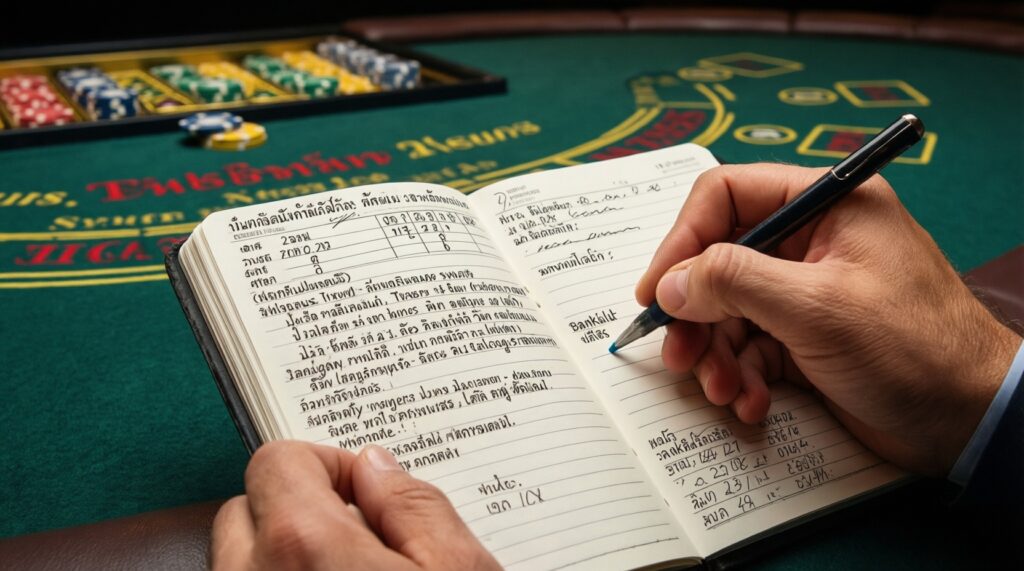
Tracking is the difference between "I think I'm doing fine" and a plan you can actually improve. Keep it simple: date, casino (or location in Thailand), rules notes, starting bankroll, ending bankroll, hours, and any deviations.
Common mistakes that ruin the value of records:
- Changing unit size mid-session and logging it as one continuous result.
- Not recording table rules and conditions, then blaming variance for everything.
- Mixing travel/food tips into bankroll results (financial noise).
- Selective memory: only logging "interesting" sessions.
- Chasing losses after a bad run and calling it "adjusting strategy."
- Using too many categories so you stop logging entirely.
- Comparing one session to one session instead of reviewing trends over time.
- Checklist: Log every session within 10 minutes of finishing.
- Checklist: Track results in units and hours, not only in THB.
- Checklist: Note any rule deviations so you can remove them later.
Table Selection and Tactical Adjustments to Protect Your Bankroll
If your plan feels stressed, you do not need to "be tougher." You need a safer environment. These alternatives reduce bankroll pressure without requiring perfect play.
- Lower minimum tables (smaller units) - best when your bankroll in units is too small for your current stakes.
- Shorter sessions with stricter caps - best when fatigue or tilt is your main leak.
- Rule selection over table hopping - best when you can find more favorable rules; fewer changes means fewer mistakes.
- Flat betting with a hard max bet - best when you keep breaking your bet sizing strategy under stress.
- Checklist: If you cannot state the rules clearly, do not sit.
- Checklist: Avoid crowded, high-noise tables if they cause rushed decisions.
- Checklist: Leave the moment you break a rule; that session is no longer "controlled."
Common Practical Concerns and Quick Answers
Is flat betting a valid blackjack bet sizing strategy for intermediate players?
Yes. Flat units are the safest default when your edge is uncertain or you prioritize stability over growth.
Do I really need a blackjack bankroll calculator if I already have a unit size?
Not strictly, but it helps you compare scenarios (smaller unit, shorter session, tighter stop-loss) without guessing.
What should I enter into a blackjack risk of ruin calculator if I don't know my exact edge?
Use conservative assumptions and run stress tests by lowering the edge further. If the plan fails under conservative inputs, reduce stakes.
How do I know my blackjack bankroll management plan is too aggressive?
If normal losing swings repeatedly push you to your stop-loss or force you to resize your unit, your plan is too aggressive for your bankroll.
Should I set a stop-win target, or just play until the time limit?

Use both. The time limit controls fatigue; the stop-win limits the chance of giving back gains when your discipline weakens.
How often should I change my unit size?
Infrequently and only between sessions. Change it after consistent execution and record review, not after one winning or losing night.
Does a blackjack session management strategy guarantee profit?
No. It reduces avoidable losses from tilt and overexposure; it cannot change the underlying game expectation.